Wind Repowering in Rhineland-Palatinate
Rhineland-Palatinate is a state of uplands and forests. Wind energy here almost never arises on the plain but on the ridges of the Hunsrück, the Eifel, the Westerwald and the Pfälzerwald. Two themes therefore shape the build-out more strongly than elsewhere: the technical and legal mastery of wooded upland sites, and community participation, which in RP became an early political hallmark of the energy transition. Together these two explain why the state expanded strongly in the 2010s — and why the WaLG (Wind Energy Areas Act) target is nonetheless currently being missed.
Forest and Upland Sites: Hunsrück and Eifel
A high forest share means that a large part of Rhineland-Palatinate's wind sites lies in the forest. Landesforsten RP (the state forestry agency) is thus the central lessor and has developed its own established procedures for allocating sites. Upland locations in the Hunsrück and the Eifel offer acceptable wind yield by state standards at low population density — good prerequisites, but also demanding boundary conditions: forest conversion, access via steep forest tracks, crane pads on slopes and a species-protection regime that, alongside red kite (Rotmilan) and black stork (Westerwald), also covers the wildcat of the Eifel. The EEG southern bonus (+0.30 ct/kWh) is an essential factor for the economics of these low-mountain sites. For turbine selection at weaker upland locations, an early estimate with the repowering tools is worthwhile.
Community Participation as a Site Factor
RP was an early mover on the financial participation of municipalities and citizens — community wind and participation models via Landesforsten and municipal land are lived practice here, not the exception. For developers this is a double lever: where the host municipality also benefits from lease income and participation, local resistance falls and procedures run more predictably. Conversely, municipalities expect robust participation offers before they make land available. Anyone planning repowering should review the existing participation contracts of the old fleet, since they are renegotiated when turbines are replaced. The system of area and site planning is covered in the Planning section.
Market Data for Rhineland-Palatinate
| Installed turbine fleet | approx. 1,800 turbines |
| Installed capacity | 3.9 GW |
| Repowering candidates 2026–2030 | approx. 450 |
| Top regions | Hunsrück, Eifel, Westerwald, Pfälzerwald |
| Permitting authority | SGD Nord (Koblenz), SGD Süd (Neustadt an der Weinstraße) |
| Minimum setback | no blanket rule (TA Lärm + shadow flicker) |
WaLG Behind Schedule: 1.1 instead of 2.2 Percent
Despite the strong build-out of recent years, RP at around 1.1% of designated area lies well below the WaLG target of 2.2% by 2032. The shortfall creates pressure to act: if the interim target is missed, the exclusionary effect of the existing concentration zones lapses — wind energy would then be privileged and admissible across the entire outlying area under § 35 BauGB, which weakens regional steering. For developers the delay means, in the short term, more area designation and accelerated regional-plan updates. The formal steps of turbine approval are summarised in the BImSchG (German Federal Immission Control Act) procedure; the nature-conservation assessment runs through the relevant expert reports.
Repowering the Existing Fleet: What to Consider
With around 450 repowering candidates through to 2030, RP is one of the stronger repowering states. Many turbines of the first build-out wave stand on attractive upland sites whose new development would today be only partly possible — repowering secures these locations. In practice this means: larger rotors and higher hubs replace smaller old turbines, which shifts the noise and shadow-flicker contour and triggers new expert reports. On forest sites, questions of renewed forest conversion and of access for heavier components come on top. Because many existing turbines are tied into community-wind and municipal participation models, the lease and participation contracts are part of the repowering planning too, not to be clarified only afterwards. There is also the grid question: older sites often hang on grid connection points whose capacity for the higher output of the new turbines must be reassessed. Early coordination with the grid operator prevents a technically sensible repowering from failing at the feed-in limit.
Regionally Active Engineering Firms
- juwi AG (Wörrstadt) — the largest developer from Rhineland-Palatinate
- ABO Wind AG (Wiesbaden, active in RP) — project development
- Landesforsten RP — forest-site lessor
- LfU RP (Landesamt für Umwelt / State Environmental Agency) — environmental authority
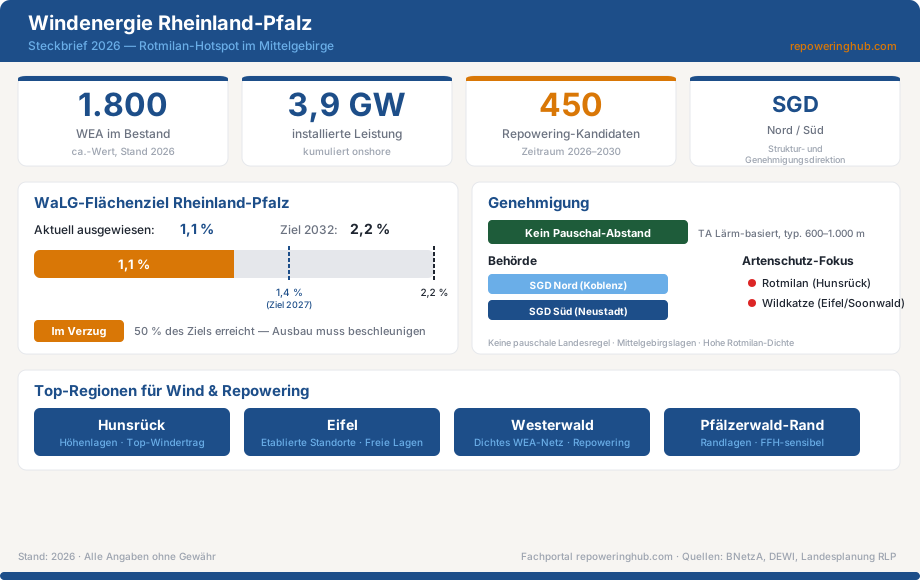
Wind energy in Rhineland-Palatinate – market data, WaLG status and permitting framework
Permitting Timelines at SGD Nord and SGD Süd
The two structural and permitting directorates SGD Nord (Koblenz) and SGD Süd (Neustadt an der Weinstraße) handle the immission-control procedures for the northern and southern parts of the state respectively. SGD Nord is responsible for repowering projects in the Hunsrück and Eifel, SGD Süd for sites in the Pfälzerwald — both authorities have comparatively extensive procedural experience with forest and upland sites thanks to the state's long-standing high share of wind energy. This does not automatically shorten processing times, but it makes it easier to assess which documents and expert reports are needed for a complete application. Anyone planning repowering should coordinate the preliminary review of forest conversion with the responsible SGD early, since access routes and crane pads on upland sites often trigger additional forestry-law permitting steps.
Grid Connection on Upland Sites: Transformer Capacity and Access
Many existing turbines in the Hunsrück and the Eifel were connected to grid connection points in the 2000s that are designed for significantly lower output. Repowering that doubles or more than doubles the rated output per turbine therefore regularly requires a review and often a reinforcement of the local grid connection capacity. On forest sites, access for heavier components adds a further factor — rotor blades and tower sections of modern turbines are longer and heavier than those of the old turbines, which can require an adaptation of the forest tracks. Both issues belong at the start of project planning, because they demand both time and budget; an initial classification of the investment cost is provided by the repowering tools. Anyone who only calculates these costs during the permitting phase risks unpleasant surprises shortly before construction begins — early rough planning with the grid operator and the responsible forestry office almost always pays off.
Repowering or new build in Rhineland-Palatinate?
We connect you with planning firms experienced in Rhineland-Palatinate — including forest sites under a Landesforsten lease.
Submit an enquiry