Landscape Impact Plan (LBP) for Wind Turbines
The LBP (Landschaftspflegerischer Begleitplan) is the formal documentation of the environmental impact on nature and landscape caused by the wind turbine construction, together with the corresponding compensatory and replacement measures. It fulfils the impact regulation requirements under Section 15 of the Federal Nature Conservation Act (BNatSchG) and is a mandatory component of every BImSchG application.
What does the LBP contain?
- Baseline survey: Vegetation, biotope types, habitat structures at the site and in the extended impact zone
- Impact description: Area/volume losses from foundation, crane pad, access road, cable trench, transitional phase
- Impact balance following state-specific methodology (biotope scoring, points-based model)
- Avoidance and mitigation measures (e.g. construction timing restrictions, protective fencing)
- Compensatory and replacement measures: ecological enhancement of areas outside the impact site
- Compensation balance: comparison of value points — impact vs. compensation; target at least 1:1, often with a surcharge
Typical impact footprint per turbine
| Element | Permanent sealing | Temporary (construction) |
|---|---|---|
| Foundation | approx. 400–600 m² | — |
| Crane pad | approx. 1,500–2,500 m² | additional 1,000–2,000 m² |
| Access road (new build) | 200–400 m × 4 m wide | — |
| Cable trench | construction only | 3 m working strip per 100 m |
| Total per turbine | 2,500–4,500 m² | 1,500–3,500 m² |
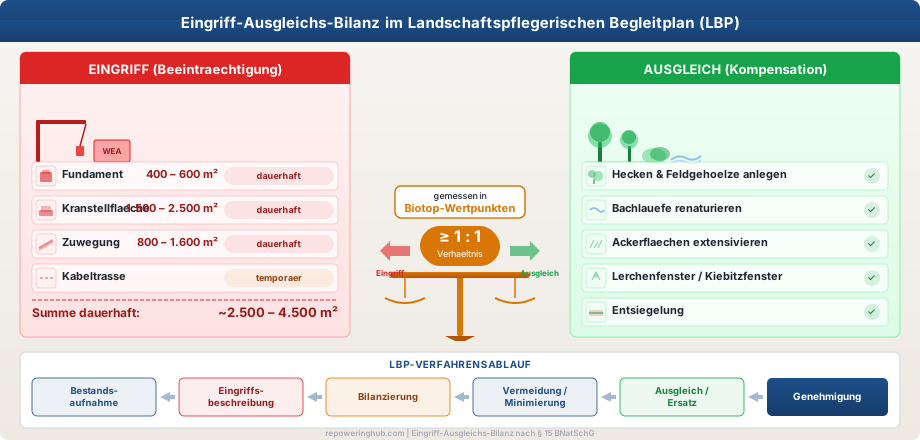
Impact-compensation balance in the LBP — compensation in biotope value points must reach at least 1:1
Typical compensatory measures
- De-sealing of disused traffic or farmyard surfaces
- Planting hedgerows, field copses, orchard meadows on intensively used arable land
- Renaturalisation of streams, floodplains, wetlands
- Extensification of arable land to species-rich grassland or fallow
- Habitat enhancement for target species (e.g. skylark plots, lapwing plots)
- Purchase of eco-credits from certified eco-accounts (where own land is unavailable)
What does the LBP cost?
Indicative range: EUR 8,000 – 25,000 for the LBP preparation. Factors:
- Number of turbines + size of the planning area
- Site complexity (forest vs. open land)
- Own compensation land search required vs. eco-credit purchase
In addition, the compensation costs for the measures themselves: typically EUR 20,000–150,000 per wind farm, depending on impact size and type of measures chosen.
Who prepares this?
Landscape/environmental planning offices, often as a package together with the EIA screening and, where applicable, the full EIA. Where the impact balance is tight, a firm with its own nature conservation land holdings for direct compensation land brokering is advantageous.
The biotope scoring method in detail
In most federal states, the impact-compensation balance is based on a biotope value-point system: every biotope type — from intensively used arable land to species-rich wet grassland — is assigned a point value per square metre reflecting its ecological quality. The impact is calculated by multiplying the affected area by its baseline value and subtracting the value that remains after construction; the difference is the value loss to be compensated. Compensatory measures work by converting an area from a lower to a higher biotope value — intensively used arable land developed into species-rich grassland, for instance, generates a positive point balance that offsets the impact. The specific value tables and conversion factors differ between federal states, but the underlying principle is comparable nationwide.
Timing: when does the compensation have to be completed?
Contrary to a common assumption, the compensatory measure does not necessarily have to be completed before construction begins — under planning law it is sufficient that it is legally secured in the permit, for instance through an easement or a contract with the landowner. Actual implementation, such as planting hedgerows or converting arable land to extensive grassland, usually runs in parallel with or shortly after the turbine's construction phase. For eco-credit purchases from a certified eco-account, this question largely does not arise, because the compensatory measure has already been implemented in advance and recorded in the account.
LBP for your wind farm
We connect you with a landscape planning office experienced in BImSchG applications — including eco-credit brokering if desired.
Request a quoteFrequently asked questions
What is the difference between compensation and replacement?
Compensation = like-for-like restoration in the same natural area. Replacement = equivalent measure at a different location. For major impacts, a combination is common — smaller measures on-site, larger enhancement in the wider natural area.
Can eco-credits from other federal states be used?
Rarely — most federal states require eco-credits from the same natural area or the respective state. North Rhine-Westphalia and Lower Saxony are somewhat more flexible; Bavaria and Baden-Württemberg are stricter.
How does the LBP work for repowering?
For repowering, a new impact balance is required — the old turbine was already an impact; the new one constitutes a new impact. However, decommissioning the old turbine can partly count as compensation (de-sealing of the old foundation area).
What happens if the impact is not compensable?
In that case, a substitute payment under Section 15(6) BNatSchG applies — a monetary amount paid to the nature conservation authority, which uses it for compensatory measures. In practice this is rare for wind turbines — the impact is usually regionally compensable.
Who checks whether the compensatory measures are actually implemented?
The nature conservation authority monitors implementation as part of the statutory impact regulation; many permits prescribe monitoring over several years with a reporting obligation for the operator. If compensatory measures are not implemented on time or not maintained permanently, the authority can subsequently tighten conditions or, in extreme cases, put the permit at risk — permanent upkeep of the compensation land is therefore just as much part of the planning as its one-off creation.
The LBP for repowering: decommissioning as partial compensation
A special feature of repowering is that the impact of the new turbine is not considered in isolation. Decommissioning the old turbine — de-sealing the foundation, the old crane pad, and access roads no longer needed — is credited in the balance as partial compensation. However, since new turbines generally require considerably larger foundations and crane pads than the old ones, this credit rarely offsets the additional land take in full; a residual compensation requirement remains in most repowering projects.