Shadow Flicker Report for Wind Turbines
The shadow flicker report (Schattenwurfgutachten) predicts how many hours per year and how many minutes per day the moving rotor shadow reaches the nearest residential buildings — so-called "periodic shadow effect". It is a mandatory component of every BImSchG permitting procedure.
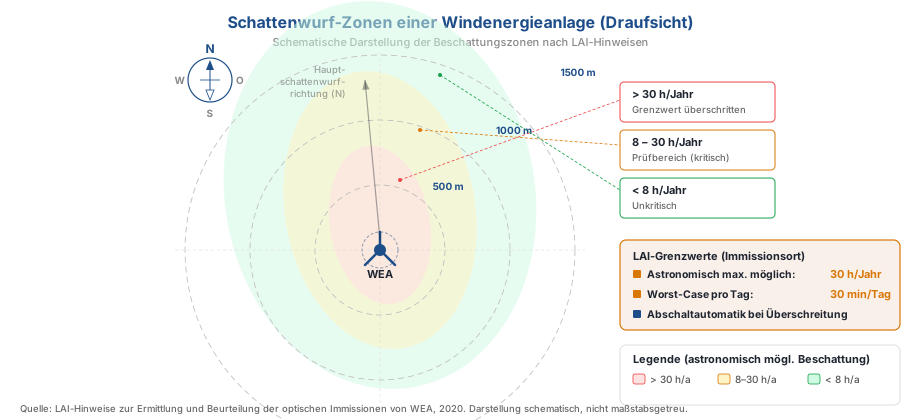
Shadow flicker zones around a WTG — schematic plan view per LAI guidelines (30/30/8 rule)
What does the report assess?
- Astronomically maximum shadow flicker: worst-case calculation assuming the sun is always shining, the wind always blows from the unfavourable direction, and the rotor always rotates. Threshold: ≤ 30 h/year and ≤ 30 min/day.
- Real shadow flicker: accounting for average cloud cover, wind conditions, and standstill periods. Threshold: ≤ 8 h/year.
- Cartographic representation: iso-lines of shadow flicker as overview + detailed evaluation per immission point.
- Mitigation concept: if thresholds are exceeded, shutdown via shadow flicker module with astronomical clock and light sensor.
The LAI guidelines (summary)
The "Guidelines on the determination and assessment of optical immissions from wind turbines" of the LAI (German Federal/State Working Group on Immission Control, last version 2002, currently under revision) are adopted as binding assessment basis in almost all federal states:
- Maximum 30 hours per calendar year of astronomically calculated shadow flicker at an immission point
- Maximum 30 minutes per day
- Real-meteorological maximum 8 hours per year
How is shadow flicker calculated?
The moving rotor shadow occurs when the sun is low enough and falls behind the rotor onto a window. The software reconstructs the geometry for every point in time across the year:
- Sun position (azimuth and elevation) calculated minute by minute over the entire year at the site — purely astronomical.
- Rotor geometry: hub height and rotor diameter determine the size of the shadow-casting area.
- Immission point location: coordinates and height of the relevant window.
- Range cut-off: beyond roughly ten times the rotor diameter, the shadow becomes so diffuse that it is no longer considered relevant.
Summing all the minutes in which an immission point lies in the rotor shadow yields the astronomically maximum shading duration per day and year. The real duration is additionally weighted with local sunshine, wind, and operating probabilities.
Astronomical vs. real value — why two thresholds?
The astronomical value (≤ 30 h/year, ≤ 30 min/day) is the planning value: it assumes constant sunshine, continuous operation, and always unfavourable rotor position. It is independent of actual weather and therefore robust against disputes over which measurement year to use. The real value (≤ 8 h/year) reflects that the sun does not always shine and the turbine does not always run. In permitting practice, the astronomical value is usually the one that triggers the shutdown module — it is more conservative and easier to verify.
Legal basis: LAI guidelines and case law
The LAI guidelines are not a law but an administrative-guidance-style orientation. Through case law, however, their thresholds are treated as a concretisation of harmful environmental effects under Section 3 of the Federal Immission Control Act (BImSchG). Administrative courts have confirmed the 30-hour and 30-minute thresholds as the limit of reasonableness. In practice this means: if the assessment stays within these values, shadow flicker is generally unobjectionable; if it exceeds them, a technical limitation (shutdown module) becomes a permitting requirement.
Repowering: more shadow, but controllable
Larger rotors cast a longer shadow that reaches further. On the other hand, repowering turbines are often sited more favourably and come standard with a shadow flicker shutdown module. Because the module shuts the turbine down precisely once the daily or annual budget is reached, yield loss typically stays below 1%. Protection applies to residential development that existed or was bindingly planned at the time of permit approval.
What does the report cost?
Guideline value EUR 3,000 – 12,000 for a wind farm with 3–6 turbines. Key factors:
- Number of turbines + number of immission points
- Topography (complex terrain makes rendering more elaborate)
- Shutdown logic design for many immission points
Who prepares the report?
Specialised acoustics and immission engineering firms — typically the same ones that also prepare the sound protection report (combined commissioning often saves 20–30%). Key software: WindPRO (EMD), WindFarmer (DNV), WAsP extensions.
Shadow flicker report + sound protection as a package?
We forward your enquiry to a firm that prepares both reports as a combined commission — this is usually faster and more cost-effective than separate commissions.
Request a quoteFrequently asked questions
What about light flashes at sunset ("disco effect")?
Rotor blades of modern WTGs have a matte coating that virtually eliminates this effect. Older turbines with high-gloss paint have been decommissioned. In the report, this is generally mentioned only as a note.
Is the shutdown module active from day one of commissioning?
Yes — the shadow flicker module is configured before commissioning with the immission point coordinates and the daily/annual budgets specified in the report. It shuts down the turbine automatically from the first day of operation.
What happens if new residential buildings are built within the impact zone after commissioning?
Protection under the LAI guidelines applies only to residential buildings that existed or were planned at the time of permit approval. New construction in the impact zone after commissioning has no protection claim. Recommendation nonetheless: update the module configuration to avoid complaints.
Can the shadow flicker calculator on this site do this?
The online calculator only shows the astronomically possible shadow flicker of a single turbine — a good initial plausibility check. An official report must additionally aggregate all turbines in the farm, consider topography, and use certified software (WindPRO or similar).