Sound Protection Report for Wind Turbines
The sound protection report (Schallschutzgutachten) is one of the central mandatory reports in the BImSchG permitting procedure for wind turbines. It assesses whether the noise generated by the turbines complies with the immission thresholds of the TA Lärm at the nearest residential buildings — and identifies what mitigation measures are required if not.
When is a sound protection report required?
- Always in the BImSchG procedure — both in the simplified and the formal process
- Also for repowering (new turbine = new procedure = new report)
- For turbine replacement or capacity upgrades to existing turbines
- On request of the permitting authority in response to neighbour complaints at existing sites
What must be included? — Mandatory contents
- Source data of the turbines: sound power level LWA in dB(A) from the manufacturer's measurement report (FGW TR 1 or IEC 61400-11), incl. ±2σ safety margin
- Immission points: list of all sensitive receptors (IO) within the impact zone with protection category per TA Lärm (general residential area, mixed-use, village, commercial area)
- Calculation per DIN ISO 9613-2 (point-source model, octave-band spectrum, alternatively LAI point-source model with flat-rate surcharge)
- Consideration of reflection, ground, weather (worst-case assumptions)
- Level summation for multiple WTGs + pre-existing noise from other installations
- Assessment against TA Lärm thresholds day/night (see table below)
- Mitigation and optimisation measures if thresholds are exceeded: night-time reduced mode, noise-reduced mode, turbine type change
TA Lärm thresholds (excerpt)
| Area type | Day (06–22 h) | Night (22–06 h) |
|---|---|---|
| Industrial area | 70 dB(A) | 70 dB(A) |
| Commercial area | 65 dB(A) | 50 dB(A) |
| Mixed-use / core area, village area | 60 dB(A) | 45 dB(A) |
| General residential area | 55 dB(A) | 40 dB(A) |
| Purely residential area | 50 dB(A) | 35 dB(A) |
| Spa area, hospitals | 45 dB(A) | 35 dB(A) |
The decisive value for WTGs is usually the night-time threshold for the nearest general residential area (40 dB(A)) — it triggers a noise-reduced night mode in many cases.
What happens if thresholds are exceeded?
The report must propose mitigation measures that ensure compliance:
- Noise-reduced night operation (most common solution): speed and/or pitch reduction at night, yield loss typically 1–4% p.a.
- Turbine type / manufacturer mode optimisation: some manufacturers offer certified quiet modes with defined LWA values
- Layout adjustment: repositioning critical turbines further from the receptor
- Noise protection at the receiver (sound-insulating windows) — rather exceptional, rarely used in practice
What does a sound protection report cost?
Guideline value EUR 5,000 – 25,000 for a wind farm with 3–6 turbines. Key factors:
- Number of turbines + number of immission points
- Pre-existing and additional loads (other WTGs, industry, traffic) — higher complexity
- Need for a mitigation concept (night-shutdown logic)
- Special low-frequency / infrasound report (rare, but if required + EUR 5,000–15,000)
Who prepares the report?
Sound protection reports may only be prepared by measurement bodies accredited under § 29b BImSchG or qualified acoustics engineering firms. Established providers in the onshore WTG sector include TÜV Sued, Deutsche WindGuard, ITAP, Wölfel, KOETTER Consulting Engineers, Müller-BBM, as well as numerous regional specialists.
Why pre-existing noise load is often the decisive factor
Not every noise source at a site originates from the planned turbine. Existing commercial operations, road or rail noise, and neighbouring wind farms count as pre-existing load and must be factored into the assessment. If this pre-existing load already sits close to the immission threshold, little headroom remains for the new turbine — in extreme cases a site is effectively not permittable despite otherwise unremarkable turbine emissions. Conversely, low pre-existing load at a remote site can create headroom for a more powerful turbine configuration. The report must therefore always capture the real pre-existing noise situation at the specific site, rather than calculating the planned turbine in isolation.
Repowering: new source, changed geometry
Even where a sound report already exists for the old turbine at the site, repowering requires a complete recalculation. Modern turbines have a higher absolute sound power level, but are often positioned further from residential buildings and offer graduated, certified noise modes for night-time reduction. What counts for the permitting outcome is solely the calculated level at the immission point — not the source level of the individual turbine. In many cases the night-time threshold can be met despite a louder individual turbine, because the total turbine count typically decreases during repowering, making the level summation at the immission point more favourable overall than under the old configuration. In site planning it is therefore worth comparing different turbine configurations — more smaller turbines versus fewer larger ones — from an acoustic standpoint before finalising the turbine choice.
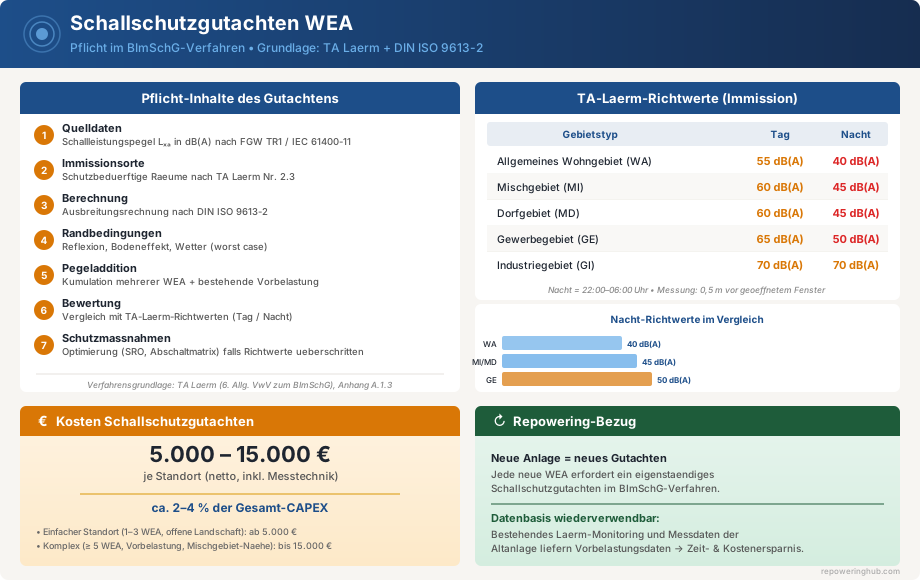
Sound protection report WTG — mandatory contents, TA Lärm thresholds, costs and repowering relevance
Request a sound protection report for your wind farm
We forward your enquiry to a qualified acoustics engineering firm and obtain a quotation — tailored to site, turbine count, and permitting stage.
Request a quoteFrequently asked questions
What is the difference between acoustic emission prognosis and sound protection report?
The acoustic emission prognosis is the actual noise level calculation (source data + propagation model + comparison with TA Lärm). The sound protection report is usually the extended document that additionally proposes concrete measures and describes the mitigation concept. In practice, the terms are often used interchangeably.
How reliable are the prognoses?
Very reliable — the point-source model per DIN ISO 9613-2 has been proven in permitting practice for decades and is designed conservatively. Real-world measurements typically come in 0.5–2 dB below the prognosis. Authorities accept the model without dispute.
Do we need to measure after commissioning?
Often yes — the permit almost always includes the condition of an acceptance measurement after commissioning (typically within 6 months). The measurement is performed per FGW TR 1 / IEC 61400-11 and verifies the turbine's sound power level against the value used in the report.
What about infrasound and low-frequency noise?
The sound protection report assesses the audible frequency range (16 Hz – 16 kHz) per TA Lärm. Infrasound (< 20 Hz) is not addressed in standard reports — the TA Lärm does not provide thresholds for it. Low-frequency components between 8 and 100 Hz can be assessed additionally in special reports per DIN 45680, which are rarely required in practice.