Visual Impact Assessment for Wind Turbines
The visual impact assessment shows how the planned turbines will appear in the existing landscape — and is a mandatory component of the formal BImSchG permitting procedure. It is also the most important communication tool for public engagement events with citizens and local politicians.
What is delivered?
- ZVI map (Zone of Visual Influence) — visibility analysis: from which areas the turbines are visible, and from which they are obscured
- Photomontages from 6–12 representative viewpoints: current state + photomontage with planned turbines, identical camera data
- Landscape scenery assessment: impact evaluation under the protected asset "landscape"
- Pre-existing impact assessment from existing turbines + infrastructure
- Recommendations: optimise turbine positioning, height limitation, construction cut
Selection of viewpoints
Authority requirement: 6–12 viewpoints, selected according to the following criteria:
- Nearest settlements (3 main views per locality, from entrance roads and main streets)
- Important crossroads and hiking trails
- Touristically significant vantage points (hilltop churches, castles, observation towers)
- Representative residential buildings (from the district with the strongest visual impact)
- Protected areas (nature reserves, landscape protection areas, recreational areas)
- Cultural heritage monuments in the line of sight
Technical standards
| Parameter | Standard |
|---|---|
| Focal length (full-frame equiv.) | 50 mm (normal); 35 mm for long-distance views |
| Camera height | 1.60 m (eye level) |
| Photo timing | Foliage-dependent (summer + winter variant) |
| Weather conditions | Clear visibility, blue sky or light cloud cover |
| Software standards | WindPRO, WindFarmer; LandschaftsPro for photomontage |
| Turbine geometry | Exact modelling from manufacturer geometry data |
| Print format | A3 landscape, 300 dpi, calibrated print |
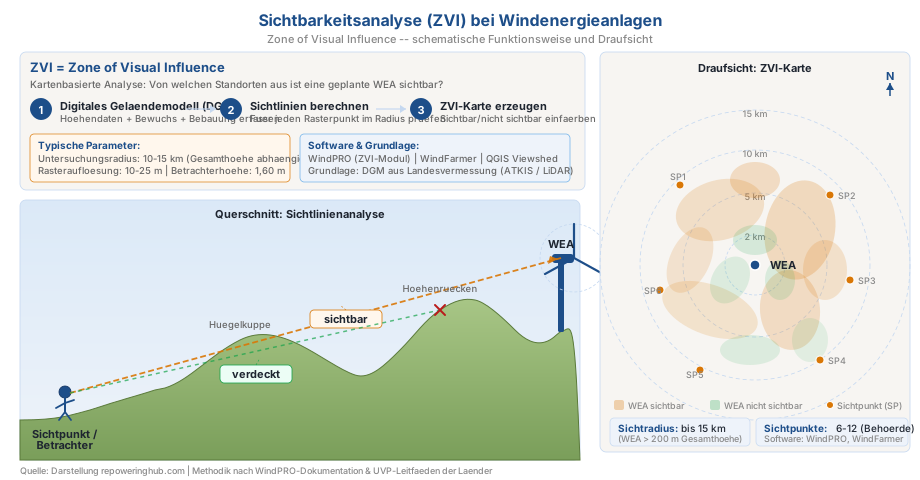
Zone of Visual Influence (ZVI) — visibility analysis with terrain profile and map view
What does it cost?
Indicative range: EUR 4,000 – 18,000. Factors:
- Number of viewpoints (6 vs. 12)
- On-site photography + weather conditions (waiting time for good conditions)
- Summer + winter variant (doubles the effort)
- Topographic complexity (hilly terrain more expensive than flat land)
- Animation/video options (rare, but useful for public referendums)
The most common point of dispute in practice is not the photomontage itself but the choice of viewpoints: citizen initiatives often demand additional locations that are especially relevant to them, while the project developer wants to keep the effort contained. Agreeing the viewpoint list with the permitting authority early on prevents the visualisation from later being rejected as incomplete and the procedure's timeline from suffering as a result.
Who prepares this?
Specialised landscape/visualisation consultancies or the turbine manufacturers themselves (with a WindPRO licence). Important: calibration against on-site photographs, documented camera data, and where applicable comparison with existing turbines in the region.
Legal basis and assessment standard
The visualisation is not an end in itself — it supplies the factual basis for assessing the landscape scenery under Section 14 BNatSchG (impact mitigation regulation) and, for projects subject to an environmental impact assessment, for the "landscape" protected-asset review within that assessment. The permitting authority uses the photomontages to judge whether the turbines significantly impair the landscape scenery and whether that impairment can be compensated through mitigation or replacement measures. In practice, hardly any authority accepts a purely verbal-argumentative assessment without pictorial documentation — the photomontage is the actual evidence.
With wind turbines, height adds a further complication: unlike, say, buildings, the long-distance effect of 200-metre turbines can hardly be described verbally without risking overstatement or understatement. The photomontage makes the effect objectively verifiable and thereby protects both the project developer from excessive rejections and the public from the impact being trivialised.
Procedure of a typical commission
- Handing over site and turbine data: exact coordinates, hub height, rotor diameter, and manufacturer geometry of the planned turbines.
- Defining viewpoints — usually in coordination with the authority, based on the visibility analysis and the selection criteria listed above.
- On-site appointments: weather-dependent, often with several weeks' lead time, since clear visibility and sometimes a particular season (foliage state) are required.
- Compositing and quality assurance: calibrating focal length, perspective, and scale against the real photographic data.
- Report with individual sheets per viewpoint, usually as an A3 print and a digital PDF for the permit application.
Commission a visual impact assessment
We connect you with a consultancy experienced in WindPRO — including the 360° online variant for public engagement events if desired.
Request a quoteFrequently asked questions
Are computer renderings sufficient, or must photomontages be used?
Pure renderings are not accepted — the authorities require photomontages in which the turbine is rendered into an actual on-site photograph. This ensures realistic scale accuracy and lighting conditions.
How far can the turbine position be shifted for a favourable image?
Not at all — the visualisation must exactly match the planned turbine position. If the position changes during the procedure, the photomontages must be updated.
What about summer/winter changes?
Deciduous vs. bare vegetation can significantly alter visibility. For high-value landscape areas, the authority often requires both variants — for average sites, usually only the most critical one (winter).
What about night views / BNK?
With demand-driven night-time marking (BNK), the aviation obstruction lighting is very rarely active. A separate night view is therefore usually not required — a textual note in the report is sufficient.
Can an existing visualisation be reused for repowering?
No. During repowering, turbine height, count, and often the exact position relative to the old turbine all change — so the long-distance effect is a different one. The visualisation must be produced completely anew for the new turbine configuration; at most the viewpoint selection and the on-site photos without the turbine can be partly reused.