Visual Encroachment Effect of Wind Turbines
The visual encroachment effect (German: optisch bedrängende Wirkung, OBW) describes the phenomenon whereby a wind turbine, through its sheer size, rotor movement, and proximity to residential buildings, can create an unreasonable visual burden. In the BImSchG permitting procedure, the OBW is an independent public interest that must be assessed alongside noise, shadow flicker, and species protection. The legal basis is the duty of consideration (Gebot der Rücksichtnahme) under § 35 (3) sentence 1 BauGB in conjunction with § 15 (1) sentence 2 BauNVO (cf. BVerwG, Decision of 11 December 2006, Ref. 4 B 72.06).
Legal Framework and Landmark Ruling
The key case law on the OBW originates from the Higher Administrative Court of North Rhine-Westphalia (OVG Münster). In its judgment of 09 August 2006 (Ref. 8 A 3726/05), the court developed a graduated distance formula that has since served as a nationwide guideline:
| Distance to residential buildings | Assessment per OVG Münster |
|---|---|
| below 2× total height of the turbine | Encroaching effect generally assumed |
| 2× to 3× total height | Case-by-case assessment required |
| above 3× total height | Encroaching effect generally not assumed |
For modern turbines with total heights of 200 to 250 m, this means: below 400–500 m an encroaching effect is generally assumed; above 600–750 m it is generally not. Between these thresholds, a case-by-case assessment decides. The Federal Administrative Court (BVerwG) has confirmed these principles in several decisions (inter alia BVerwG, Decision of 11 December 2006, Ref. 4 B 72.06; BVerwG, Decision of 23 December 2010, Ref. 4 B 30.10).
Assessment Criteria in Detail
At distances between 2× and 3× total height, the authority examines the following criteria to determine whether an unreasonable impairment exists:
- Distance and total height: The ratio of the distance between the turbine base and the dwelling to the total height (hub height + half rotor diameter) is the central starting value.
- Viewing angle and orientation: How much of the dwelling facade faces the turbine. Main living rooms with a direct view of the turbine carry more weight than secondary rooms or closed rear facades (OVG Münster, Ref. 8 A 3726/05).
- Topography and screening: Terrain elevations, forest, buildings, or plantings between the turbine and the dwelling can reduce visibility and thus the encroaching effect.
- Pre-existing burden: If other turbines are already visible, the cumulative burden is assessed. In repowering cases, the pre-existing burden from legacy turbines may be taken into account.
- Number and arrangement of turbines: Multiple turbines creating a “barrier effect” (encirclement of the dwelling) intensify the encroaching effect.
- Rotor movement: The rotation of large rotors creates a visual disturbance effect that goes beyond the mere static building mass.
What Does the Report Contain?
A visual encroachment report typically comprises the following elements:
- Visibility analysis (ZVI map): GIS-based calculation of the Zone of Visual Influence. It shows, area-wide, from which locations the turbine is theoretically visible — taking into account terrain models, forest, and settlement structures (calculated e.g. with WindPRO or QGIS).
- Photomontages / visualisations: Calibrated photomontages from defined viewpoints (typically 4–8 locations) that realistically depict the visual impression of the planned turbine. Method analogous to the visual impact assessment.
- Distance calculation: Precise determination of the distance between the tower base and the relevant immission points (dwellings, terraces, garden areas).
- Assessment per immission point: Case-by-case evaluation based on the above criteria (viewing angle, orientation, pre-existing burden, topography), with result: reasonable / unreasonable.
- Recommendations: Where applicable, mitigation measures (e.g. relocation of the turbine site, visual screening plantings as a permit condition, colour design).
What Does a Visual Encroachment Report Cost?
Guideline: EUR 3,000 – 10,000 per report. The range depends on the number of immission points, the complexity of the topography, and the scope of the photomontages. A simple report for a single turbine with 2–3 affected dwellings starts at around EUR 3,000. For a wind farm with multiple turbines and numerous viewpoints, costs can rise to EUR 8,000–10,000. For comparison: a pure visual impact assessment without OBW evaluation costs EUR 4,000–18,000, with the photomontage production accounting for the largest cost share.
Relevance in Repowering
When repowering older wind turbines, the OBW assessment is particularly relevant: the new turbines are typically considerably taller than the existing ones (e.g. 250 m instead of 100 m total height). This shifts the distance thresholds significantly. However, the reduction in turbine numbers (e.g. from 10 legacy turbines to 3 new ones) can improve the overall visual impression and reduce the encirclement effect. The authority also considers the pre-existing burden from the legacy turbines (cf. OVG Münster, Judgment of 01 July 2013, Ref. 2 D 46/12.NE).
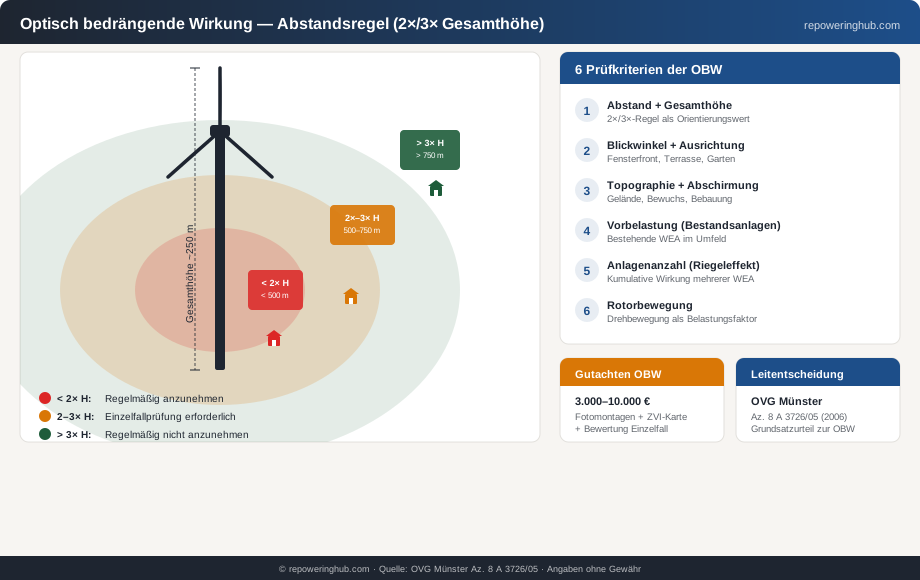
Visual encroachment — distance zones per OVG Münster and assessment criteria
Request a Visual Encroachment Report
We connect your enquiry with an experienced engineering firm for visibility analyses and OBW assessments — matched to your site and permitting stage.
Request a quoteFrequently Asked Questions
At what distance is a wind turbine considered visually encroaching?
According to the landmark ruling of the OVG Münster (Ref. 8 A 3726/05, 2006): Below 2 times the total height, an encroaching effect is generally assumed. Above 3 times, it is generally not assumed. In between, a case-by-case assessment decides based on viewing angle, topography, and pre-existing burden.
Is the report mandatory in the BImSchG procedure?
There is no explicit statutory obligation. However, the permitting authority can require the report if residential buildings are located within the relevant distance range (below 3× total height). In practice, it is almost always required at distances under 1,000 m from dwellings, as the authority must verify compliance with the duty of consideration (§ 35 (3) BauGB).
How does the OBW report differ from a visual impact assessment?
A visual impact assessment shows the optical impression of the planned turbine via photomontages — it is a presentation method. The OBW report goes further: it evaluates the reasonableness of the visual burden based on the case law criteria (distance, viewing angle, pre-existing burden) and reaches a legal conclusion (reasonable / unreasonable). Photomontages are one component of the OBW report.
Who prepares a visual encroachment report?
Typical authors are landscape planners, urban planners, or specialised engineering firms with experience in visibility analyses in the wind energy sector. They work with software such as WindPRO, WindFarmer, or GIS-based ZVI tools. There is no legally prescribed accreditation, but experience in wind turbine permitting is essential.