How long does a wind turbine permit take?
In short: The statutory deadline is 3 or 7 months — reality is considerably longer. Simplified procedure 4–8 months, formal procedure with EIA (Environmental Impact Assessment) 18–30 months. The actual bottleneck is almost always the breeding-bird survey, which requires at least one full season.
Procedure types and realistic duration
| Procedure | Statutory deadline | Realistic |
|---|---|---|
| Simplified (§ 19, 1–19 turbines) | 3 months | 4–8 months |
| Formal (§ 10, from 20 turbines / protected area) | 7 months | 18–30 months |
Which procedure applies to your project is determined by the BImSchG pre-assessment (preliminary check).
Why does it take so long? The time-critical path
The statutory deadline only starts once the application is complete. Until the application is complete, all mandatory expert reports must be in place — and that takes time:
- Breeding-bird survey: 6–10 field visits March–August = at least one full season, often two
- Bat survey: April–October
- Noise, shadow flicker, LBP (landscape management plan), visualisation: 2–4 months in parallel
- Structural stability + subsoil: 1–3 months
If you start the bird survey in May, you will have the first robust data no earlier than August of the following year.
Where most of the time actually gets lost in the procedure
Anyone planning the permit timeline regularly underestimates two things: the time before the application is filed, and the iteration loops during review. The statutory deadline only starts once the authority classifies the application as complete — until then, the clock formally isn't running, even if months have already passed in reality. If a follow-up request comes in during review (for example supplementary bat data or a revision of the noise forecast), the deadline pauses again. In practice, these follow-up-request loops add up to several extra months on more complex projects — one reason why experienced developers deliberately commission expert reports with a safety margin and in close coordination with the authority, rather than submitting the bare minimum.
Differences between German states
The BImSchG procedural steps are standardised nationwide, but the actual processing time varies noticeably between German states — depending on staffing levels at the permitting authorities, the number of parallel procedures, and the LAI guidelines, which serve as technical interpretation guidance and are applied with varying degrees of strictness by the states. States with high build-out momentum and correspondingly expanded permitting authorities tend to process applications faster than those with thinner staffing relative to a comparable number of applications. A state-specific estimate should therefore always be cross-checked with the responsible lower immission control authority or a regionally experienced expert-report firm.
Typical overall process (phases)
- Site check: 1–3 months
- Turbine type + land lease: 3–6 months
- Expert reports (breeding birds critical): 6–12 months
- BImSchG application procedure: 4–18 months
- Construction + commissioning: 8–14 months
From project start to an operating turbine: realistically 2–3 years. Details in the repowering process.
Simplified vs. formal procedure — what it depends on
The fork between the simplified and formal procedure is decided above all by the number of planned turbines and possible protected-area involvement. Up to 19 turbines at one site, the simplified procedure under § 19 BImSchG regularly applies, without mandatory public participation and without an environmental impact assessment in the strict sense — which explains the shorter real duration. From 20 turbines, in the case of certain pre-existing burdens, or if a Natura 2000 site could be affected, the formal procedure under § 10 BImSchG becomes mandatory, with a compulsory EIA and public display of the documents including an objection period. This display-and-objection phase in particular — typically several weeks plus the necessary evaluation of submissions received — is one of the main reasons for the significantly longer real duration of the formal procedure.
What repowering projects do differently on the timeline in practice
For a 1:1 repowering, it's worth building the timeline backwards from the expiring EEG support period of the old turbine, rather than forwards from the desired construction start: once the end of the support period is fixed, you can work out by when the new turbines must be permitted and erected to avoid an uneconomic gap between decommissioning and recommissioning. This backwards planning usually reveals much earlier where buffers are missing in the schedule than a purely forward plan starting from project kickoff.
Frequently asked questions
What happens if the authority exceeds the deadline?
The deadlines are target deadlines (Soll-Fristen). In the case of substantial overrun, the applicant can file an action for failure to act (Untätigkeitsklage, § 75 VwGO) — rarely used in practice.
Can I start construction before the permit is granted?
No. Only after the BImSchG permit has been issued. However, some components (the turbines) are ordered in advance because of long lead times.
How long is the permit valid?
As a rule, construction must begin within 3 years, otherwise the permit lapses. With an EEG award, the additional 30-month deadline until commissioning also applies.
Does a 1:1 repowering really shorten the permitting duration?
In many cases yes, but not automatically in every one. The advantage is that the grid connection point, access road, and part of the site data already exist, and existing knowledge of local bird and bat activity can often serve as a basis. However, if the turbine type changes significantly — for example a taller hub height or larger rotor diameter — the authority will generally require updated noise, shadow-flicker and species-protection reports, because the emission and impact zones shift. The time saved therefore mainly comes from planning and land securing, less reliably from the technical reviews themselves.
What can a developer actively do to save time?
The most effective lever is an early, complete application package: commissioning all mandatory expert reports in parallel rather than sequentially, booking expert-report firms with enough lead time, and clarifying open questions informally with the authority in advance avoids the costliest delays — namely multiple rounds of follow-up requests in the middle of an ongoing procedure. Realistic scheduling for the breeding-bird season, which cannot be compressed at will, is also one of the few levers actually within the developer's control — anyone who underestimates it ends up losing an entire additional survey year.
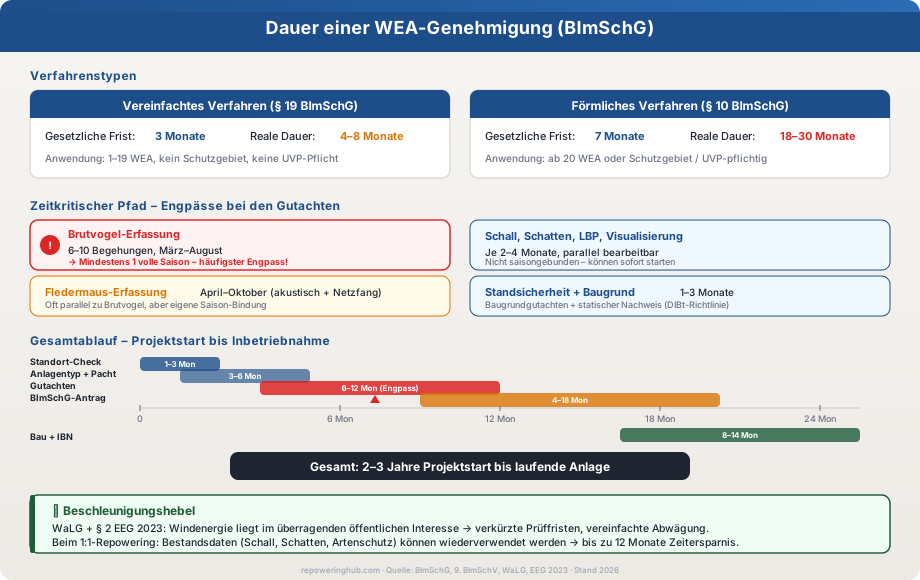
Duration of a wind turbine permit – procedure types, time-critical path and acceleration