Community Participation in Wind Farms: Who Benefits?
In short: Today a wind farm brings the host municipality tangible money — via the municipal payment under § 6 EEG (0.2 ct/kWh) and the trade tax (Gewerbesteuer), 90 % of which stays local. Citizens can participate financially (cooperative, savings bond, discounted electricity). Acceptance grows where the value creation stays in the region.
1. What the Municipality Receives
| Source | Order of magnitude |
|---|---|
| § 6 EEG municipal payment | 0.2 ct per kWh fed into the grid — can be offered voluntarily, tax-free for the municipality |
| Trade tax (Gewerbesteuer) | since 2021, 90 % to the host municipality (tax apportionment) |
| Lease on municipal land | where the municipality itself is the landowner |
Example: A farm feeding in 50 GWh per year brings around EUR 100,000 per year to the municipality through § 6 EEG alone — over the operating life a multi-million figure, predictable and independent of the budget.
2. How Citizens Can Participate
- Community-wind cooperative (Bürgerwind-Genossenschaft): shares in the operating company, voting rights and profit distribution. The strongest model for local identification — more under Community Wind.
- Savings bond / subordinated loan: a fixed interest rate for residents, without entrepreneurial co-responsibility. Low entry amounts.
- Regional electricity tariff: residents draw discounted power from "their" wind farm.
- Citizens' foundation / common-good fund: part of the revenue flows into local projects (daycare, clubs, village community).
3. Why This Determines Acceptance
Studies on the acceptance of wind energy show the same finding: opposition drops markedly when local people share economically — instead of merely seeing the turbines while the returns flow elsewhere. Early, honest participation in both planning and revenue is the most effective acceptance factor.
How Participation Is Set Up in Practice
The process differs markedly depending on whether a municipality or a citizens' group is the driving force. If the operator itself approaches the host municipality early — ideally before construction begins, not only once grid connection is due — the § 6 EEG payment can often be agreed in the same discussions as the local development plan. If the initiative instead comes from citizens, it usually needs a longer lead time: founding a cooperative, with articles of association, a capital plan and a supervisory body, can easily take several months before the first shares can be subscribed.
A point that is often lost in the public debate: the § 6 EEG payment and financial citizen participation are not mutually exclusive — they complement each other. The municipal payment flows into the municipal budget and thereby indirectly benefits everyone (roads, daycare, clubs), while a cooperative stake or a savings bond specifically reaches those households that actually want to contribute capital. A good participation concept combines both levels rather than limiting itself to one.
What's Different in Repowering Compared with New Construction
At a repowering site, the starting position is more favourable than when a wind farm is first planned: the municipality already knows the turbines, many residents have gathered years of experience with the operation, and conflicts from the original permit have usually been resolved. This shifts the debate away from fundamental acceptance and toward the concrete question of how the higher yields of modern turbines are distributed. If little or no municipal payment was made under the old wind farm, the repowering moment is the natural point to make up for that — an argument that, in our experience, tends to land well at citizens' meetings because it builds on experience already made rather than on future promises.
For the operator's economics, the municipal payment can be integrated into the yield planning like a fixed cost block, similar to lease payments. A look at the repowering IRR calculator shows how strongly a payment of 0.2 ct/kWh actually affects overall returns — in practice, usually far less than the debate around it suggests, because it remains a smaller line item compared with lease and operating costs.
Common Pitfalls in Implementation
- Communicating too late: if the participation model is only announced after construction has started, it comes across as an afterthought rather than an integral part of the planning — which substantially weakens its effect on acceptance.
- Unclear share distribution: cooperative models in practice often fail not on capital but on unresolved questions of say — who may subscribe how many shares and what voting weight comes with them should be regulated transparently from the outset.
- Missing separation from investment advice: operators offering citizen participation schemes operate in a regulated area (Vermögensanlagengesetz, prospectus requirements depending on volume) — this belongs with professional legal support, not an informal conversation on the village square.
What a Municipality Should Check Before Agreeing
Before a municipal council agrees to a § 6 EEG payment, it is worth looking at the contractual duration: the payment is tied to the turbine's operating life, not to a fixed period — if operation ends early (decommissioning, operator insolvency), the payment also ceases. Municipalities with several wind farms on their territory should also check whether the payments from different operators can be cleanly separated in budget planning, rather than treating them as a single blanket revenue source.
Frequently Asked Questions
Is the § 6 EEG payment mandatory?
No, it is a voluntary offer from the operator to the municipality — but it is used very frequently because it makes the permit politically easier. For the municipality it is exempt from income and corporation tax.
Is a community-wind investment financially worthwhile?
It can offer attractive returns, but it is an entrepreneurial investment with risk (wind, electricity price, technology). Savings bonds carry less risk but pay lower interest. An investment should be examined like any other financial investment — we do not provide investment advice.
Do neighbouring municipalities also get a share?
Since the EEG amendment, municipalities in the surrounding area can also be given a (proportional) share of the § 6 payment when turbines stand close to the municipal boundary. This defuses conflicts between neighbouring localities.
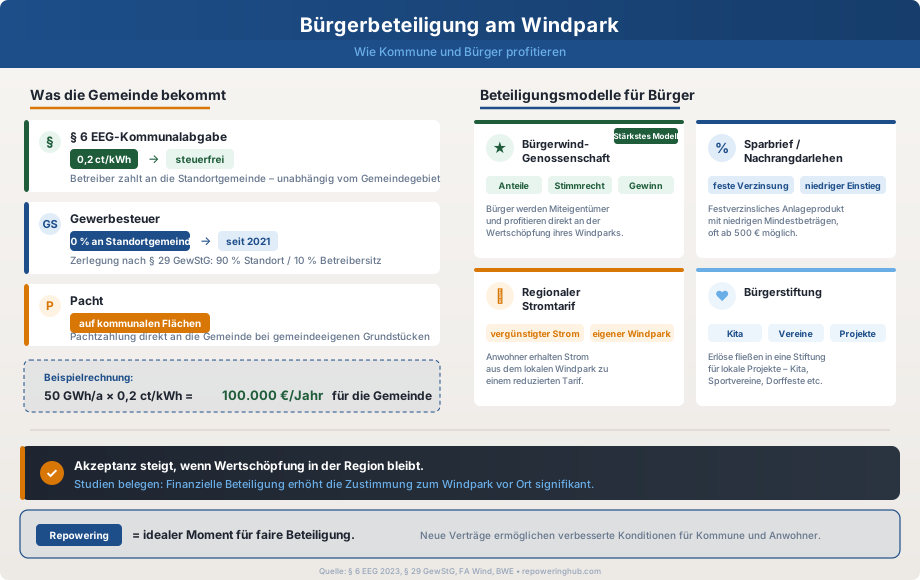
Community participation in a wind farm – municipal payment, trade tax and participation models
Planning a repowering project and want to set up a fair participation model? We connect operators and municipalities with experienced engineering firms.
Get in touch