Repowering Project Process
From initial assessment to an operating wind farm: 7 main phases, realistically 24–36 months total project duration. The critical path is always species protection — everything else can be parallelized.
Phase 1 — Site Check (1–3 Months)
- Wind resource data research: existing measurement data from the old turbine + long-term reference (MERRA / ERA5)
- Planning law pre-assessment (Section 35 BauGB (Federal Building Code), concentration zone)
- Noise/shadow flicker pre-check with target turbine type
- Species protection pre-assessment (existing data, protected areas in the vicinity)
- Output: Go/no-go decision + preliminary economic assessment
Phase 2 — Turbine Selection + Lease Negotiation (3–6 Months)
- Turbine type selection based on wind class, site conditions, manufacturer availability
- Obtain manufacturer offers + technical optimization (site class S, mode selection)
- Negotiate lease agreements with landowners
- Right-of-way arrangements for any required new crane pad areas
Phase 3 — Permitting Planning (6–12 Months)
The largest block — preparing all mandatory expert reports:
- Breeding bird survey (1–2 seasons!) — the critical path
- Bat survey (1 season)
- Noise assessment + shadow flicker assessment
- LBP (Landscape Management Plan) + UVP (Environmental Impact Assessment) pre-screening
- Visualizations from 6–12 viewpoints
- Structural pre-assessment + ground investigation
Phase 4 — BImSchG Application Procedure (4–18 Months)
- Submit application with complete documentation
- In the simplified procedure (Section 19): 3–8 months
- In the formal procedure (Section 10) with public participation: 12–18 months
- Resolve authority queries + supplementary requests
- Permit with conditions (noise-reduced night mode, shadow flicker shutdown, bat algorithm)
Phase 5 — EEG Auction (Parallel)
- After receiving the BImSchG permit, participate in the next BNetzA (Federal Network Agency) tender date
- Bidding strategy: ceiling price vs. own minimum LCOE
- If awarded: 30-month deadline for commissioning begins
Phase 6 — Demolition + Construction (8–14 Months)
- Demolition of old turbines: 1–3 weeks per turbine
- Recycling of old turbine components (steel, copper, rotor blades)
- Foundation removal to 1.5 m below ground level
- New foundation construction for new turbines
- Turbine logistics + erection (large crane, approx. 1 week per turbine)
- Grid connection to new transformer station
Phase 7 — Commissioning + Marketing (2–4 Months)
- Trial operation, manufacturer acceptance
- Official acceptance measurements (noise, shadow flicker)
- EEG market premium activation with direct marketer
- Handover to asset management
- Breeding bird survey (the season cannot be accelerated)
- Authority processing time in formal procedures (litigation backlog)
- Turbine delivery times (currently 12–18 months from order)
- Lease negotiations with multiple landowners
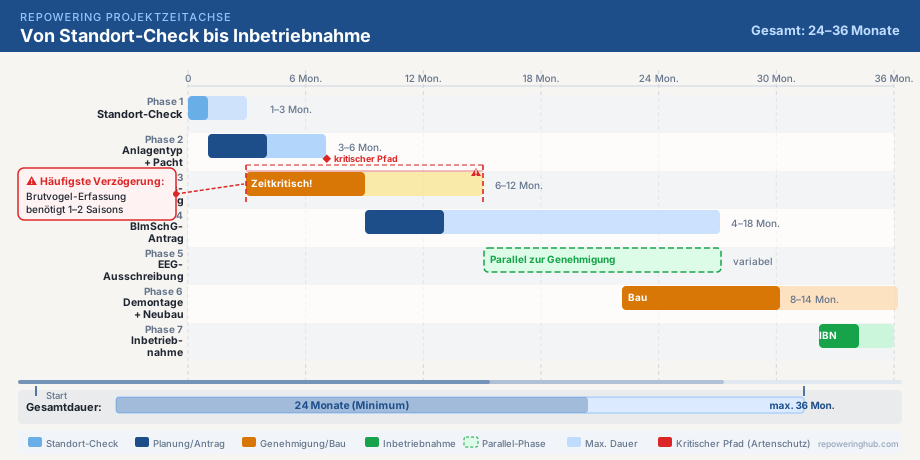
Repowering project process — 7 phases over 24–36 months, critical path: species protection surveys
Simplified for 1:1 Repowering?
The WaLG (Onshore Wind Act, 2022) created simplifications for 1:1 repowering:
- Existing data from the old wind farm (noise measurements, species protection data) can partly be reused
- Impact balance in the LBP is reduced through decommissioning of the old turbine
- With the same number of turbines, procedure type often remains the same or lower
- Faster authority processing is possible (but not guaranteed)
Project planning for your wind farm repowering?
We connect you with a planning firm experienced in repowering — from the initial site study through expert report commissioning to construction supervision.
Request consultationFrequently Asked Questions
Can we continue operating during the permitting process?
Yes — the old turbines continue running until demolition and generate EEG/market revenue. Demolition only takes place shortly before new construction, typically all turbines simultaneously.
What happens to the transformer station?
The old transformer station rarely fits the much larger new turbines. In most repowering projects, the transformer station is completely replaced. With a good grid configuration, the cable route to the grid feed-in point is retained.
How long are the funding commitments for the old turbine valid?
EEG funding runs for 20 years, counted from commissioning. Example: turbine commissioned in 2001, EEG ends 31 December 2021. After that: continued operation or repowering.
Can we get the repowering award before the BImSchG permit?
No — the BImSchG permit must be in place before the bid, otherwise exclusion from the tender date. Plan a 2–3 month buffer between permit and bid submission.
How early should the turbine order be placed?
Given delivery times of 12–18 months from order, an option agreement with the manufacturer during the permitting phase is advisable — it secures delivery timing and price without making the final order binding before the permit is granted. Developers who only start the manufacturer search after receiving the permit noticeably extend the total project duration.
The Critical Path: Why Species Protection Sets the Pace
Unlike permitting, the auction, or turbine ordering, faunistic surveys cannot be accelerated with money or additional staff. Breeding birds are mapped over a full breeding season (March to August), and collision-prone species such as red kite or white-tailed eagle sometimes over two seasons. The technical requirements follow the Helgoland Paper of the German state bird conservation working group (LAG VSW) and, since 2022, the nationwide significance distances under Section 45b BNatSchG. Anyone who starts the survey only after completing the site and lease phase quickly loses a full year. In practice, it pays to bring breeding-bird and bat surveys forward and commission them in parallel with Phase 2, as soon as the site is fundamentally secured. The individual technical reports — avifauna, bats, noise, shadow flicker — are described in the expert reports overview. Developers who consistently follow this sequencing often gain several months on the overall project — an advantage that translates directly into the economics as an earlier start of market-premium payments.
Cost Blocks Across the Project
Spending is distributed unevenly across the phases. Planning and expert-report fees dominate the early phases, while turbine purchase and grid connection dominate the later ones.
| Phase | Main Cost Blocks | Order of Magnitude |
|---|---|---|
| 1–2 Site & turbine selection | Wind assessment, pre-screening, legal advice | €20,000–60,000 |
| 3 Expert-report package | Species protection, noise, shadow flicker, LBP, EIA pre-screening | €80,000–250,000 per park |
| 6 Demolition & construction | Turbine purchase, foundations, decommissioning, crane, access roads | approx. €1,000–1,300/kW (indicative) |
| 6–7 Grid | Transformer station, cabling, grid connection point | project-dependent |
Indicative CAPEX figures based on industry and Fraunhofer IEE data; site- and market-dependent. A reliable calculation is prepared by the commissioned engineering firm — a first approximation is available from the repowering yield calculator (DE).
What Can Be Parallelized — and What Cannot
The biggest time lever is not accelerating individual steps but overlapping them cleverly. Turbine ordering (option agreement), expert-report commissioning and the BImSchG application can largely run in parallel. What is not negotiable is the sequence permit → auction bid → award: without a legally valid BImSchG permit, a bid to the Federal Network Agency is inadmissible. Equally fixed is the EEG's 30-month deadline between award and commissioning. The procedure type — simplified under Section 19 or formal under Section 10 BImSchG with public participation — largely determines the duration and is explained on the BImSchG procedure page.