Sound Emission Measurement at Wind Turbines
The sound emission measurement determines the sound power level LWA of a wind turbine directly at the source. A standardised microphone is positioned at the tower base and sound is recorded at defined wind speeds. The result — the emission level in dB(A) — is the key input parameter for every acoustic immission prognosis and therefore for the assessment under TA Lärm (Technical Instructions on Noise Abatement).
While the immission prognosis calculates how loud a turbine is perceived at nearby residences, the emission measurement determines how loud it actually is. Both reports complement each other and are frequently required together in the BImSchG permit procedure.
Standards and Regulations
The governing standard is DIN EN IEC 61400-11:2019 (international: IEC 61400-11 Ed. 3.1). It defines the entire measurement procedure: microphone positioning, wind speed ranges, analysis method and presentation of results. In Germany, the standard is supplemented by the FGW TR1 (Technical Guideline 1) of the Fördergesellschaft Windenergie (FGW e. V.), which sets additional requirements for measurement uncertainty, tonal audibility and the safety margin (FGW TR1 Rev. 26, as of 2023).
For official assessment, the LAI Guidelines on Noise Determination (Federal/State Working Group on Immission Control, 2017) also apply. They regulate how the measured LWA value feeds into the sound propagation calculation according to DIN ISO 9613-2.
Measurement Procedure in Detail
- Microphone arrangement: A measurement microphone is placed on a ground board (diameter approx. 1 m) at a defined distance from the tower base — typically hub height plus half the rotor diameter behind the turbine, downwind (DIN EN IEC 61400-11:2019, Section 6). A reference microphone is set up in parallel to capture background noise.
- Wind speed normalisation: Measurements are normalised to a standard hub height of 10 m to ensure comparability between different sites. The sound power level is reported for integer wind speeds from 6 to 10 m/s (from 5 m/s for low-wind turbines).
- Tonal penalties: If the turbine produces audible single tones (e.g. from gearbox or blade tip effects), a tonal penalty KT of up to 6 dB is determined and added to the level (FGW TR1, Section 5.6). This tonality can significantly increase the permit-relevant noise level.
- Measurement uncertainty and safety margin: FGW TR1 requires an upper confidence interval value: the declared sound power level is the mean plus the expanded measurement uncertainty (typically +2 dB standard deviation, coverage probability approx. 90%). This ensures a conservative prognosis calculation.
When Is a Sound Emission Measurement Required?
- Type approval / manufacturer measurement: Every wind turbine manufacturer has its turbine types measured per IEC 61400-11 before market release. The measurement values appear in the data sheet and are used in the BImSchG prognosis.
- Neighbour complaints: If residents complain about noise, the authority can order a site-specific verification measurement to check the actual level of the specific turbine.
- Repowering: When replacing old turbines, manufacturer measurements typically exist for the new turbine types. For the old turbines (pre-FGW TR1), standardised measurement data is often missing — a verification measurement to document the existing situation can then be appropriate.
- Regulatory condition: The permitting authority can require a post-commissioning measurement as a secondary condition in the BImSchG permit (proof that predicted levels are met).
- Older turbines without FGW measurement: Turbines erected before the introduction of FGW TR1 (first edition 2002) may lack standard-compliant measurement data. For a current immission prognosis (e.g. when repowering adjacent areas), a verification measurement is then necessary.
Sound Emission vs. Sound Immission — Comparison
| Criterion | Sound Emission Measurement | Acoustic Immission Prognosis |
|---|---|---|
| What is determined? | Sound power level LWA of the turbine (source) | Rating level Lr at the immission point (receptor) |
| Method | Measurement at tower base (field measurement) | Calculation (propagation model DIN ISO 9613-2) |
| Standard | DIN EN IEC 61400-11 / FGW TR1 | DIN ISO 9613-2 / TA Lärm |
| Timing | At existing turbine (post-erection) | Pre-construction (predictive, in permit procedure) |
| Result unit | dB(A) sound power level | dB(A) rating level |
| Cost (guideline) | EUR 5,000 – 15,000 per turbine | EUR 5,000 – 20,000 per wind farm |
How Much Does a Sound Emission Measurement Cost?
Guideline: EUR 5,000 – 15,000 per turbine. The price depends on turbine size (hub height, measurement effort), travel distance of the measurement team, and the number of measurement nights. For wind farms with identical turbines, the authority may accept that only one reference turbine is measured — reducing costs significantly. Tonality analyses and extended frequency spectra (third-octave band, narrow-band analysis) increase the effort at the upper end of the range.
(Guideline without guarantee, based on market research and experience values from German acoustic engineering firms, as of 2024/2025. Actual prices depend on the individual case.)
Who May Perform the Measurement?
Only measuring bodies accredited under § 29b BImSchG or acoustic engineering firms accredited per DIN EN ISO/IEC 17025. The accreditation must explicitly cover the test field "noise immission protection / sound emission measurement at wind turbines". Established providers in Germany include: Deutsche WindGuard, TÜV Süd, ITAP, Wölfel, KÖTTER Consulting, Müller-BBM and specialised regional firms.
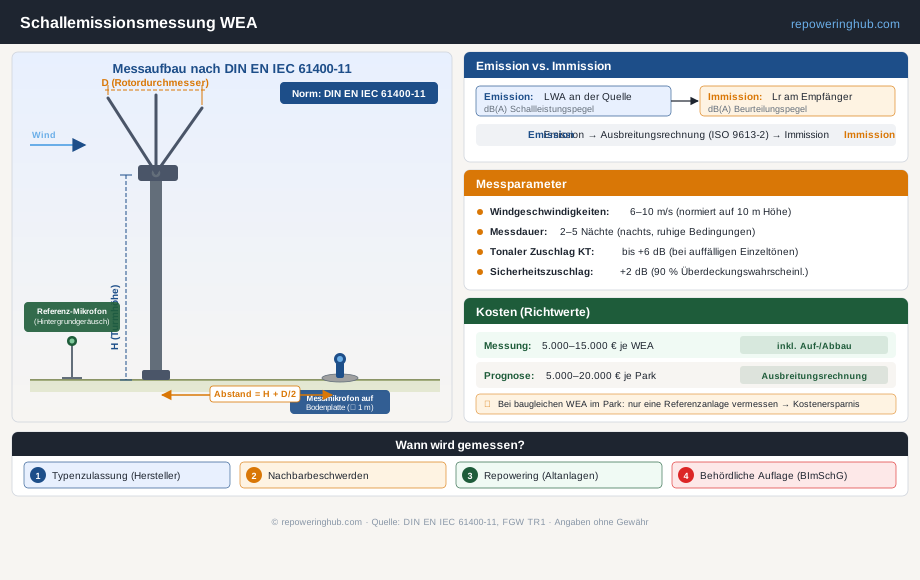
Sound emission measurement — setup per IEC 61400-11, parameters and cost comparison
Commission a Sound Emission Measurement
We forward your enquiry to an accredited acoustic measurement institute — matched to turbine type, site and scope (type measurement, verification measurement, tonality analysis).
Request a QuoteFrequently Asked Questions
How much does a sound emission measurement cost per turbine?
Guideline: EUR 5,000 to 15,000 per turbine. For wind farms with identical turbines, unit costs decrease because in some cases only one reference turbine needs to be measured. Tonality analyses and narrow-band evaluations can increase the effort at the upper end of the range.
How long does a sound emission measurement take?
The field measurement at the tower typically takes 2 to 5 nights, as defined wind speed ranges (6–10 m/s at hub height) must be covered. Including analysis and report preparation, the process usually takes 4 to 8 weeks.
Can the manufacturer data sheet value replace the measurement?
For the BImSchG permit, the manufacturer's value (measured per IEC 61400-11) plus the FGW TR1 safety margin is generally sufficient. A site-specific verification measurement is mainly required in cases of complaints, older turbines without standardised measurements, or by regulatory order.
What is the difference between sound emission and sound immission?
Sound emission is the noise at the source (the turbine itself, measured at the tower base). Sound immission is the noise arriving at a distant receptor point (e.g. a residential building). The emission measurement provides the input data used by the immission prognosis to calculate the noise level at the nearest residence.