How Much CO2 Does a Wind Turbine Save?
In short: In the German electricity grid mix, an average of 344 g CO₂ is emitted per kilowatt-hour of electricity (source: UBA, 2025). Every kWh of wind power displaces this fossil share — a modern 6 MW turbine with an annual yield of 18 GWh therefore saves around 6,200 tonnes of CO₂ per year.
The Calculation
CO₂ savings [t/year] = annual yield [GWh] × emission factor [344 g/kWh] / 1,000
| Turbine | Annual yield | CO₂ savings/year | over 20 years |
|---|---|---|---|
| Old turbine 1.5 MW | ~3 GWh | ~1,000 t | ~20,000 t |
| Modern 3 MW | ~8 GWh | ~2,800 t | ~55,000 t |
| Modern 6 MW | ~18 GWh | ~6,200 t | ~124,000 t |
| 6 MW top site | ~23 GWh | ~7,900 t | ~158,000 t |
Grid Mix Comparison — Historical and Current
| Year | g CO₂ / kWh grid mix DE | Source |
|---|---|---|
| 2024 | 363 g | UBA 2024 |
| 2025 (preliminary) | 344 g | UBA 2025 |
The factor falls with each further expansion of renewables — good for the climate overall, but in purely arithmetic terms it reduces the CO₂ savings value of a single new wind turbine. As long as the grid mix is not entirely CO₂-free, the effect remains clearly positive — the savings per turbine do not fall because wind power is getting worse, but because the overall system is getting cleaner and the comparison baseline shifts along with it.
Energy Payback
Modern onshore wind turbines typically recover the energy input for their manufacture and construction within under one year of operation. Over their 25-year service life they therefore deliver many times the manufacturing energy invested. This order of magnitude applies across the industry; specific values are reported in the manufacturers' life-cycle analyses (LCA) and vary in detail depending on turbine type, site wind conditions and the manufacturing chain assumed.
What Actually Goes Into the Manufacturing Balance
The CO₂ backpack of a wind turbine is mostly incurred before it ever starts operating: steel and concrete for the tower and foundation, composite materials for the rotor blades, copper and rare earths for the generator and cabling, plus transport and the construction process itself. Manufacturers' life-cycle analyses (LCA) typically report these emissions as "embodied emissions" and set them against the clean energy generated over the turbine's operating life. This comparison is exactly what produces both the energy payback time and the CO₂ payback time — two related but not identical metrics that studies sometimes conflate.
Why the Figure Varies Slightly Between Sources
Anyone searching online for the CO₂ savings figure per wind turbine will find different numbers — this is rarely down to incorrect data, but to different reference bases: some sources calculate against the German grid mix, others against the European one; some already subtract the turbine's manufacturing emissions, others only look at the operating phase; and the emission factor itself changes every year as the energy transition progresses. For reliable figures it is therefore always worth checking the specific source and its calculation year — blanket comparisons like "one wind turbine saves X cars" without a cited source should be treated with caution.
Avoided Emissions vs. Fully Saved Emissions
An important distinction: wind power does not "save" CO₂ in the sense of shrinking a balance sheet — it displaces fossil generation in the same grid at the same time. When wind is strong, gas and coal plants throttle back their output — so the avoided amount also depends on which power plant is currently covering the residual load at the margin (the so-called marginal generator). In periods with a lot of coal in the grid, the CO₂ avoided per kWh of wind power tends to be higher than in periods with a lot of gas or an already high renewables share. The UBA average factor smooths out these fluctuations into a practical annual metric.
Why a Single CO₂ Figure Never Tells the Whole Story
An isolated annual figure like "6,200 t CO₂ saved" says little about how the savings are distributed across a turbine's operating years or how they compare with other climate measures at the same site. For a project assessment, the cumulative balance over the full operating life — calculated against the grid mix applicable in each respective year — is usually more informative. That is why credible climate balances for a wind farm typically present a time series rather than a single static figure.
Frequently Asked Questions
Why does the grid mix CO₂ value not fall faster?
Because coal and gas power plants are dispatchable and fill the gaps in the renewable generation profile. Only with extensive expansion of storage and flexibility will the remaining fossil share fall quickly.
Does the construction energy input really "cancel out"?
Yes — energy payback has been methodologically well established for decades. The LCA comparison with fossil electricity generation comes out clearly in favour of wind even when conservative assumptions are chosen, including decommissioning and disposal.
Are there methodological debates?
Yes, above all about the right reference value: against which grid mix do you compare? The UBA factor (average) is the standard; some methods use the marginal mix — which is higher (fossil) in many hours and lower in others.
Does repowering additionally improve the CO₂ balance?
Indirectly, yes, in two ways. First, a modern turbine produces significantly more energy per unit of embodied manufacturing emissions than a 20-year-old one, because both efficiency and full-load hours have increased — the manufacturing CO₂ backpack is spread across more kilowatt-hours generated. Second, decommissioning the old turbine recovers large quantities of material such as steel and copper for reuse, which lowers the resource — and thus indirectly the emissions — burden of new turbines elsewhere. Details on material recycling are covered in the guide Wind Turbine Recycling.
How does wind's CO₂ balance compare with solar?
Both technologies sit in a similar order of magnitude in life-cycle analyses, clearly below fossil generation, with slight differences depending on the study, turbine or module type, and site yield. A sound comparison depends critically on the system boundaries used — blanket rankings without a stated methodology should be read critically, especially if they cite a single isolated study rather than combining the findings of several independent analyses.
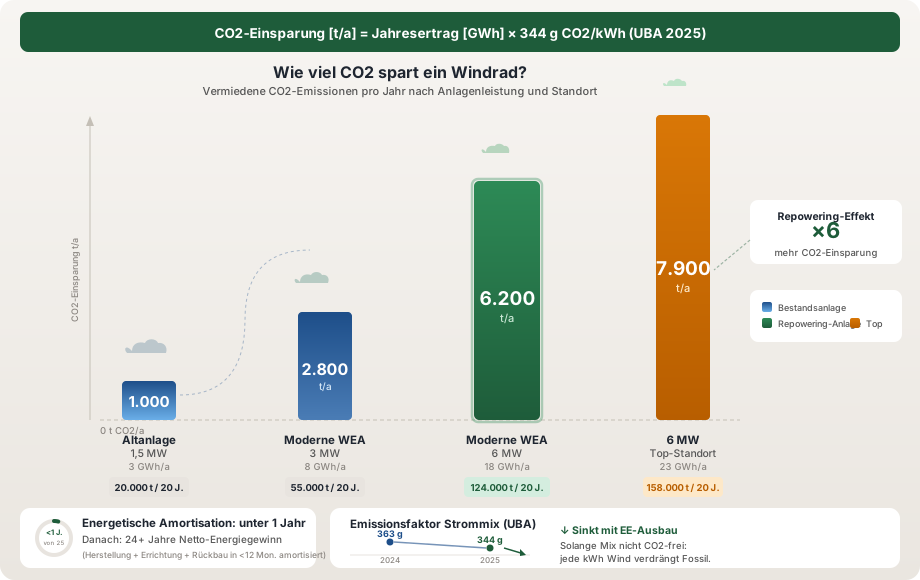
CO2 savings by turbine size – UBA factor, 20-year balance and energy payback