How Long Does a Wind Turbine Last?
In short: Technically, a modern wind turbine lasts 25–30 years with good maintenance. But EEG (German Renewable Energy Sources Act) support only runs for 20 years. It is precisely this gap that determines what happens next: continued operation or repowering.
Two different "lifespans"
| Dimension | Duration |
|---|---|
| EEG support period | 20 years from commissioning |
| Technical design (type certificate) | 20–25 years |
| Real lifespan with good maintenance | 25–30 years |
| Foundation | 40+ years (often usable longer than the turbine) |
What happens after 20 years?
When EEG support ends, the guaranteed feed-in tariff disappears. Three options:
- Continued operation (post-EEG): Electricity is sold at the market price or via a PPA. Worthwhile as long as OPEX stays below the electricity price.
- Repowering: Demolition + a new, larger turbine. Increases yield by a factor of 2–3. See repowering vs. continued operation.
- Decommissioning: complete dismantling + site restoration, if repowering is not possible.
How does a turbine age?
- Years 1–10: little wear, manufacturer warranty, OPEX 20–25 €/MWh
- Years 11–15: generator/gearbox overhaul possible, OPEX rises
- Years 16–20: manufacturer support ends, repairs more involved, OPEX 30–40 €/MWh
- Years 20+: insurance becomes more expensive — the economic trigger for repowering
Why technical and economic lifespan diverge
Confusing these two figures is the most common mistake in thinking about wind turbine lifespan. The technical lifespan is an engineering design figure: wind turbines are dimensioned under the IEC 61400 standards series and DIBt (Deutsches Institut für Bautechnik) guidelines for a design life of usually 20 years. This figure describes how many load cycles the tower, rotor blades and drivetrain are designed to withstand with adequate safety margins — not the point at which the turbine inevitably fails.
The economic lifespan, by contrast, ends once ongoing costs (maintenance, insurance, lease, direct marketing) exceed the achievable electricity revenue. As long as the market value of the electricity generated stays above operating costs, a carefully maintained turbine can keep running even past the expiry of its type certificate — provided a continued-operation assessment confirms the residual structural stability. It is precisely in this zone between the end of the technical design life and the economic break-even point that the decision between continued operation and repowering gets made.
What shortens or extends lifespan in practice
Not every turbine ages at the same rate. Site and operations management are decisive: a turbulent site in low mountain terrain or immediately behind a forest edge stresses the rotor blades more through uneven inflow than a freestanding turbine inland — local turbulence intensity can be roughly assessed in advance with the turbulence indicator. Consistent condition-based maintenance (condition monitoring), early gearbox or bearing replacement, and clean oil management push expensive major failures further out. Conversely, deferred maintenance and cold-start stress accelerate wear. The economics of continued operation over the remaining years can be compared using the LCOE calculator and the repowering yield calculator.
What a continued-operation assessment actually checks
Anyone wanting to keep a turbine running beyond the end of its type certificate cannot avoid a continued-operation assessment (also called a "lifetime extension" report). At its core, it examines the residual structural stability of the load-bearing components — tower, foundation, machine bedframe and rotor blades — based on the load cycles actually experienced, not just the original design assumptions. This usually includes an evaluation of operating data (SCADA history), a visual inspection of critical welds and blade surfaces, and, where necessary, a renewed structural-stability calculation under the relevant DIBt guidelines. Similar to the structural stability report in a new-build procedure, the goal is to demonstrate with traceable technical criteria that the turbine will safely survive its remaining operating years. If the assessment comes back negative, or if extensive refurbishment would be needed, the economic balance usually shifts toward repowering.
Maintenance strategy over the operating years
The maintenance strategy changes noticeably as the turbine ages. In the first years of operation, pure manufacturer warranty with scheduled maintenance at fixed intervals dominates. As the turbine ages, condition-based maintenance (condition monitoring) grows in importance: vibration sensors on the drivetrain and evaluation of oil and temperature data make it possible to replace wear parts — especially the gearbox, main bearing and generator — before a total failure threatens. This forward-looking approach does incur ongoing costs, but it lowers the risk of unplanned, considerably more expensive major repairs in the final third of the operating period. Anyone wanting to realistically estimate operating costs over the remaining term will find reference points in the guide operating costs of wind turbines.
Repowering as a plannable process, not a last resort
Important for operators and landowners: the decision for repowering is rarely made spontaneously on the day EEG support ends — it is typically set in motion several years earlier, because a BImSchG permitting procedure needs lead time. The rough sequence — from site assessment through expert-report preparation to permitting and the actual decommissioning of the old turbine — is described in the guide repowering process. Anyone who plans early avoids a gap between shutdown and recommissioning, and can use the old turbine's remaining operating years specifically for preparation instead of letting them pass unused.
Frequently asked questions
What happens to the rotor blades at the end of life?
Steel, copper and concrete are recycled to >90 %. Rotor blades (fibreglass) are the sticking point — they are currently incinerated for energy recovery in cement plants. More under decommissioning.
Can the lifespan be extended?
Yes, through a "lifetime extension" report that assesses the residual structural stability. This makes continued operation beyond the type-certificate period possible.
How much is an old turbine still worth?
The recycling proceeds minus dismantling are usually marginal (0–50,000 €/turbine net). The value lies in the still-operable site, not in the old turbine.
From when does repowering pay off over continued operation?
Roughly, once the expected repair and insurance costs of the old turbine rise relative to its residual yield, while a modern turbine type at the site would generate a multiple of that. Because modern turbines have significantly taller towers and larger rotor diameters, the yield jump is often bigger than the pure capacity jump — details under repowering vs. continued operation.
Does offshore last longer than onshore?
The design lifespan is comparable (roughly 20–25 years under IEC 61400), but offshore turbines face stronger corrosion and saltwater exposure, requiring more involved maintenance. This guide refers to the onshore fleet, which dominates the German repowering market.
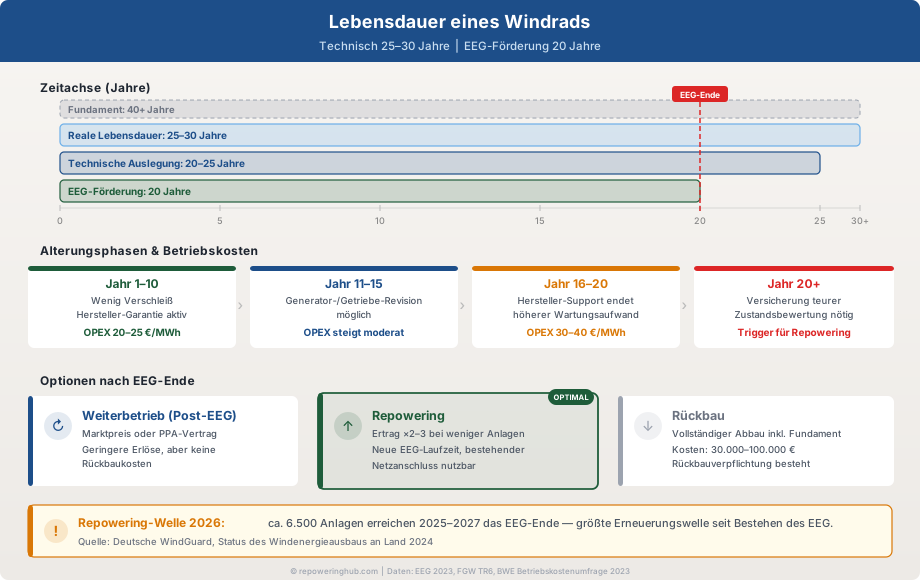
Wind turbine lifespan – EEG end, ageing phases and options after 20 years