What happens to the lease contract in repowering?
In short: The repowering event is usually the most important moment for negotiation over the entire lease term. Either the old contract contains a repowering clause with an extension — or a new contract is drawn up. In both cases the rent generally rises significantly, because the new turbine generates a multiple of the old output.
Three typical starting positions
| Contract situation | Consequence in repowering |
|---|---|
| Repowering clause in the old contract | Contract extends automatically by 20–25 years, rent adjusts according to the agreed formula |
| Lease end coincides with EEG end | Renegotiation — the strongest negotiating position for the landowner |
| Old contract continues, repowering planned | Addendum required (turbine type, number, rent methodology) |
Rent mechanics in repowering
With a revenue-based rent (4 to 7 percent of the electricity revenue, the common standard), the rent rises roughly in proportion to the increase in yield. A 6 MW turbine instead of a 1.5 MW turbine means, depending on the site, roughly three to four times the annual revenue and thus rent. A rough estimate of the new yield is provided by the repowering yield calculator; recommended reading on the rent question itself: lease income.
Pool models as a fair solution within the park
In repowering, fewer but larger turbines are often built — the turbine locations shift. So that suddenly only one owner profits and others come away empty-handed, a land pool (Flächenpool) is the usual answer: all land owners in the park share the total rent according to their share of the area, including access roads and cabling. More background under lease & site acquisition.
What a good repowering clause should cover
Whether an old contract works smoothly at repowering depends almost entirely on how precisely the repowering clause is drafted. From the landowner's perspective, a robust clause should regulate at least the following points: the term extension (20 to 25 years from commissioning of the new turbine is typical, not from the date the contract was signed), the rent adjustment for a changed turbine capacity, an inflation-indexing mechanism to protect value over the long term, and a provision for the case where the new turbine does not stand exactly on the originally leased plot but is shifted slightly as part of site optimisation. If any of these components is missing, negotiation becomes unavoidable at the repowering event — which in practice is not necessarily a bad thing, because it gives the owner a chance to renegotiate terms that were not yet market standard when the original contract was signed 15 or 20 years earlier.
Tax treatment of lease income
For private landowners, lease income from leasing land for wind turbines regularly counts as income from letting and leasing under Section 21 of the German Income Tax Act (EStG). For agricultural businesses, classification can be more complex if the leased land previously formed part of the business assets — it is worth consulting a tax advisor before signing an addendum or a new contract, especially when repowering brings a significantly higher lease payment than before. This page is not a substitute for tax advice; it is only meant to flag that a rising rent also needs to be reassessed for tax purposes and does not automatically continue under the previous assessment logic.
Typical points of dispute in practice
Contract practice reveals a few recurring areas of conflict. First, access roads and cable routing: repowering often changes crane pads, access ways and cable routes, which requires additional or altered usage rights on neighbouring land — who is compensated for this, and how, should be clearly regulated in the pool agreement. Second, decommissioning the old turbine: who bears the cost of dismantling and restoring the old foundations if they are not reused? The usual approach is for the operator to bear these costs and to post a decommissioning bond, which should be explicitly recorded in the new lease. Third, the duration of the construction phase: during dismantling of the old turbine and construction of the new one, there is often a period with no or reduced rent payment if the rent is purely revenue-based — a minimum rent or a construction-period compensation clause in the contract prevents income shortfalls for the owner here.
Why early advice pays off
Because a repowering permit procedure needs several years of lead time, the lease question in practice often comes up well before the actual end of the EEG (Renewable Energy Sources Act) subsidy period — project developers secure land early to have planning certainty for the BImSchG permit. For landowners this means: whoever only engages with the topic shortly before the contract expires has less time to obtain comparable offers or bring in a specialist law firm. A look at comparable, already concluded repowering lease contracts in the region — for example via a citizens' initiative or a land-pool association — helps build a feel for market-standard terms before the first figure is put on the table.
Frequently asked questions
Can I terminate the contract during repowering?
As a rule no, as long as the old contract is still running and the operator fulfils its obligations. But: repowering is practically not feasible without a mutually agreed contract amendment — that is your bargaining chip.
What if the repowering location shifts?
The usual approach is to bring all owners of the old locations into the new pool — even if the new turbine no longer stands exactly on their land. Without a pool, conflicts arise that can delay or prevent a repowering.
When should I seek legal advice?
Before signing any addendum or new contract. We do not provide individual legal advice (RDG, the German Legal Services Act), but on request we put you in touch with experienced specialist lawyers/notaries via the contact page.
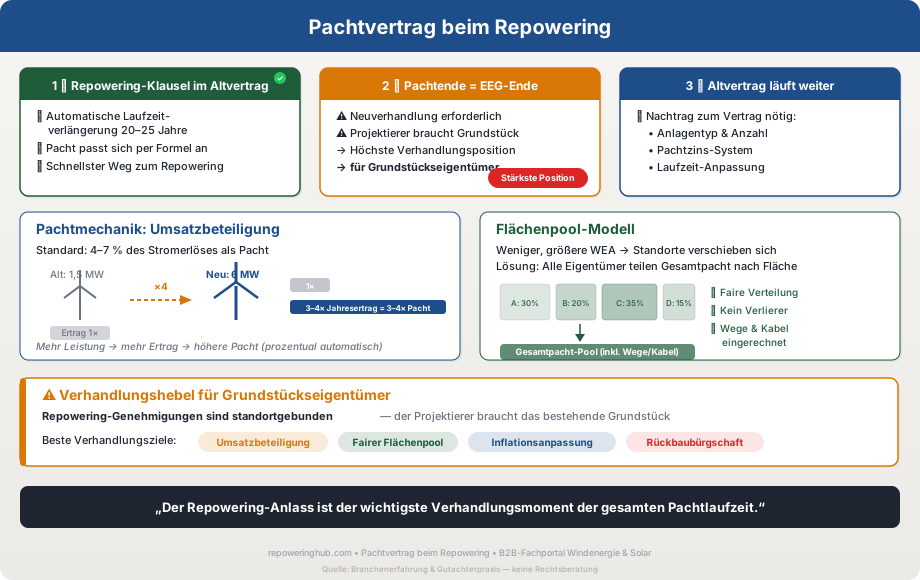
Lease contract in repowering – scenarios, rent mechanics and land pool model