How Long to Build a Solar Park?
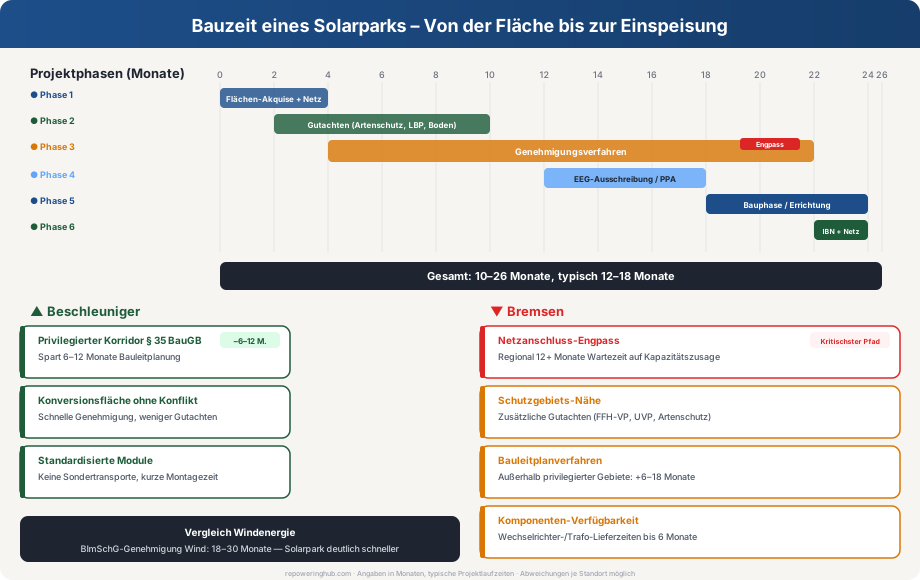
In brief: The construction itself takes 3–6 months (small installations 2–3), the permitting procedure 12–18 months, and the overall process from first contact to commissioning typically 12–18 months, with outliers of 10–26 months (sources: FlächenMakler, landverpachten.de).
Phases at a glance
| Phase | Typical duration |
|---|---|
| Site acquisition + preliminary grid-connection inquiry | 2–4 months |
| Expert reports (species protection, LBP, possibly soil, glare) | 4–8 months in parallel |
| Permitting procedure | 12–18 months (often faster when privileged) |
| Auction (EEG) or PPA negotiation | 3–6 months |
| Construction phase / erection | 3–6 months (small installations 2–3) |
| Commissioning + grid energisation | 1–2 months |
Where it goes faster — and where it gets stuck
Accelerators:
- Privileged corridor under § 35 BauGB (Federal Building Code) since Solarpaket I (Solar Package I): a building permit instead of a Bebauungsplan (local development plan) — often saves 6–12 months (see Permitting).
- Conversion site with no conflict situation: rapid authority approval possible.
- Standardised module / mounting-system choice: no special logistics required.
Brakes:
- Grid-connection bottleneck: often the most critical path, regionally 12+ months of waiting time (see Grid Connection).
- Proximity to sensitive protected areas: additional compatibility assessments.
- Land-use planning procedure with public participation: outside the privileged status.
- Component availability: inverters and transformers can be lead-time drivers.
Why "construction time" is not the same as project duration
Anyone asking how fast a solar park can be built usually means two very different things. The construction itself — driving the posts, mounting the racking, laying the modules, cabling and the transformer station — is surprisingly short: a mid-size ground-mounted park goes up in a few months, because the build is highly standardised and can run in parallel. The lion's share of the overall timeline instead falls on the development phase beforehand: site securing, expert reports, the grid-connection commitment and the permitting procedure run partly in parallel, but they determine the critical path. The often-quoted range of 12 to 26 months almost always describes this overall process, not the construction phase.
In practice this means: anyone wanting to shorten the project duration should not start with the assembly work, but with clarifying grid connection and building rights early. These two points decide whether a project ends up toward the lower or the upper end of the range.
Grid connection as the hidden pacemaker
While expert reports and building rights can be planned fairly reliably with experience, the grid connection is the hardest factor to calculate. Regionally overloaded distribution grids lead to waiting times that can dominate the schedule — regardless of how quickly permitting and construction progress. That is why the grid-compatibility inquiry belongs at the very start of any serious project development, ideally in parallel with site securing. Only once the grid-connection point and feed-in capacity are confirmed is the schedule reliable. Anyone who reverses the order and brings in the grid operator late risks a fully permitted, construction-ready park waiting months for its connection.
Frequently asked questions
What is the absolute minimum?
On a perfectly prepared site with immediately available grid connection and a privileged location, 9–10 months from first contact are possible. A realistic, plannable order of magnitude is 12–18 months.
What destroys schedules most often?
Grid-connection bottlenecks, additionally requested expert reports and component lead times. Early clarification with the DSO (distribution system operator) and the authority reduces the risk considerably.
What if the EEG auction has to wait?
With a valid permit, you can wait for the next suitable auction — the BNetzA (Federal Network Agency) publishes the dates in advance. Alternatively, enter the PPA market directly.
Can the construction phase run through winter?
In principle, yes — assembly is less weather-sensitive than, say, concrete work, because it is mostly driven and bolted together. Frost can make driving the posts harder in certain soils, but rarely causes long stoppages. More critical are closed survey windows for species protection, which tend to affect the lead-in phase instead.
Do large parks get built faster per MW than small ones?
Yes, there are economies of scale: large parks work with several assembly crews in parallel, so construction per megawatt becomes more efficient. The permitting and grid-connection effort, by contrast, does not scale linearly, which is why large projects often reach the grid faster per MW than many small installations — one reason the ground-mounted market is moving toward large parks.
Permitting procedure: two paths, two schedules
The difference between the privileged procedure and a classic local development plan (Bebauungsplan) is the single biggest time lever in the whole project. If a project runs through the privileged corridor under § 35 BauGB, the building authority essentially checks site criteria and the expert-report situation and issues a building permit — a procedure that in many cases can be completed in a few months. The classic route via a Bebauungsplan, by contrast, requires a council resolution by the municipality, formal public and authority participation with display periods, and often an environmental report. This route is more flexible under planning law — it also allows sites outside the privileged criteria — but takes structurally longer, because political and administrative coordination steps are chained one after another and can hardly be run in parallel.
For project planning this means: the choice of procedure should be clarified as early as possible with the responsible building authority and the municipality — when in doubt, even before site securing is finalised. A project that is wrongly calculated on the fast corridor but actually needs a Bebauungsplan easily loses six to twelve months against the original schedule.
Coordinating expert reports as a time factor in its own right
The expert reports running in parallel cannot be shifted around at will. Species-protection surveys, for example on breeding birds or bats, are tied to vegetation periods and survey windows — if a survey window is missed, the corresponding study slips by a whole season. Anyone starting a project in autumn should therefore coordinate a survey calendar with the commissioned expert firm from day one, rather than commissioning the studies only after site securing is complete. This lead time is one of the most frequently underestimated time sinks in the whole process, because unlike pure administrative steps it cannot be sped up simply by adding staff.
How much time buffer should you realistically plan for?
Experienced project developers routinely calculate a buffer of several months on top of the average process duration, for authority follow-up requests, delayed statements from public bodies, or unexpected grid-connection feedback. A schedule calculated too tightly without this buffer frequently leads to schedule slippage against investors or EEG auction rounds in practice.
Does the number of land owners affect the duration?
Yes — the more owners a site has, the more involved lease negotiations and parcel coordination become. A project with a single owner can usually be secured contractually much faster than a patchwork of many small parcels held by different owners.
Solar park construction time – phase timeline, accelerators and brakes