What does a BImSchG permit procedure for wind really cost?
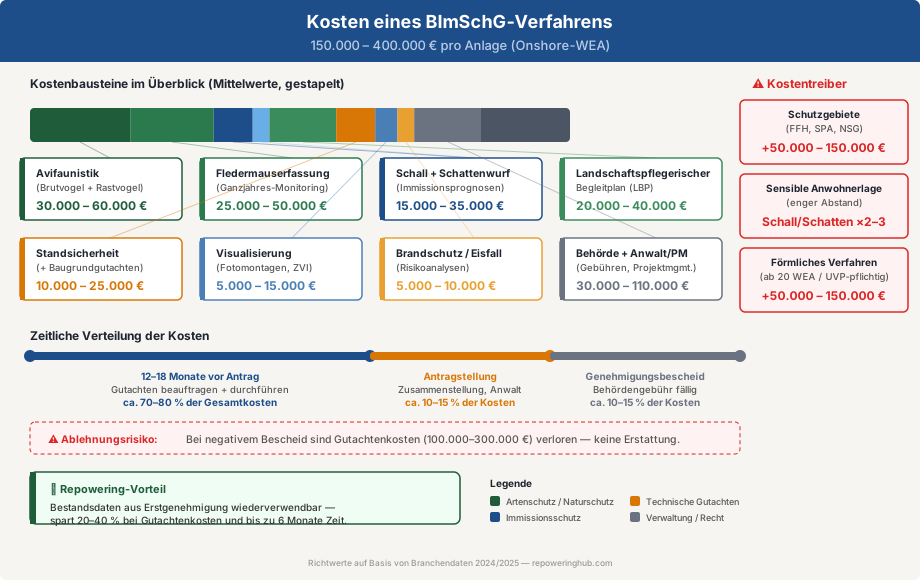
In short: For a standard BImSchG permit procedure (federal immission control permit) per wind turbine, you should budget EUR 150,000 to 400,000 — the bulk is expert reports, plus the authority fee on top. In sensitive locations (protected areas, neighbour conflicts, mandatory EIA) this becomes considerably more. An honest preliminary check usually saves several times its own cost.
The cost blocks at a glance
| Block | Range per turbine |
|---|---|
| Avifauna (breeding birds + resting birds) | 30,000–60,000 € |
| Bat survey | 25,000–50,000 € |
| Acoustic emission prognosis | 10,000–25,000 € |
| Shadow flicker report | 5,000–10,000 € |
| Landscape impact plan (Landschaftspflegerischer Begleitplan) | 20,000–40,000 € |
| Structural stability proof + ground survey | 10,000–25,000 € |
| Visualisation | 5,000–15,000 € |
| Fire-safety / ice-throw concepts | 5,000–10,000 € |
| Authority fee (state fee schedule) | 10,000–50,000 € (often tied to the investment sum) |
| Lawyer + project management | 20,000–60,000 € |
A concrete upfront estimate for your project is provided by the BImSchG application cost estimator. The individual expert reports are described, with methodology, in our expert reports hub.
What makes the range so wide
- Protected areas within range (FFH, SPA, NSG): require an EIA screening (UVP-Vorprüfung) or a full assessment, often also an FFH appropriate assessment — quickly +50,000 to 150,000 € per turbine.
- Sensitive neighbouring residences: several immission points multiply the effort for noise and shadow flicker reports.
- Collision-endangered species (red kite, white-tailed eagle, etc.): additional anti-collision concepts and possibly trial operation.
- Formal procedure from 20 turbines or with EIA: public participation + hearing date = higher legal/project costs.
When the money is gone — and when it isn't
Expert report costs arise up front — typically 12 to 18 months before the application is filed, because the breeding-bird survey needs at least one season (see permit duration). If the project is later abandoned or rejected, these costs are lost. That is precisely why a well-founded BImSchG preliminary check and a realistic repowering process plan are the most important lever for reducing risk.
Where the money actually goes during the process
Most developers underestimate not the total sum but its timing. In the first six months after site selection, hardly any hard costs arise — wind measurement, land securing and initial talks with the authority usually run on flat fees or internal resources. The real spending push starts once the mapping season for breeding and resting birds begins: from that point, several expert-report contracts run in parallel, and most of the cost range described above is committed within a few months. Anyone who starts this phase without a preliminary check carries the full risk alone.
A second cost block, often forgotten, arises after the permit is granted, not before: conditions attached to the decision — for example a monitoring programme for bats during the first years of operation, or a curtailment protocol for certain weather conditions — create ongoing costs that many calculations leave out. These items belong in a sound economic viability calculation, not just the one-off procedure costs.
Repowering vs. new construction on a new site
In 1:1 repowering on an already-used site, site search falls away, and baseline data from the original procedure often already exists. This mainly lowers the cost of avifauna and noise reports, because part of the data base can be updated rather than collected from scratch — provided the authority accepts the transfer, which is handled differently case by case. In new construction on an undeveloped site, by contrast, the entire mapping chain starts from zero, which tends to push the range toward its upper end. A comparison of both paths is provided in continued operation vs. repowering.
An often-overlooked factor: the number of turbines in the wind farm changes the cost per turbine non-linearly. Reports such as the avifauna survey or the landscape impact plan are commissioned for the entire wind farm and then allocated across the number of turbines — in a farm with ten turbines instead of three, the share per turbine drops noticeably, because the base cost of the survey is spread across more units.
How developers manage cost risk in practice
Three levers recur in nearly every project that keeps costs under control:
- Order of commissioning: check exclusion criteria first (distance to settlements, protected-area boundaries, wind resource), then commission the expensive field surveys. Reversing this order means paying for surveys at sites that fail anyway.
- Bundled awards: an engineering firm that offers several reports together (e.g. avifauna + landscape impact plan) saves coordination effort and often reduces the total price compared with separate awards.
- Early dialogue with the authority: an informal preliminary meeting with the permitting authority often clarifies early on whether a full EIA is looming — which can mean a six-figure difference in the budget.
Costs in regional comparison
The range of the authority fee depends noticeably on which federal state a project is located in — fee schedules are state law and differ in assessment basis and maximum rates. Anyone planning or comparing a project across several federal states should not apply one fee schedule across the board, but ask the competent authority individually for each site. The workload of expert-report firms also affects the price: in regions with high repowering activity, experienced firms for avifauna and noise reports are often booked out for months, which shows up as longer lead times and typically higher fees than in regions with lower demand.
Frequently asked questions
Are the expert reports negotiable?
The necessity follows from the procedure — what has to be examined is not negotiable. What can be negotiated: fees, bundled awards to a single firm, reuse of earlier data. We can connect you with experienced engineering firms (see contact).
How high exactly is the authority fee?
It is governed by the fee schedule of the respective federal state — often the investment sum is the assessment base at roughly 0.5–2 %. The competent permitting authority gives the precise figure.
What does the formal procedure cost on top?
With public participation and a hearing date (§ 10 BImSchG), legal and project management costs of between 50,000 and 150,000 € per wind farm are added, depending on the conflict situation and the volume of objections.
BImSchG procedure costs – cost blocks, cost drivers and timing of expenditure