Why Do Some Wind Turbines Stand Still?
In short: A standstill usually does not mean "broken", but a controlled shutdown — due to shadow flicker, species protection, grid congestion, maintenance or negative electricity prices. In total, a turbine often stands still for several hundred hours a year, most of them as planned.
The 7 Most Common Reasons
- Shadow-flicker shutdown: When the rotor shadow hits a residential building within the minutes capped by the LAI (German states' working group on emission control), the turbine shuts down automatically — typically a few minutes on a few days per year.
- Species-protection shutdown: in case of collision risk (raptors, bats) or phenologically (harvest/mowing) — see Bird Strike and § 45b BNatSchG (Federal Nature Conservation Act).
- Grid curtailment / redispatch: When regional grid capacity is insufficient, the turbine is curtailed or switched off by the grid operator. The operator receives a compensation payment.
- Negative electricity prices: With very high renewable generation and low demand, exchange prices fall into negative territory — turbine operators then voluntarily switch off so as not to give electricity away (or, since the EEG adjustment, to avoid having to pay for it).
- Scheduled maintenance: service appointments, inspections, filter changes — several days of standstill per turbine each year.
- Storm control / storm shutdown: in extreme winds — see Wind Turbine in a Storm.
- Ice-build-up shutdown: sensors detect ice forming on the rotor blades and stop the turbine to protect against ice throw — see Ice Throw Hazard.
How Much Does This Cost the Turbine Operator?
| Shutdown reason | Yield loss (typical) |
|---|---|
| Shadow flicker | < 1 % |
| Species protection | 1–5 % (higher at conflict sites) |
| Grid curtailment (redispatch) | regionally up to double digits, with compensation payment |
| Maintenance | 1–2 % (technical availability ≥ 98 %) |
| Storm / ice | small — seasonal |
| Negative electricity prices | rising with renewable share, single-digit percent |
Overall, the technical availability of modern turbines is typically ≥ 98 %. The losses from regulatory and market-driven shutdowns come on top of that.
How the shutdown works technically
The turbine's control software (SCADA system) continuously monitors a wide range of parameters at once: wind speed and direction, the sun's position for the shadow-flicker forecast, signals from camera systems for bird detection, messages from the grid operator, and the current exchange electricity price. If one of these values reaches the threshold set in the permit or the grid-connection contract, the turbine automatically moves to a reduced operating mode or to a standstill — usually within seconds to minutes. No staff member has to intervene; operations management merely receives a notification and logs the event for the annual reporting obligation to the permitting authority.
This automation also makes economic sense: a wind farm with several dozen turbines could not possibly make manual shutdown decisions for every single trigger at the required speed. Operations management typically only steps in if a turbine remains at a standstill beyond the expected period, or if a sensor reports a malfunction.
What this means for residents and host municipalities
For residents, a visible standstill is often the only point of contact with a turbine's actual operating reality — which is why uncertainty runs high when a rotor stands still for hours or days. In most cases it is worth looking at the weather: scheduled shutdowns cluster during very high or very low wind speeds, at low temperatures with icing risk, or on sunny winter days with a low sun angle. Municipalities and host communities can also refer to the conditions set out in the permitting procedure — these are publicly available and specify the permissible shutdown reasons and times in detail.
A common misunderstanding concerns the order of triggers: shadow-flicker and species-protection shutdowns are set purely by permit conditions and have nothing to do with grid load. Anyone observing a standstill on a windless but sunny day is usually seeing a shadow-flicker shutdown; on a very windy day with many turbines in the wind farm standing still at once, redispatch is by far the more likely cause.
Frequently Asked Questions
Are turbines shut down for purely political reasons?
No. Shutdowns are based on permitting conditions, grid requirements or market-price signals. Political decisions act through the framework conditions (EEG, land-use planning), not directly on operation.
Does the operator receive money for every shutdown?
Only for regulatory-triggered grid curtailments (§ 13 EnWG (Energy Industry Act) / EEG). Not for permitting shutdowns (shadow, species protection) or for voluntary shutdowns due to market price.
Why do several turbines in a wind farm often stand still at the same time?
Because they share the same regulatory trigger (grid congestion, storm, regional electricity price) — or because maintenance in the farm is bundled together.
Can a specific turbine's standstill be checked after the fact?
Yes. Operations management logs every shutdown event, including cause and duration, in the SCADA history. If residents or authorities have questions, this makes it possible to prove afterwards whether a shadow-flicker, species-protection or grid condition was the reason. These logs are part of the annual reporting obligation to the permitting authority.
Does frequent standstill affect the turbine's service life?
Barely. Regulated shutdowns are operating states foreseen by the manufacturer and do not stress the components more than regular full-load operation. What matters more for a wind turbine's service life is the load cycling from gustiness and the total number of start-stop cycles, not any single planned shutdown.
Repowering shifts the picture
With repowering, the weighting of standstill causes shifts noticeably. Modern turbines with a larger rotor diameter and greater hub height do generate more shadow-flicker minutes in certain configurations, but they usually come with more precise forecasting software that narrows the shutdown windows more tightly to the actually affected time slots. For species-protection shutdowns, the yield loss often falls, because camera-based detection systems are now standard and replace blanket, seasonal standstill periods. Grid connection shows an effect too: newer substations and grid reinforcements, which get planned anyway as part of a repowering project, frequently reduce the redispatch rate at the site. Anyone planning the economics of a repowering project should therefore not carry over the old turbine's historical shutdown statistics unreflectingly to the new one.
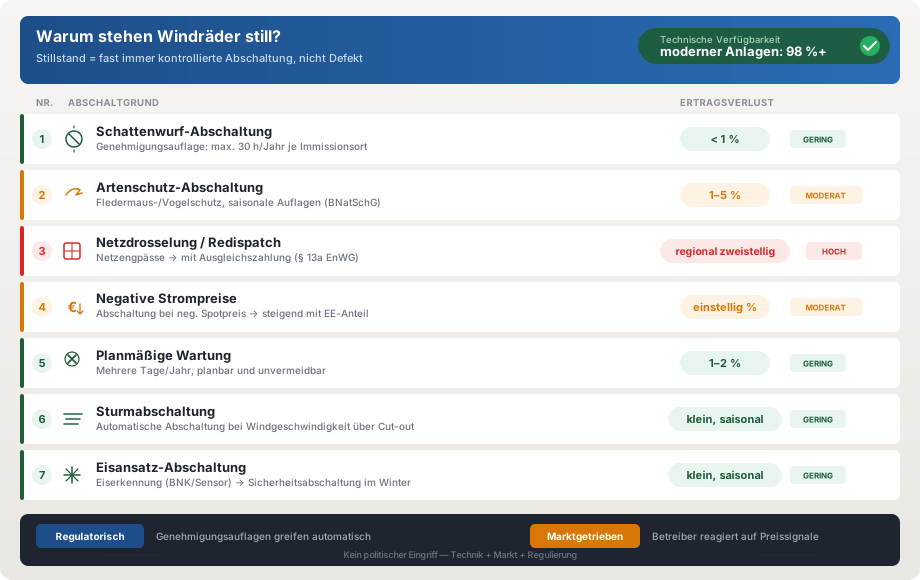
Reasons a wind turbine stands still – 7 causes with yield loss and availability