Wind turbine shadow flicker: how disturbing is it really?
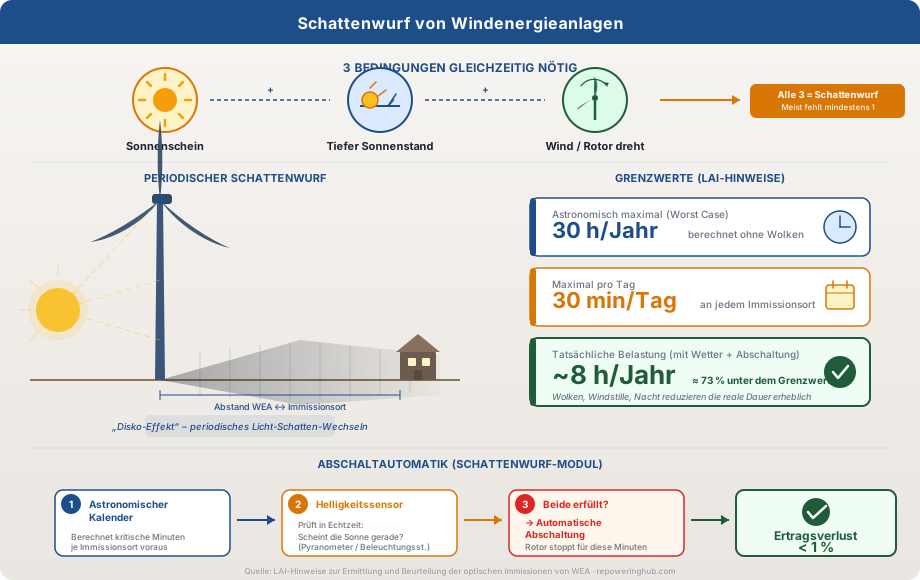
In short: Periodic shadow flicker — the moving shadow cast by the rotor blades — is strictly limited by law: no more than 30 hours per year and 30 minutes per day (astronomically possible), and in reality a maximum of around 8 hours per year. If more is reached, the turbine switches off automatically. Permanent nuisance is therefore ruled out.
What is "periodic shadow flicker"?
When the sun is low behind the turbine, the turning rotor casts a moving, periodically flickering shadow — the so-called disco effect. It only occurs when three conditions are met at the same time: sunshine, a suitable sun position (morning/evening, low) and wind (the rotor is turning). On most days of the year at least one condition is missing.
The limits (LAI guidelines)
| Criterion | Limit |
|---|---|
| Astronomical maximum possible | 30 hours / year |
| Per day | 30 minutes / day |
| Real (actual, with weather statistics) | approx. 8 hours / year |
The decisive factor is the protected outdoor living area or the living-room window. The values come from the LAI guidelines (Bund/Länder-Arbeitsgemeinschaft Immissionsschutz, the Federal/State Working Group on Immission Control) and are fixed as a condition in the permit notice.
How compliance is ensured
During the procedure, a shadow flicker report calculates the possible shading duration for every affected immission location. If it exceeds the limit, a shadow-flicker shutdown module becomes a condition:
- An astronomical calendar knows the critical minutes for each dwelling.
- A brightness sensor checks whether the sun is actually shining at all.
- Only when both apply is the turbine stopped for those minutes.
The yield loss is minimal (usually well below 1 %), because only a few minutes on a few days are affected. The shadow flicker calculator allows a rough estimate of your own.
Frequently asked questions
Does it also flicker at night or when it is cloudy?
No. Without direct sun there is no shadow flicker. That is why the real burden is much lower than the astronomical maximum — the sensor only switches on during actual sunshine.
Does the shadow on the garden count too?
Protected areas are living rooms and outdoor living areas (terrace, balcony). Pure farmland or traffic areas are not relevant. The report defines the decisive immission locations.
What about the flashing light of the rotor blades?
Reflections are avoided by matt, anti-glare coatings on the rotor blades — this has been standard for years and is also regulated in the procedure.
How a shadow flicker report calculates it
Every prognosis is based on the geometric position of the turbine relative to each affected home. From hub height, rotor diameter and site coordinates, it is possible to calculate for every day of the year the time at which the sun sits low enough for a shadow to reach the relevant window at all. This astronomically maximum possible shading duration is a pure geometry figure — it assumes permanent sunshine and a constantly turning rotor, which never happens in practice. That is why standard meteorological data (probability of sunshine by time of day and month) is additionally used to determine the real, actually expected shading. Both figures appear side by side in the report, because the LAI guidelines prescribe both limits separately.
With several turbines in a wind farm, it is not just the per-turbine figure that is considered, but also the combined load at each immission location — several rotors can theoretically hit the same point of immission one after another. The report therefore states a cumulative annual load from all relevant turbines for each affected building, not just individual per-turbine figures.
Difference for repowering sites
With repowering of existing wind farms, the geometry often changes significantly: new turbines are usually taller, have larger rotor diameters, and stand at slightly different positions compared with the old ones. A shadow-flicker prognosis for the existing fleet therefore cannot simply be carried over — it must be recalculated completely for the new turbine configuration. In practice, a larger but more slender modern turbine can even lead to less shading at some immission locations than the smaller old turbines, because rotor position and distance change. Blanket statements are not possible here; what matters is the case-by-case calculation in the permitting procedure.
What if the limit were exceeded anyway?
If the prognosis without a shutdown module shows an exceedance, that is not a barrier to permitting — it leads to a mandatory shutdown-module condition in the permit notice. The turbine may then only go into operation with the module active. After commissioning, the function is usually spot-checked through an evaluation of operating data — the responsible immission-control authority can demand evidence of the actual shutdown frequency. If the module does not work as forecast, subsequent orders up to operating restrictions may follow.
Does the limit also apply to several wind farms nearby?
Yes, what matters is the total load at a point of immission from all turbines that can cast a shadow there at all — regardless of whether they belong to the same wind farm or to different operators. With several wind farms in spatial proximity, the combined effect must be taken into account in the respective permitting procedure.
Can a shutdown module be retrofitted?
In principle, yes — modern turbine control systems are designed to support a shadow-flicker module, even retroactively. For very old existing turbines this can be more involved technically; repowering resolves the issue anyway through the completely new turbine control system.
Why the real figure is so much lower than the astronomical one
The gap between 30 hours of astronomically possible and around 8 hours of really expected shading surprises many laypeople — but it is explained entirely by the statistics of sunshine and wind occurrence. The astronomical figure assumes that on every single one of the theoretically possible days, the sun shines unobstructed exactly at the critical time and the rotor is turning. In reality, on a substantial share of these days the sky is cloudy, or there is a lull so the rotor stands still and no shadow moves at all. Only combining the astronomical geometry with long-term weather statistics yields the realistic prognosis the permitting authority ultimately relies on.
Where immission locations typically lie
Not every building near a wind turbine automatically counts as a protected immission location. What matters are living spaces with windows and regularly used outdoor living areas such as terraces. Outbuildings without habitable quality, pure storage or barn buildings, and agricultural land generally do not count. The shadow flicker report lists each specifically affected building for the project individually and states its prognosis separately — blanket statements about "the neighbourhood" do not replace this case-by-case assessment.
Does the prognosis change with the seasons?
Yes, significantly. In the winter half-year the sun sits lower overall, meaning shadow flicker can potentially occur across more daylight hours — though on many winter days the sunshine duration is lower anyway. The report models the entire annual cycle to the minute, so the summer and winter effects are already factored in.
Is shadow flicker checked once or repeatedly?
The prognosis is prepared once before the permit is granted. If the surrounding development later changes — for example a new home built closer to the turbine — a renewed check may become necessary if this creates a new protected immission location.
Shadow flicker from wind turbines – conditions, LAI limits and shutdown module