Who decommissions a wind turbine — and what does it cost?
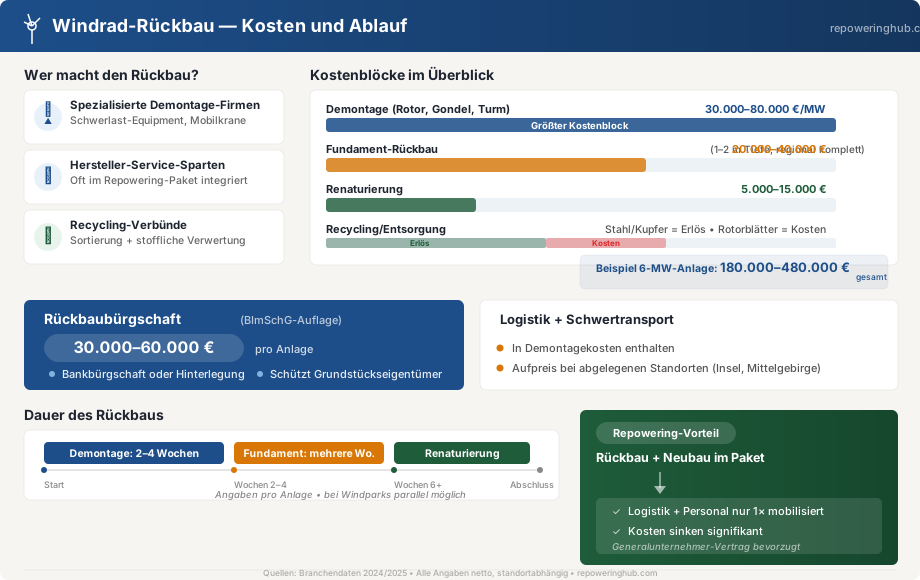
In short: Specialised dismantling firms carry out the decommissioning — from heavy-lift logistics through to recycling. Realistically, you need to budget EUR 30,000–80,000 per megawatt plus EUR 20,000–40,000 for foundation removal. The decommissioning bond (Rückbaubürgschaft) protects the landowner — the costs never land on them.
Decommissioning vs. repowering: different cost logic
Important for context: pure decommissioning without a new build is the financially less favourable option, because the full decommissioning costs are not offset by new ongoing revenue from the site. With repowering, by contrast, the old turbine's decommissioning costs flow into the overall calculation of the new project — they are refinanced through the higher revenue of the new, more powerful turbine. That is one of the main reasons decommissioning and repowering are, in practice, almost always thought of and tendered as a joint package once a site is ready for a new turbine anyway.
For operators without a repowering project directly following — for example because the site is no longer designated for wind energy under land-use planning, or because site planning is delayed — decommissioning remains a pure cost item that must be financed entirely from the deposited bond or from ongoing operational reserves.
Who carries out the decommissioning?
- Specialised decommissioning companies with heavy-lift equipment (crane logistics, hydraulic dismantling, special transport for rotor blades).
- Manufacturer service divisions sometimes offer decommissioning themselves, often bundled with the repowering contract.
- Recycling networks handle the sorting and recovery of the materials — see Recycling.
Are you looking for a concrete recommendation for your site? Through our contact page we connect you with experienced decommissioning/repowering specialists.
Cost blocks in detail
| Block | Range |
|---|---|
| Dismantling of rotor, nacelle, tower | EUR 30,000–80,000 / MW |
| Foundation removal (often down to 1–2 m depth, in some regions complete) | EUR 20,000–40,000 / turbine |
| Logistics & heavy haulage | included in the dismantling price; surcharge for remote sites |
| Recycling/disposal charges | steel/copper = revenue, rotor blades = cost |
| Renaturation of the site | EUR 5,000–15,000 / turbine |
The recycling revenue (steel and copper fractions) is offset by the dismantling firm against the dismantling costs — net, the operator lands at the figures stated above.
What makes decommissioning more expensive depending on the site
The ranges quoted above are benchmarks for a site with normal accessibility. Several factors can push the actual cost noticeably higher:
- Accessibility: steep access roads, soft ground or a lack of paved tracks require additional road building for the heavy-lift cranes — a cost block that already arose once when the turbine was built and may be needed again for decommissioning.
- Turbine height: the greater crane reach needed for modern multi-MW turbines means more specialised and more expensive crane technology than for older, lower turbines.
- Regional market conditions: in periods with many parallel repowering projects, decommissioning capacity is scarcer, which affects the prices dismantling firms charge.
- Foundation size: the larger, deeper foundations of modern turbines mean more concrete rubble and higher disposal or recovery costs.
A realistic, robust cost estimate for the specific site therefore always comes from a quote by a specialised decommissioning firm on the ground, not from the general range alone.
The decommissioning bond
The BImSchG (Federal Immission Control Act) notice sets a decommissioning bond (Rückbaubürgschaft) as a condition — typically EUR 30,000 to 60,000 per turbine, and in some regions more. It is provided via a bank guarantee or a deposit and is reviewed every few years for adequacy. This ensures that the decommissioning is financed securely, even if the operator runs into economic difficulties.
Frequently asked questions
Does the foundation stay in the ground?
The standard is removal down to at least 1–2 m depth; in many federal states (Bundesländer) complete removal is required. The exact requirements are set out in the permit notice or in the lease agreement.
What happens to the rotor blades?
They are shredded and recovered through co-processing in cement plants (combined material and thermal recovery), mechanically recycled into fibre flour, or broken down using chemical processes. Details under Recycling.
How long does decommissioning a turbine take?
Pure dismantling takes 2–4 weeks per turbine where access is good. Foundation removal and renaturation take several additional weeks. In a wind farm, several turbines are decommissioned in parallel or in sequence.
Is the decommissioning bond adjusted over the operating period?
Yes, usually at multi-year intervals. Because the costs for crane logistics, personnel and disposal can change over 20 or more years of operation, many permit notices provide for a periodic review and, where necessary, adjustment of the deposited bond amount. This is meant to prevent a sum calculated decades earlier from no longer covering the actual decommissioning costs by the end of the operating period.
What happens if an operator becomes insolvent before decommissioning has taken place?
This is exactly the case the decommissioning bond exists for: it is secured independently of the operator's economic situation, as a bank guarantee or a deposit, and can be drawn on by the permitting authority or the landowner to finance the decommissioning. Without this safeguard, the landowner — or in the worst case the public purse — would have to cover the costs in an insolvency. That is precisely what the mandatory decommissioning bond is meant to rule out from the start.
Is decommissioning regulated comparably for a solar park?
In principle, yes: for ground-mounted solar parks too, permitting authorities regularly require a decommissioning obligation with financial security. But the cost structure differs significantly, because PV installations typically involve no deep foundations and no comparably elaborate heavy-lift crane logistics — decommissioning is usually limited to module tables, mounting structures, cabling, and fully returning the site to its original agricultural or nature-conservation condition.
Wind turbine decommissioning – cost blocks, decommissioning bond, duration and the repowering advantage