Decommissioning of Wind Turbines
When repowering, the old turbine must be dismantled and the site restored to its original condition — this is a legal obligation under German law. Here is everything you need to know about the process, costs, recycling status, and the decommissioning surety bond.
What Does the Law Require?
Section 35 para. 5 BauGB (Federal Building Code): the operator must fully decommission the turbine and restore the site at the end of use. This obligation is an integral part of the permit and is secured by a surety bond.
Scope of Decommissioning
- Turbine dismantling: rotor, nacelle, tower sections removed via large crane
- Foundation removal: typically to 1.5 m below surface level (some federal states require full removal)
- Crane pad removal: gravel removed, soil loosened, reseeded
- Access road removal: only if newly built for the turbine; existing roads remain
- Transformer station + cables: removed or taken over by the repowering turbine
- Site restoration: soil and vegetation restored, often returned to agricultural use
Decommissioning Costs
| Item | Cost per turbine |
|---|---|
| Dismantling (large crane + logistics) | 40,000–80,000 EUR |
| Recycling / disposal | 30,000–80,000 EUR (rotor blades main cost driver) |
| Foundation removal (partial) | 20,000–40,000 EUR |
| Foundation full removal (rarely required) | 60,000–120,000 EUR additional |
| Crane pad + site restoration | 10,000–30,000 EUR |
| Transformer station + cables | 10,000–30,000 EUR (if not reusable) |
| Total per turbine | 110,000–250,000 EUR |
| Recycling revenue (steel, copper) | −20,000 to −60,000 EUR (offset) |
| Net cost | 50,000–200,000 EUR |
Decommissioning Surety Bond
Before commissioning, the operator must deposit a financial security — typically:
- Bank guarantee or cash deposit with a bank/insurance company
- Amount: 6.5–8% of the turbine's investment cost, or a flat 100,000–200,000 EUR per turbine
- Interest: retained by the operator, so inflation increases the decommissioning fund value
- In case of early decommissioning: the bond is partially or fully released
Recycling Rates of Modern Turbines
| Component | Share of total weight | Recycling rate |
|---|---|---|
| Steel (tower, main components) | approx. 65% | > 95% |
| Concrete (foundation) | approx. 20% | > 90% as aggregate |
| Copper, aluminum (generator, cables) | approx. 4% | > 95% |
| Ferrous metals (nacelle) | approx. 5% | > 95% |
| Polymers, lubricants, electronics | approx. 2% | thermal recovery |
| GRP rotor blades (glass-fibre reinforced plastic) | approx. 4% | the bottleneck |
Rotor Blades — The Unsolved Problem
Rotor blades made of glass-fibre or carbon-fibre reinforced plastic are currently the biggest technical bottleneck in wind turbine recycling. The available options:
- Cement kiln co-processing: incineration as fuel substitute + GRP ash as cement addite (standard solution in 2026)
- Mechanical shredding: processed into granulate for use in concrete or composites — smaller market
- Pyrolysis: thermal decomposition, fibres partially recoverable — developing, high costs
- Solvolysis: chemical separation, fibre and matrix recovery — pilot plants
Rotor blade processing costs: currently 1,000–2,000 EUR per tonne (vs. 200–400 EUR for steel recycling).
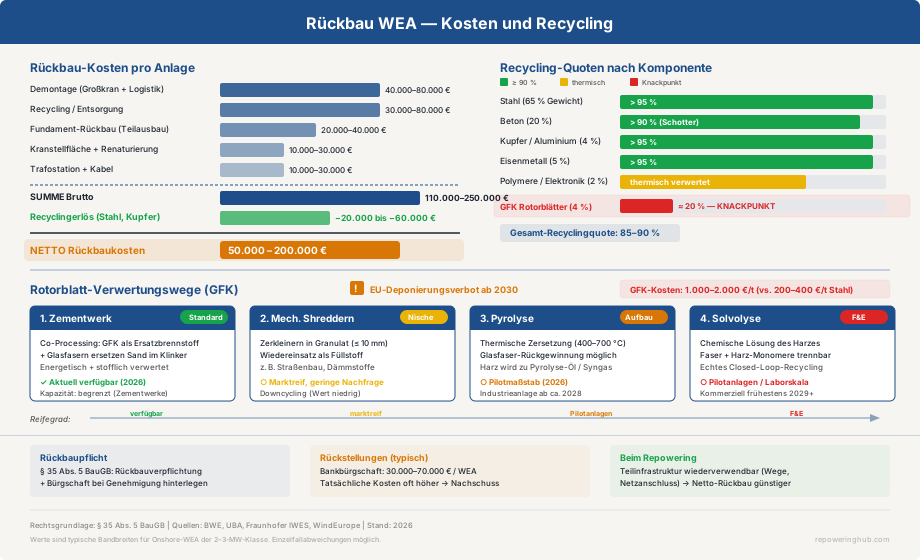
Decommissioning costs and recycling rates — rotor blades as the biggest challenge
Site Reuse Options
- Repowering: the site is reused for the new turbine — construction works can be combined with decommissioning
- Full decommissioning without repowering: usually returned to agricultural use
- PV follow-up use: increasingly attractive, as the site is already anthropogenically pre-impacted — hybrid wind+PV solutions emerging
Decommissioning for your existing wind farm?
We connect you with specialised decommissioning firms (dismantling + recycling) — often bundled with the repowering turbine supplier.
Get in touchProcess and Timeline of a Decommissioning
A turbine decommissioning is predictable and runs through clearly separated phases. A single tower is usually dismantled within a few days once the crane is on site; the time-critical part is crane logistics rather than the mechanical work itself.
- Preparation (weeks 1–4): disconnection by the grid operator, draining of oil and operating fluids, removal of internal nacelle components, site setup.
- Crane assembly (days 1–2): a crawler or lattice-boom crane with sufficient lifting capacity is assembled — for hub heights above 100 m this is the most demanding step of the whole operation.
- Dismantling (days 2–4): rotor blades lowered individually or as a full rotor star, nacelle lifted off, tower sections disassembled from the top down.
- Foundation and site works (weeks 5–8): the concrete foundation is broken up or blasted, reinforcement steel separated, crane pad and access road removed.
- Sign-off (weeks 9–10): site restoration, documentation submitted to the permitting authority, release of the surety bond.
In a repowering project these phases overlap with the new build: the crane that takes down the old turbine is often kept on site and reused directly for erecting the new one, which saves both set-up time and transport cost.
Foundation Removal — State-by-State Differences
How deep the foundation must be removed is the single biggest cost lever, and it is set either by state regulation or by conditions attached to the individual permit. A wind turbine foundation weighs 1,000–3,500 tonnes of concrete depending on turbine size. Two variants are used in practice:
- Partial removal to roughly 1.5 m below surface level: the dominant standard nationwide. The remaining foundation slab is covered over and the land returns to agricultural or forestry use.
- Full removal: taking out the entire foundation. Required in individual permits or in water-sensitive locations. Considerably more expensive and associated with higher CO2 and truck-traffic impact.
Which variant applies is always stated explicitly in the permit decision. Clarifying this with the authority early pays off, since a full removal requirement materially changes the decommissioning provision needed. Background on the legal basis: Section 35 BauGB.
Frequently Asked Questions
Who pays the decommissioning costs?
The turbine operator. When repowering, these costs are typically included in the investment calculation for the new turbine.
What happens to the surety bond during repowering?
It is offset: the old turbine's bond is released upon successful decommissioning, while the new bond for the replacement turbine is deposited simultaneously.
Why is full foundation removal controversial?
Full removal (50–120 tonnes of concrete down to groundwater level) has high environmental costs (CO2 emissions, truck traffic, soil disruption). Partial removal to 1.5 m below surface is the standard and avoids most impacts — vegetation grows over it.
What is the current lead time for decommissioning firms?
Specialised decommissioning firms are heavily booked — 6–12 months lead time is typical. Early commissioning as part of the repowering project plan is essential.
Where do the rotor blades go after dismantling?
They are shredded and mostly processed in the cement industry, both materially and thermally: the glass-fibre reinforced plastic substitutes for fuel, and the ash goes into the cement as an addite. Pyrolysis and solvolysis processes for fibre recovery are being scaled up but remain more expensive. Landfilling is the outcome the industry is actively working to avoid, and EU rules are pushing it out entirely by 2030.
Can the old access road be reused for the repowering turbine?
Often, yes. Existing access roads, crane pads, and the grid connection point are a real site advantage in repowering. Modern, larger turbines typically need wider turning radii and more load-bearing surfaces, though, so part of the infrastructure usually needs upgrading rather than simply being reused as-is.