Repowering Market 2026
Germany is facing the largest repowering wave of the Energiewende (energy transition): many turbines built between 1996 and 2005 are reaching the end of their EEG funding period. At the same time, the federal government is pushing via the WaLG (Wind Energy Area Requirements Act) and EEG 2024 toward 115 GW of onshore wind capacity by 2030. The market is active, tight, and predictable.
Stock and Repowering Potential
| Metric | Value (as of 2026) |
|---|---|
| Onshore wind turbine stock in Germany | approx. 28,500 turbines |
| Installed onshore capacity | approx. 62 GW |
| Pre-2005 turbines in operation (repowering candidates) | approx. 9,000 |
| Reaching EEG end 2025–2027 | approx. 6,500 |
| Theoretical repowering potential (capacity addition) | 20–35 GW |
| BWE forecast repowering 2026–2030 | 5–7 GW per year |
Sources: BNetzA Marktstammdatenregister (Core Energy Market Data Register), BWE (German Wind Energy Association), Deutsche WindGuard. Values are estimates and subject to fluctuation.
Regional Distribution
| Federal state | Turbine stock | GW installed | Repowering candidates 2026 |
|---|---|---|---|
| Lower Saxony | approx. 6,300 | 13.0 GW | approx. 1,800 |
| Brandenburg | approx. 3,900 | 8.3 GW | approx. 1,100 |
| Schleswig-Holstein | approx. 3,200 | 7.9 GW | approx. 1,000 |
| North Rhine-Westphalia (NRW) | approx. 3,700 | 7.0 GW | approx. 1,200 |
| Saxony-Anhalt | approx. 2,900 | 6.2 GW | approx. 700 |
| Mecklenburg-Western Pomerania | approx. 1,900 | 3.9 GW | approx. 400 |
| Rhineland-Palatinate | approx. 1,800 | 3.9 GW | approx. 450 |
| Hesse | approx. 1,200 | 2.5 GW | approx. 250 |
| Baden-Württemberg + Bavaria + others | approx. 3,600 | 9.1 GW | approx. 1,600 |
Two Key Market Bottlenecks in 2026
- Turbine delivery times: manufacturer lead times currently 12–18 months from order. Very tight on the supply side — even major OEMs (Vestas, Enercon, Nordex) are fully booked.
- Expert availability: accredited acoustic, species-protection, and landscape-planning consultancies are at capacity. Booking the full expert report package currently requires 8–14 months lead time.
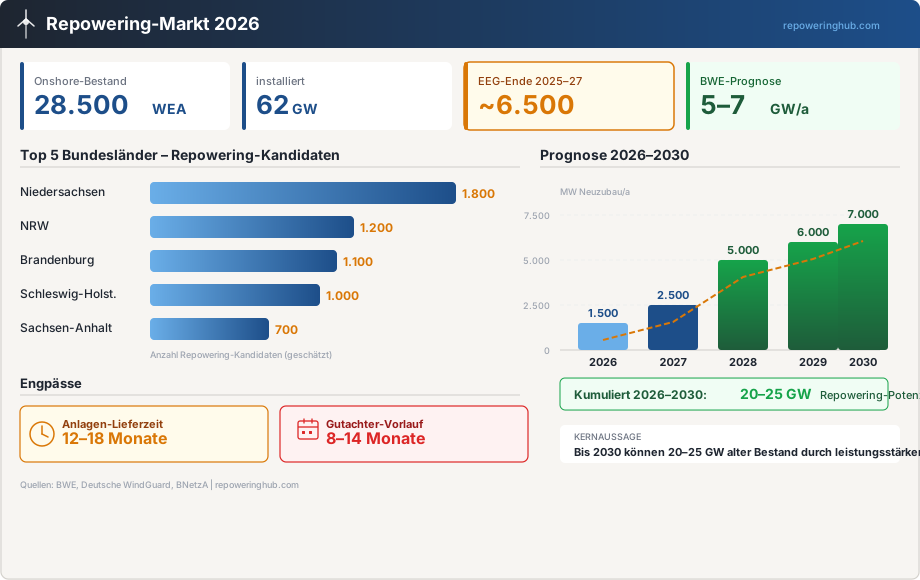
Repowering market 2026 — stock, regional distribution, and forecast
Market Participants
- Large operators: RWE, EnBW, Vattenfall, Iberdrola, ENERCON (own parks) — systematically repowering their 2002-era fleets
- Mid-size developers: ABO Wind, Energiekontor, juwi, BayWa r.e., NaturEnergie — often acting as service providers for site owners
- Community wind cooperatives: increasingly important, as many pioneer parks were community projects
- Institutional investors: growing institutional capital (wind as an asset class)
- Landowner alliances: farmers joining forces to repower under their own management
Repowering Strategies
- 1:1 swap: same number of turbines, new type — simplest procedure, WaLG (Wind Energy Area Requirements Act) streamlining benefits
- Consolidation: e.g. 8 turbines reduced to 3, higher capacity per unit, land freed up
- Expansion: developing additional sites in the vicinity (often constrained by community acceptance)
- Hybrid: adding solar PV on the same site — emerging pattern
Forecast 2026–2030
Expected trajectory according to BWE / WindGuard:
- 2026: approx. 1,500 MW repowering commissioned
- 2027: approx. 2,500 MW
- 2028–2030: 5,000–7,000 MW per year
- Cumulative by 2030: approx. 20–25 GW repowering additions (on top of new-build)
Why Expansion Targets Increase Repowering Pressure
The EEG 2023/2024 fixes an onshore expansion target of 115 GW by 2030 — roughly double the current stock of about 62 GW. New greenfield sites emerge only slowly under the Wind Energy Area Requirements Act (WaLG) because regional and municipal land-use planning takes years. Repowering on sites that are already developed, already grid-connected, and largely accepted by local communities is therefore the fastest lever for adding capacity without opening new conflicts. That is why federal and state governments specifically favor repowering through Section 16b BImSchG and the WaLG streamlining provisions. The legal basis is summarized on the Section 35 BauGB / WaLG page.
Bottlenecks Beyond Permitting
Even with a fast permit, three factors slow the market down. First, turbine availability: European manufacturers are fully booked, with 12–18 month lead times now standard, which is why projects increasingly reserve turbines under option contracts before the auction award. Second, expert report capacity: accredited acoustic, species-protection, and landscape-planning consultancies are booked out 8–14 months in advance. Third, grid connection: the higher feed-in capacity often exceeds what the existing connection point can handle, and substation upgrades have their own long lead times. Projects that do not start all three tracks in parallel with the BImSchG application easily lose a year — the project timeline is set out on the Process page.
What Could Tip the Market
The BWE and Deutsche WindGuard forecasts are not a given. On the upside, rising ceiling prices, faster procedures, and scarce new sites all make repowering more attractive. On the downside, persistently high electricity prices extend unsubsidized continued operation of old turbines and push repowering decisions back, as do delivery bottlenecks for turbines and expert reports. For site owners this means the choice between continued operation and repowering depends heavily on the specific turbine's situation and should be backed by a concrete economic calculation — see Economics and Turbine Classes.
Repowering market analysis for your region?
We connect you with a market consultant with regional repowering focus — including competitive analysis, OEM comparison, and permitting trends for your federal state.
Get in touchFrequently Asked Questions
Why are so many turbines reaching EEG end simultaneously?
EEG funding started for many pioneer turbines in 2000–2005 with the first EEG legislation. 20 years later, the funding period expires in 2020–2025. This creates the historic repowering wave.
Are there regional bottlenecks?
Yes — permitting authorities in Brandenburg, Schleswig-Holstein, and Lower Saxony are particularly overloaded. Processing times often exceed 18 months. In Bavaria, the 10H distance rule significantly delays the maturation of the repowering market.
How do electricity prices affect the repowering rate?
Significantly — when electricity prices are high, continued operation of old turbines remains profitable longer, delaying repowering. When prices are low, repowering becomes the only economically viable option — triggering a repowering construction wave.
What does this mean for turbine delivery times?
Delivery times have increased considerably — current wait times for Vestas, Enercon, and Nordex are 12–18 months from order. Early reservation is worthwhile; some projects order turbines before receiving BImSchG approval (option contracts).
Is the market concentrated among a few large operators?
No, the market remains structurally mixed. Large utilities systematically repower their own legacy fleets, while mid-size developers mostly act as service providers for private and municipal landowners. In particular, the many pioneer parks from the 1990s and early 2000s that often started as community wind projects tend to keep their local ownership structure through repowering — the turbine type changes, the ownership frequently does not — which noticeably eases local acceptance of repowering compared with a completely new, outside investor. That effect repeatedly shows up as an accelerating factor in permitting procedures.