Low-Wind Turbines
Low-wind turbines are the answer to southern German and inland sites: large rotor with a relatively small generator. They reach rated power at lower wind speeds, thereby delivering more full-load hours — at a lower absolute peak output. This suits sites with 5.5–6.5 m/s mean wind speed.
The Concept — Specific Power (W/m²)
Specific power is the ratio of rated power to rotor swept area:
specific power = rated power [W] / rotor area [m²]
| Class | Specific Power | Typical Use | FLH Expectation |
|---|---|---|---|
| High-Wind (Class I) | ≥ 400 W/m² | Coastal, offshore | 3,500+ h/a |
| Medium (Class II) | 300–400 W/m² | Northern Germany | 2,500–3,500 h/a |
| Low-Wind (Class III) | 200–300 W/m² | Southern / inland | 2,200–3,000 h/a |
| Extreme Low-Wind | < 200 W/m² | Deep southern Germany | 2,500–3,200 h/a |
Current Low-Wind Turbines 2026
| Manufacturer / Type | Rated Power | Rotor | Specific Power | Hub Height |
|---|---|---|---|---|
| Vestas V162-5.0 | 5.0 MW | 162 m | 243 W/m² | 119–166 m |
| Vestas V172-5.0 | 5.0 MW | 172 m | 215 W/m² | 175 m |
| Enercon E160 EP3 4.6 | 4.6 MW | 160 m | 229 W/m² | 120–166 m |
| Enercon E175 EP5 6.0 | 6.0 MW | 175 m | 249 W/m² | 175 m |
| Nordex N163/5.X | 5.7 MW | 163 m | 273 W/m² | 118–164 m |
| Nordex N175/6.X | 6.8 MW | 175 m | 283 W/m² | 179 m |
| Siemens Gamesa SG170-5.X | 5.X MW | 170 m | ~245 W/m² | 115–165 m |
Trade-off: Low-Wind vs. High-Wind
| Low-Wind Turbine | High-Wind Turbine | |
|---|---|---|
| Reaches rated power at | 9–10 m/s | 12–13 m/s |
| Full-load hours | Higher (at same wind) | Lower |
| Absolute annual energy | Lower | Higher |
| Tower height often | Higher (164–175 m) | Lower (120–140 m) |
| CAPEX | Higher per MW | Lower per MW |
| Optimal site | v < 7 m/s | v > 8 m/s |
Economic Example: Southern German Site
Site with v = 6.2 m/s at 150 m hub height (typical southern German ridge):
| High-Wind 5.5 MW (320 W/m²) | Low-Wind 5.0 MW (243 W/m²) | |
|---|---|---|
| FLH expected | 2,000 h/a | 2,700 h/a |
| Annual yield | 11.0 GWh | 13.5 GWh |
| Investment (rule of thumb) | 1,250 €/kW × 5,500 = 6.9 million € | 1,350 €/kW × 5,000 = 6.8 million € |
| LCOE | 78 €/MWh | 65 €/MWh |
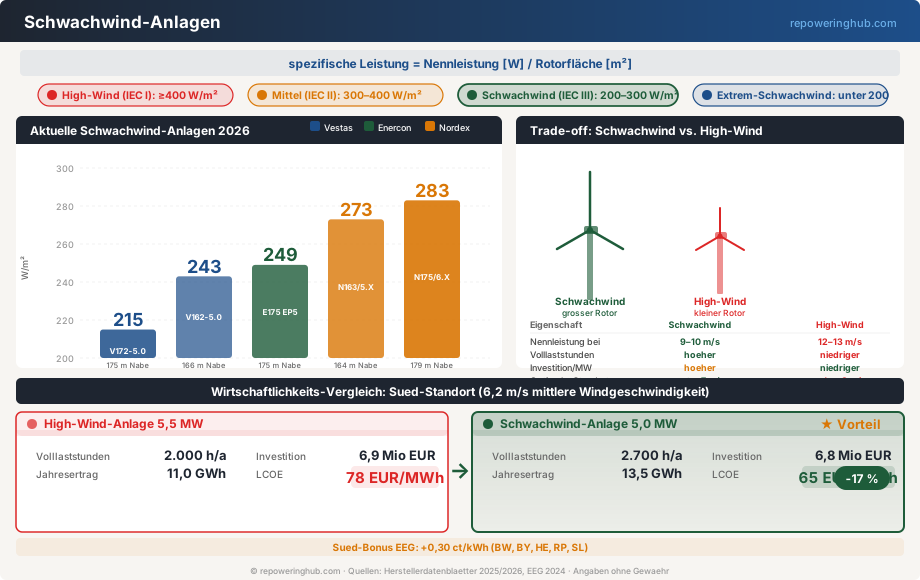
Low-wind turbines — manufacturer comparison, trade-offs and economics
Turbine Selection for Your Low-Wind Site?
We connect you with a manufacturer-neutral wind consultant — comparative yield assessment for 3–4 low-wind turbine types at your specific site.
Get in TouchWhy Large Rotors Deliver More at Low-Wind Sites
The power contained in wind grows with the cube of wind speed, but only with the square of rotor diameter. At low-wind sites (v < 7 m/s), the missing wind energy can be partially compensated by a larger rotor area — a 172 m rotor captures around 51% more area than a 140 m rotor. The generator, meanwhile, is deliberately kept small, since rated power is rarely reached anyway. The result: more operating hours in the partial-load range, where the turbine actually runs, instead of the rare full-load hours that barely occur at low-wind sites.
Blade Geometry and Control Technology
Low-wind rotors are aerodynamically designed differently from high-wind blades: slimmer profiles with greater relative thickness in the inner blade section for stiffness at lower weight, plus a pitch control optimised for low inflow speeds. The design point is typically 8–9 m/s rather than 11–12 m/s for high-wind types. This also means blade tip speed increases at the same rotational speed, which is why modern low-wind rotors often run at a reduced rated rotational speed with a correspondingly larger diameter, in order to stay within the noise power levels permitted at the nearest sensitive receptor under the TA Lärm noise directive (see permitting procedures (DE)).
Grid Compatibility at Lower Peak Output
A practical side effect of the smaller generator rating: the grid connection capacity per turbine is lower, so the grid connection point less often becomes the limiting factor. In a wind farm with several low-wind turbines, the simultaneous feed-in peak is reduced, which matters particularly where transformer capacity is tight in rural medium-voltage grids (20 kV) — an aspect worth clarifying early in the grid connection request to the responsible distribution system operator.
Manufacturer Warranties and Power Curve Verification
For low-wind projects it is worth taking a close look at the manufacturer's contractually guaranteed power curve, because the economic leverage here is particularly large: a 3–5% deviation in the partial-load range between 6 and 9 m/s affects annual yield at low-wind sites more strongly than at high-wind sites, since this exact speed range accounts for the bulk of operating hours. A power curve guarantee with measurement per IEC 61400-12-1 within the first 1–2 years of operation is standard practice; if the guarantee is not met, contractual penalties or manufacturer remediation obligations apply.
Tower Concept: Steel Tube, Hybrid, or Concrete
The hub heights of 150–175 m needed for low-wind sites push pure steel-tube towers to their transport and stability limits. In practice, hybrid towers (concrete shaft in the lower section, steel tube adapter above) or fully precast/prestressed concrete towers are increasingly used. Advantages: narrower transport widths (concrete segments can be delivered in narrower sections than large steel tube shells), greater natural-frequency reserve, and often lower cost per metre of additional height above 140 m. Disadvantage: greater construction-site logistics complexity and a larger crane-pad requirement during assembly.
Site Selection: When Is the Low-Wind Route Worth It?
The decision for a low-wind concept should not be made as a blanket rule, but based on actual wind resource measurement at the site. As a rough planning guideline: at a mean wind speed below 6.5 m/s at hub height, the yield advantage of the large rotor usually outweighs the higher specific investment cost. Above 7.5 m/s, the picture often reverses, because the high-wind turbine then achieves sufficient full-load hours and its lower cost per installed MW becomes decisive. In the transitional range of 6.5–7.5 m/s, a turbine-specific yield forecast for both concept variants is recommended before the investment decision is made.
Frequently Asked Questions
Are low-wind turbines worthwhile in northern Germany too?
Rarely — northern German sites achieve higher absolute yields with high-wind turbines. Low-wind turbines are only economically superior at genuinely low-wind sites (v < 7 m/s).
What about turbulence in forests?
High hub heights (164–175 m) lift the rotor well above vegetation turbulence. Low-wind turbines with 175 m hub produce significantly smoother wind conditions at forested sites than 100 m tower turbines.
Can low-wind turbines be used in repowering?
Yes — in fact, very commonly. When repowering in southern Germany, low-wind turbines are predominantly chosen because they best realise economic viability at locally moderate wind resources.