Wind Resource at the Turbine Site
Wind resource is the primary determinant of turbine yield. The energy in the wind increases with the cube of the speed — 10% more wind means approximately 33% more energy. Accurate determination of the wind resource at the site is therefore the most important planning step.
Data Sources — From Coarse to Precise
| Source | Resolution | Use |
|---|---|---|
| DWD Federal Wind Atlas | 1 km × 1 km | initial site indication, free of charge |
| MERRA-2 (NASA) | 0.5° × 0.67° | long-term reference for correlation |
| ERA5 (Copernicus) | 0.25° × 0.25° | standard for long-term reference data |
| Mesoscale model (WRF/WAsP) | 50–250 m | site-specific detailed modelling |
| On-site measurement (mast/LIDAR) | point-specific | bankability, manufacturer guarantee |
Height Extrapolation Using the Hellmann Power Law
When the measurement is taken at 100 m height but the hub height is 150 m, extrapolation is required:
v(h₂) = v(h₁) · (h₂ / h₁)α
α (Hellmann exponent) depends on terrain roughness:
- Water surface, smooth sea: α ≈ 0.10
- Open flat terrain (stubble field, heath): α ≈ 0.16
- Structured terrain (fields, hedgerows): α ≈ 0.20
- Village edge, forest clearings: α ≈ 0.28
- Closed forest, urban area: α ≈ 0.40
Example: 7.5 m/s at 100 m, Hellmann α = 0.2 → 7.5 × (150/100)0.2 = 8.15 m/s at 150 m.
Weibull Distribution
The frequency distribution of wind speed at the site typically follows a Weibull distribution with two parameters: A (scale parameter, similar to the mean) and k (shape factor). k describes the variability:
- k = 1.8 — variable wind (uplands, forest)
- k = 2.0 — standard onshore
- k = 2.2–2.5 — steady wind (coast, offshore)
On-Site Wind Measurement — Met Mast or LIDAR
| Met Mast (60–140 m) | Ground-Based LIDAR | |
|---|---|---|
| Height range | up to mast tip | 30–250+ m (simultaneously) |
| Accuracy | ± 1% | ± 2–3% (calibrated ± 1%) |
| Cost | 80,000–200,000 EUR | 120,000–250,000 EUR purchase, 30,000–80,000 EUR rental/year |
| Setup time | 4–8 weeks | 1 day |
| Permit | building authority for heights > 30 m | none |
| Bankability | MEASNET-certified OK | since 2020 certified per IEC 61400-12-1 Ed. 3 |
Long-Term Correction
A measurement period of 12 months is not sufficient for a 20-year yield forecast. The measurement data are correlated against MERRA-2 or ERA5 long-term data (40+ years):
- Determine the correlation between on-site measurement data and the long-term series at the nearest grid point
- With good correlation (r > 0.8): transfer the long-term mean to the site via regression
- Derive P50, P75, P90 yield forecasts for bankability
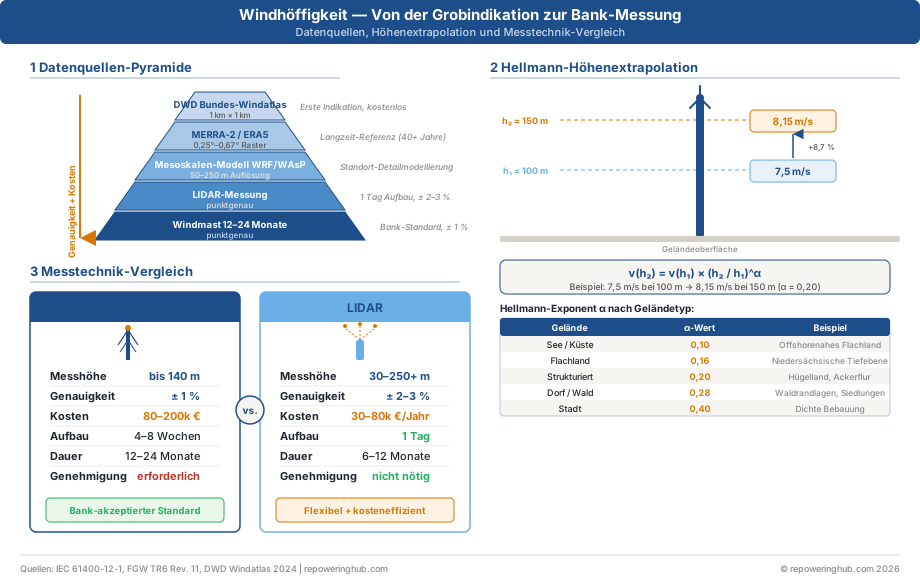
Wind resource — data sources, height extrapolation and measurement technology comparison
Wind assessment for your site?
We connect you with MEASNET-certified wind assessors — from the desktop study to a 12-month LIDAR campaign including long-term correlation.
Get in touchTurbulence Intensity as an Independent Site Parameter
Alongside mean wind speed, turbulence intensity (TI) is a second, often underestimated wind-resource parameter: it describes the variability of wind speed around the mean and directly affects the mechanical loads on rotor blades, drivetrain and tower. High turbulence — for example near forest edges, behind terrain features, or in the wake of neighbouring turbines — can raise fatigue loads to the point where manufacturers prescribe a reduced operating class or additional reinforcement. IEC 61400-1 divides sites into turbulence classes (A, B, C), which must be considered alongside the wind-speed class (I–IV) when selecting a turbine.
Complex Terrain — Additional Measurement Requirements
In upland areas, on ridges, or in strongly structured terrain, a single wind measurement at the planned turbine site is often not sufficient, because local flow varies significantly at a small scale due to terrain shape, vegetation and obstacles. For such sites, additional CFD (Computational Fluid Dynamics) modelling, or at least a mesoscale WRF simulation, is recommended to check whether the measured values transfer to the actual rotor position. The certification standard IEC 61400-12-1 therefore explicitly distinguishes between simple and complex terrain and requires additional verification procedures for complex sites before a yield forecast is considered bankable.
Forest Sites — Displacement Height and Increased Roughness
For turbine sites in or at the edge of forests, the effective ground level for wind flow shifts upward — the so-called displacement height can amount to several tens of metres depending on tree height and stand density. Wind measurements that do not account for this effect tend to underestimate the actual wind speed at hub height. At the same time, the forest significantly increases turbulence intensity in the lower 50–80 m above the displacement height, which argues for choosing sufficiently high hub heights at forest sites (typically from 160 m hub height upward, to lift the rotor above the forest-induced turbulence layer).
From Wind Measurement to a Bankable Yield Forecast
The path from a raw wind-speed measurement to a financeable yield forecast involves several intermediate steps: converting the measured wind speed into gross yield via the power curve of the selected turbine type, deducting intra-park wake losses, and accounting for technical availability as well as operational curtailments (noise, shadow flicker, bat protection, ice-warning systems). Only the result of this loss chain — not the raw wind measurement — is the figure banks and investors use for the financing decision. An independent technical due-diligence report typically re-verifies this entire chain independently before a financing commitment is made.
Wind Resource at a Repowering Site
A significant advantage of repowering over greenfield planning: the wind resource at the site is already reliably known from years of operating the existing turbine. Historical yield data from the old turbine can be used, via the power curve run in reverse, to derive a very accurate site wind speed — often more precise than any fresh measurement campaign, because several years of operation are available instead of a single 12-month measurement campaign. It should be noted, however, that the new turbine generation usually reaches significantly higher hub heights than the existing turbine; the existing yield data must therefore be extrapolated to the new hub height via the Hellmann power law before being used for the repowering turbine's yield forecast.
Frequently Asked Questions
Is the DWD Wind Atlas sufficient for the investment decision?
For the desktop pre-screening, yes. For the investment decision, NO — banks and investors require an on-site measurement or at least a certified desktop study with long-term correlation.
How long must the on-site measurement last?
At least 12 months (standard); at upland or complex terrain sites 24 months. Shorter measurement periods are possible but the uncertainty of the long-term correlation increases.
What does a certified wind study cost?
Desktop study without on-site measurement 8,000–20,000 EUR. With LIDAR measurement over 12 months 80,000–150,000 EUR. With met mast over 24 months 200,000–400,000 EUR.