Full-Load Hours (FLH) for Wind Turbines
Full-load hours are the central yield metric: notionally the hours per year in which the turbine would have to operate at rated power to achieve its actual annual energy output. They condense wind resource, turbine type and availability into a single figure.
Definition
FLH = Annual yield [MWh] / Rated power [MW]
Example: a 6 MW turbine with 18,000 MWh annual yield → 3,000 FLH/yr. The year has 8,760 h, so the turbine notionally operates at (3,000/8,760) = 34% of the time at full load. The capacity factor is therefore 34%.
Typical FLH in Germany
| Site type | FLH/yr | Remarks |
|---|---|---|
| Top coastal (SH, MV coast) | 3,500–4,200 | near-offshore conditions |
| Northern Germany inland | 2,800–3,500 | standard values for modern 6 MW turbines |
| Northern German uplands | 2,500–3,000 | NRW, Hessen ridgelines |
| Southern Germany inland | 2,100–2,700 | low-wind turbine standard |
| Southern German uplands | 2,000–2,500 | BW, BY exposed sites |
| Southern Germany lowlands | 1,700–2,100 | critical economics |
| Offshore North/Baltic Sea | 4,000–4,800 | typically significantly higher than onshore |
What Influences FLH?
- Mean wind speed at hub height: main factor (~70% of variation)
- Turbine-specific power rating (W/m²): lower W/m² → more FLH, less absolute yield
- Technical availability: 97% standard, 95%–99% achievable
- Wake losses within the wind farm: 5–10% reduction in dense configurations
- Noise-reduced night operation: −1 to −4% p.a.
- Bat/shadow flicker curtailment: −1 to −3% p.a.
- Ice accretion shutdowns: −1 to −5% p.a. (region-dependent)
- Grid-related curtailment (negative electricity prices, congestion management): variable, 0–3%
FLH and Economic Viability
| FLH | Typical LCOE | Economic viability |
|---|---|---|
| 4,000+ | 40–55 EUR/MWh | highly economic, PPA-eligible |
| 3,000–4,000 | 55–70 EUR/MWh | EEG standard |
| 2,500–3,000 | 65–80 EUR/MWh | EEG auction economically viable |
| 2,000–2,500 | 75–95 EUR/MWh | low-wind turbine, EEG south bonus required |
| < 2,000 | > 95 EUR/MWh | critical — community wind model or self-supply only |
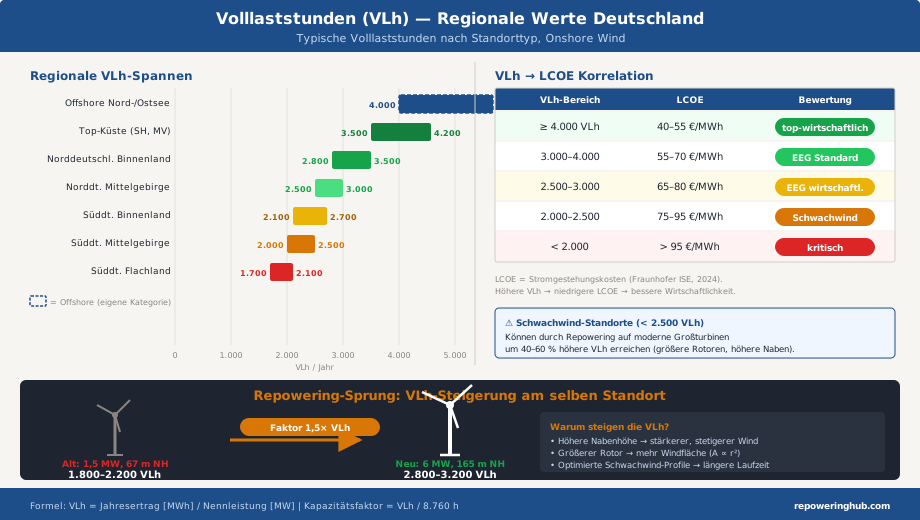
Full-load hours by region — FLH-economics correlation and the repowering leap
Bankable FLH forecast for your project?
We connect you with MEASNET-certified wind assessors for yield forecasting P50/P75/P90 including long-term correlation.
Get in touchFLH as a Benchmark Across Sites and Technologies
The strength of the FLH metric lies in making turbines of different rated power and design comparable — a 3 MW legacy model with 2,900 FLH and a new 6 MW model with 2,900 FLH at the same site deliver the same relative utilisation despite double the rated power. For site assessment, the FLH figure is therefore a better first indicator than absolute annual energy when comparing different turbine types. FLH is also useful for rough comparability with other renewable technologies: ground-mounted solar in Germany typically reaches 900–1,100 FLH/yr, while wind energy at good inland sites reaches two to three times that — one reason wind and solar complement each other seasonally in the generation mix.
Regional Differences Within a Single State
The ranges per site type in the table above conceal considerable variation within a single federal state. Coastal locations in Schleswig-Holstein or Mecklenburg-Vorpommern reach significantly higher FLH than their inland regions; within Baden-Württemberg or Bavaria, FLH expectations swing by several hundred hours between Black Forest ridge locations and Rhine-Neckar lowlands. A blanket state-level figure is therefore only useful for a rough first indication — a reliable answer requires site-specific wind measurement at hub height.
Availability as an Underrated Lever
Beyond the pure wind resource, a turbine's technical availability has a direct, linear effect on FLH: raising availability from 95% to 98% increases annual yield by around 3%, regardless of site. During operation it therefore pays to review the manufacturer's service contract (full service vs. basic contract) and the agreed response times for fault reports. In older legacy turbines nearing repowering, availability often declines due to growing spare-parts scarcity and higher failure risk in control electronics — an additional argument, alongside the pure yield increase, for timing a repowering project.
FLH in Yield Forecasting: Uncertainty Bands
Every FLH forecast carries a statistical uncertainty stemming from measurement duration, correlation quality with long-term data, and model quality. The usual metric is the standard deviation of the yield forecast (P50 uncertainty), from which P75 and P90 values are derived. At a standard deviation of 6%, the P90 value sits roughly 8 percentage points below the P50 mean; in complex terrain with higher uncertainty (standard deviation 10–12%), the gap can be considerably larger. For bank financing, this range is often more decisive than the P50 value itself, since it determines the credit envelope and the debt service coverage ratio (DSCR).
Seasonal and Daily Patterns
Wind energy in Germany is not distributed evenly across the year: autumn and winter months typically deliver 55–65% of annual yield, with summer months contributing correspondingly less. This seasonal pattern complements ground-mounted solar well, whose yield peak falls exactly in the opposite season — an argument for mixed renewables portfolios on the investor side. Within a single day, a slight afternoon/evening peak often appears due to thermally driven wind increase, which is factored into day-ahead feed-in forecasts.
FLH in Auction Documents and Economic Calculations
When preparing a bid for the EEG auction, the FLH forecast is the central input for calculating the bid value. Setting FLH systematically too optimistic risks a bid that proves uneconomic in later operation; too conservative an approach can lead to non-award in the competitive auction procedure. In practice, bids are therefore usually calculated using the P75 rather than the P50 value, to build in a safety margin against forecast uncertainty without unnecessarily inflating the bid.
Frequently Asked Questions
What are P50, P75, P90?
Probability quantiles: P50 = the median yield forecast (50% probability of being achieved). P75 = achieved with 75% probability (somewhat lower). P90 = very conservative (90% probability), used for bank financing.
Will FLH remain constant over the turbine lifetime?
No — typically a slight performance degradation of 0.3–0.8% p.a. due to wear and efficiency decline. Over 20 years this accumulates to 6–15% yield loss. Accounted for in modern yield models.
How do wake losses manifest in practice?
A turbine in the second row of a 5×5 wind farm typically loses 5–15% yield due to upstream-turbine wakes. Layout optimisation can reduce this to 3–8% — see the Turbulence Indicator (DE).