Wind Repowering in Lower Saxony
With over 13 GW of installed onshore capacity, Lower Saxony is the German state with the largest wind fleet. Around 1,800 turbines reach the end of their EEG funding period between 2025 and 2030 — a huge repowering market with strong competition for sites, turbines and engineering consultancies.
Why Lower Saxony is the largest repowering market
No other German state carries as much onshore wind as Lower Saxony. Around 6,300 turbines with a combined 13.0 GW account for roughly 21% of the national fleet — a share that neither coastal Schleswig-Holstein nor the eastern German states can match. A large part of this fleet dates back to the first and second build-out waves of the late 1990s and 2000s. These turbines, with typical rated capacities of 0.5 to 2 MW, are running out of EEG support and are, technically and economically, the classic repowering candidates. Around 1,800 of them reach the end of funding between 2026 and 2030. For project developers this means more existing sites, more grid connection points and more experienced municipalities than in any other state — but also the fiercest competition for land and expert-report capacity. Those who understand the fundamentals of repowering and the market dynamics will find the deepest market in Germany here.
| Turbine fleet | approx. 6,300 turbines |
| Installed capacity | 13.0 GW |
| Share of German fleet | 21% |
| Repowering candidates 2026–2030 | approx. 1,800 |
| Top regions | East Frisia (Ostfriesland), Lüneburg Heath (Lüneburger Heide), Wendland, Cuxhaven |
Coast and inland: two wind worlds
Lower Saxony is not a homogeneous site but splits into two very different wind regimes. On the coast — East Frisia, Cuxhaven, Wesermarsch — full-load hours run in the range of 3,500 h/a and above; here, high-capacity turbines with a high specific yield pay off. Inland, in the Lüneburg Heath, the Wendland and the fertile Börden plains, low-wind sites dominate, where large rotors with low area power density form the optimum. This division determines turbine choice in repowering: on the coast, the market-value question is central — with strong simultaneous wind generation, cannibalisation of the electricity price threatens. Inland, every additional full-load hour counts. A robust site assessment should therefore start early with a yield estimate before turbine type and hub height are fixed.
The permitting framework at a glance
- Minimum setback: no blanket state rule — TA Lärm (technical noise guidance) + LAI shadow-flicker guidance decide, typically 600–1,000 m
- Authority: Landkreis (district authority, the permitting body), Staatliches Gewerbeaufsichtsamt (state trade supervision office) for noise + emissions
- WaLG target (Wind Energy Areas Act, WaLG): 2.2% by 2032 (interim target 2027: 1.4%); current status: approx. 1.3% designated
- Regional planning: 4 regional associations, a very pronounced tradition of priority areas (Vorranggebiete)
The fact that Lower Saxony does without a blanket setback rule is a structural advantage over states with a rigid metric: the setback follows from real immission control, not from a political number. In practice, however, this also means that noise and shadow-flicker reports must be available early and cleanly — they define the permittable site. The BImSchG (German Federal Immission Control Act) procedure is the central legal framework in which these assessments converge.
Regional planning and the 2.2% land backdrop
Lower Saxony traditionally plans wind land via priority areas designated by four regional associations. The Wind Energy Areas Act (WaLG) obliges the state to make 2.2% of its land available for wind by 2032, with an interim target of 1.4% by the end of 2027. The current designation status is around 1.3% — the interim target is thus not yet secured. For repowering this is doubly relevant: existing sites within existing priority areas regularly have a planning-law head start, while new areas must first pass through regional planning. Anyone who wants to follow the exact mechanics of the land targets will find them in the WaLG.
Species protection by landscape type
The species-protection focus shifts with the landscape. Inland, the red kite (Rotmilan) is the critical species; near the coast, the white-tailed eagle (Seeadler) comes into focus; in the heath and forest areas, the black stork (Schwarzstorch). This allocation determines which avifaunistic surveys and, where applicable, anti-collision systems a site needs. Because the protected assets differ so much regionally, no expert-report kit can be transferred wholesale; the species-protection assessment must be set up site-specifically.
Processing times and legal risk
Lower Saxony has a well-established turbine permitting practice. Processing times average 6–10 months in the simplified procedure (§ 19) and 12–20 months in the formal procedure (§ 10). Litigation risk is moderate — BUND and NABU regularly file suits where protected areas are nearby, which makes the robustness of the species-protection and FFH documentation the decisive factor.
Engineering consultancies and market players
- Deutsche WindGuard (Varel) — market leader for expert reports
- BBB Umwelttechnik (Gehrden) — noise and shadow flicker
- OECOS (Hamburg) — species protection
- WindGuard Wind Analytics (Varel) — yield assessments
- NLWKN (state water, coastal and nature conservation agency) participation in permitting procedures
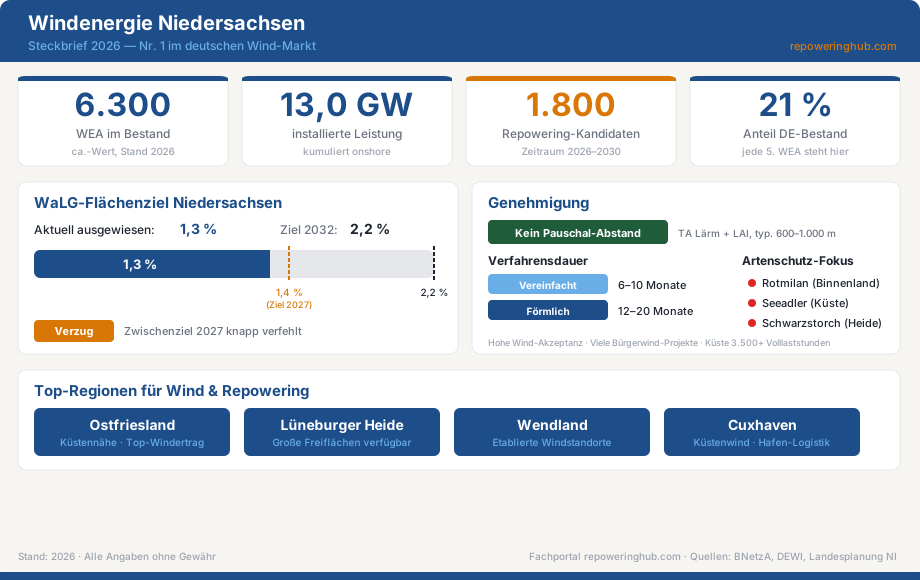
Wind energy in Lower Saxony – market data, WaLG status and permitting framework
1,800 candidates, one site — which is yours?
In Germany's largest repowering market, site and turbine choice determine yield. We connect you with a planning office that has Lower Saxony-specific permitting experience — regional-association status, coastal vs. inland turbine choice, authority contacts.
Send an enquiryWhat makes repowering here special
- High wind acceptance in the wind-tradition regions (East Frisia, Wendland)
- Strong cooperative scene: many community wind projects, often with local participation
- Top coastal sites: 3,500+ full-load hours, but market-value risk from wind cannibalisation
- WaLG status critical: if the 1.4% target is not met by 2027, the exclusionary effect of the concentration zones lapses — which weakens the steering effect of regional planning
Early project planning pays off particularly here, because experienced municipalities and existing priority areas can accelerate repowering.