Wind Repowering in Schleswig-Holstein
Schleswig-Holstein has the densest concentration of wind power in Germany — and, thanks to its coastal sites, the highest full-load hours. With a relatively permissive 400 m minimum-setback rule, the state offers economically attractive repowering conditions.
Germany's wind heartland
On a comparatively small area, Schleswig-Holstein carries around 3,200 turbines with a combined 7.9 GW. Measured against its land area, this is the highest wind density in the country. The reason is its location between the North Sea and the Baltic Sea: across large parts of the state, the mean wind speed at 150 m is 8.5 to 9.5 m/s, and even higher on the west coast. This resource sets SH apart fundamentally from the low-wind regions of the low mountain ranges — here, repowering is less about squeezing out the last kilowatt-hour than about the economically optimal use of an already strong site.
| Turbine fleet | approx. 3,200 turbines |
| Installed capacity | 7.9 GW |
| Repowering candidates 2026–2030 | approx. 1,000 |
| Mean wind speed at the coast | 8.5–9.5 m/s at 150 m |
| Typical full-load hours | 3,500–4,200 h/yr |
Early build-out wave, large legacy fleet
Schleswig-Holstein was one of the core states of Germany's wind build-out in the 1990s. This early wave left a correspondingly old turbine fleet: a high share of the stock dates from a time when 500 kW to 1.5 MW turbines were state of the art. Around 1,000 of these turbines are repowering candidates by 2030. Because at many of these early sites several small legacy turbines stand close together, the ratio of old to new turbines in repowering is often particularly favourable here — a few modern turbines replace many small ones. The basic logic of this replacement is described in our introduction to repowering.
Grid congestion and curtailment management
The price for so much wind on so little land is the grid situation. Schleswig-Holstein at times generates significantly more electricity than the grids can transport southward. The consequence is feed-in/curtailment management: turbines are curtailed during grid congestion, the foregone energy is compensated but physically lost. For the economics of a repowering project, the grid connection point and the expected curtailment are therefore as hard a factor as the wind itself. Anyone running a yield estimate should factor in the grid situation of the specific site rather than looking at full-load hours alone.
Site quality: the highest full-load hours
On the west coast and in Nordfriesland, full-load hours above 4,000 h/yr are achievable — values that hardly any inland site reaches. This shifts turbine choice clearly towards high-capacity high-wind turbines with high specific area power density; low-wind turbines with very large rotors pay off here less often than in the low mountain ranges. At the same time, the market-value risk is real: when a lot of wind feeds in simultaneously, the achievable electricity price falls.
Permitting: 400 m and the LLUR route
- Minimum setback: 400 m from residential buildings + TA Lärm (technical noise-control directive) protection
- Authority: Landesamt für Landwirtschaft, Umwelt und ländliche Räume (LLUR, State Office for Agriculture, Environment and Rural Areas)
- WaLG target: 2.0% by 2032; current status: approx. 1.9% — almost reached
- Community-wind status: voluntary, with a legal definition + tax advantages
The 400 m setback is the smallest among the German states and a clear locational advantage. SH has also nearly reached its WaLG land target at around 1.9% — the land backdrop is thus largely secured, which creates planning certainty. The actual permitting procedure runs via the BImSchG (German Federal Immission Control Act) at the LLUR and usually takes 7–12 months; longer where protected areas are nearby. Litigation risk is historically low because public acceptance is high.
Wadden Sea and species protection
The most important restricting factor is the coastal environment. The white-tailed eagle (Seeadler) forms the species-protection focus with wide-ranging exclusion and assessment zones; near the Wadden Sea, resting birds add to this. The FFH sites along the coast make coastal locations considerably harder and demand robust avifaunistic expert reports, often supplemented by anti-collision systems.
Regionally active players
- BioConsult SH (Husum) — avifauna, anti-collision systems
- Deutsche WindGuard (Kiel branch) — expert reports + yield
- EWE Erneuerbare Energien — service + marketing
- NORD/LB — financing
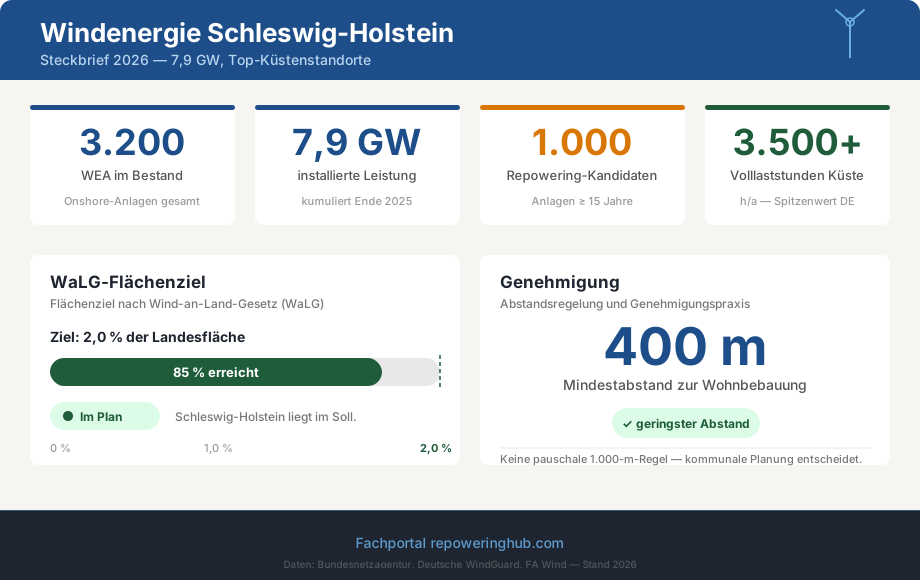
Wind power in Schleswig-Holstein – market data, WaLG status and permitting framework
Strong wind, tight grid — does your site pay off?
On the SH coast, turbine type and grid situation decide the yield. We connect you with planning firms that have SH permitting practice — high-wind turbine choice, curtailment assessment, community-wind participation, LLUR application.
Send an enquiryThe repowering calculus on the coast
- Top sites: west coast, Nordfriesland — full-load hours above 4,000 possible
- Wadden Sea protection: FFH status makes coastal sites considerably harder
- Cooperative tradition: many community-wind projects since the 1990s
- High specific power: high-wind turbines pay off here more than low-wind models
- Grid as bottleneck: curtailment reduces the effective yield despite top wind
Early project planning pays off in SH above all where grid connection and species protection are clarified early — both are the real bottlenecks here, not the wind.