Wind Energy in North Rhine-Westphalia
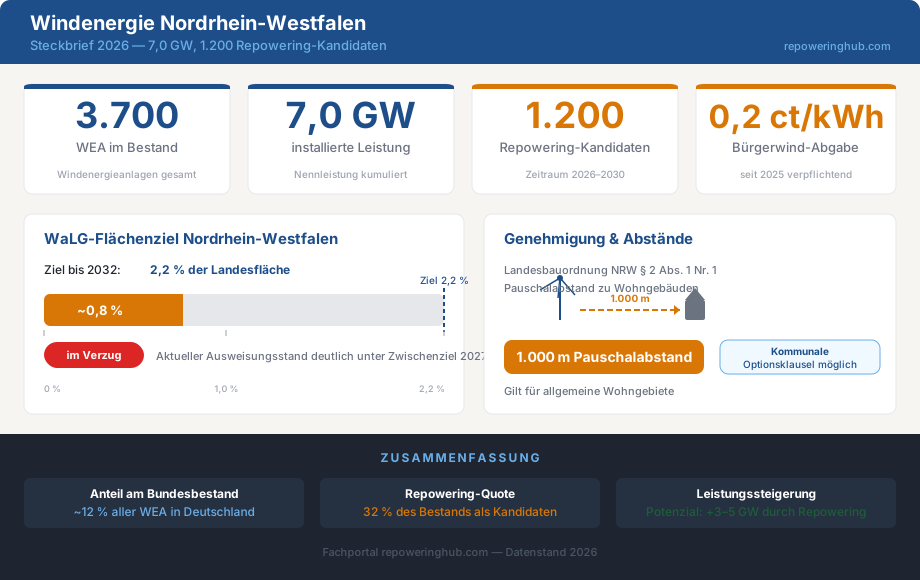
NRW is the most populous federal state and the one with the most electricity consumers — an ideal symbiosis for PPA models. At the same time, the 1,000 m setback rule is restrictive and the WaLG (Wind-on-Land Act) target is behind schedule. A community-wind levy has been in place since 2025 as an acceptance instrument.
Wind in a densely populated industrial region
NRW is a special case: not a wind-rich or land-rich coastal state, but the most populous and most densely settled federal state — and at the same time the largest electricity consumer. Around 3,700 turbines with 7.0 GW stand here above all in the low-mountain and fertile-plain locations: the Sauerland, the Eifel, the Münsterland and Eastern Westphalia. For repowering, settlement density has a twofold effect. On the one hand, it reduces the scope of available land and sharpens the setback and immission questions. On the other, the electricity offtakers sit right on the doorstep, which makes NRW one of the most interesting markets for PPA models with industrial customers. The basics of turbine replacement are described in our overview of repowering.
| Turbine stock | approx. 3,700 turbines |
| Installed capacity | 7.0 GW |
| Repowering candidates 2026–2030 | approx. 1,200 |
| Top regions | Sauerland, Eifel, Münsterland, Eastern Westphalia |
The 1,000 m debate and its consequences
The defining locational factor in NRW is the blanket setback rule of 1,000 m from pure and general residential areas. In a state with such a dense settlement structure, a rigid kilometre radius mathematically cuts large parts of the land out of use — considerably more than in sparsely populated states. Precisely for this reason, the rule contains an opt-out: municipalities may fall below the setback if they wish to do so in their planning. For repowering this is decisive, because existing sites frequently lie closer to buildings than the 1,000 m rule would allow for new areas. Whether a specific site is viable depends in the end less on the blanket figure than on the real noise and shadow-flicker values; a yield view of the site and a robust immission forecast decide.
Repowering in wind priority zones
Because new land is scarce in NRW, the focus shifts strongly towards repowering within existing wind priority zones. These already hold developed sites with grid connection, rights of way and a planning basis — a more realistic path than designating new areas against the resistance of densely settled neighbourhoods. This gives turbine replacement within existing zones a structural priority and makes early project planning with an eye on the existing stock particularly valuable.
Former coal regions as new wind land
An NRW-specific theme is the structural change in the Rhenish mining district and in the former mining regions of the Ruhr area. On the fringes of open-cast mines, on spoil heaps and on conversion sites, land arises that is difficult for conventional use but can be attractive for wind energy — pre-impacted, often without sensitive residential neighbours and in part with existing grid infrastructure from the coal past. This land category is not classic repowering, but it supplements the existing-stock market with a segment that other federal states do not have in this form.
Five district governments, five speeds
- Minimum setback: 1,000 m to pure/general residential areas (opt-out possible for municipalities)
- Authority: Bezirksregierungen (regional district governments) (5: Düsseldorf, Cologne, Münster, Detmold, Arnsberg)
- WaLG (Wind Energy Areas Act) target: 1.8 % by 2032; current status: approx. 0.9 % — behind schedule
- Community-wind levy: since 2025, 0.2 ct/kWh paid to the host municipality
Unlike in states with a single central authority, in NRW five district governments (Bezirksregierungen) run the BImSchG (German Federal Immission Control Act) procedures — with noticeably different practices. Münster and Detmold are considered relatively quick (8–12 months); Cologne and Arnsberg are much slower due to black stork conflicts (15–24 months). The choice of site thus indirectly decides the pace of the procedure. Litigation risk is high: BUND and NABU pursue numerous proceedings.
WaLG delay: risk for concentration zones
At around 0.9 % of designated land, NRW is far below the WaLG target of 1.8 % by 2032 and thus clearly behind schedule. This is more than a political figure: if a state misses the statutory interim targets, the exclusionary effect of the concentration zones lapses — the steering effect of planning via designated priority areas can then fall away. The exact mechanics are set out in the WaLG.
Species protection in the low mountains and the Münsterland
The species-protection focus is regionally split: red kite (Rotmilan) in the Sauerland, black stork (Schwarzstorch) in the Münsterland and in the forest-rich locations. The black stork in particular drives the processing times in the southern district governments. Robust avifaunistic expert reports are the critical path here, not the turbine technology.
Players and the community-wind levy
- LANUV (Recklinghausen) — state nature conservation technical authority
- Wölfel Gruppe (Höchberg) — acoustics + structural stability
- SL Naturenergie (Düsseldorf) — project development
- encity (Coesfeld) — community-wind structuring
Wind energy in NRW – market data, WaLG status and permitting framework
Tight land, five authorities — where does your site stand?
In NRW, the setback question, the responsible district government and species protection decide feasibility. We connect you with planning firms that have NRW district-government experience — site and authority assignment, opt-out review, LANUV species-protection clarification.
Submit an enquiryWhat makes NRW distinctive for repowering
- WaLG behind schedule: if the interim targets are missed, the exclusionary effect of the concentration zones lapses
- PPA potential: dense industrial landscape, PPAs with industrial offtakers right on the doorstep
- 5 district governments: site choice considerably influences the pace of the procedure
- Community-wind levy: 0.2 ct/kWh × annual yield — a calculable LCOE surcharge
- Conversion sites: former coal and open-cast-mine fringe land as a supplementary segment