Wind Repowering in Hesse
Among Germany's larger territorial states, Hesse is a special case: a large share of its wind energy stands in the forest. Where northern Germany plays out across open farmland, many Hessian projects run along the wooded ridges of the Vogelsberg, the Knüll Hills and the Rhön. This forest-site character shapes almost everything: the ownership structure, the species-protection effort and the statics of the foundations. Anyone who repowers or builds anew here plans differently than on the northern German plain.
Forest Wind: Hesse's Structural Peculiarity
A considerable share of Hesse's wind sites lies in state and municipal forest. As a state-owned enterprise, HessenForst is therefore a central lessor and party to the procedure — site control often runs through forest leases rather than through private landowners. In practice this means: clearance areas, forest-conversion permits under the Hessian Forest Act and reforestation compensation are fixed building blocks of the procedure. Forest sites also call for higher hubs — low-wind turbines with large rotors are meant to offset the friction losses of forest roughness. The EEG southern bonus (+0.30 ct/kWh) noticeably improves the economics of these sites and is a key reason why Hessian low-mountain locations pay off despite weaker wind.
Red Kite Density: the Defining Conflict
Hesse is home to around 12% of all red kites (Rotmilan) in Germany and is thus regarded as a zone of responsibility for the species. In permitting practice the red kite is therefore the dominant species-protection touchstone — ahead of the black stork, which becomes relevant mainly in the Knüll Hills. An avifauna survey with robust nest and space-use records is effectively mandatory. Where a significantly heightened collision risk cannot be ruled out, anti-collision systems with demand-based shutdown or habitat-steering measures come into play. The new rules in § 45b BNatSchG with standardised protective distances have harmonised the assessment, but do not replace early nest research. Anyone who clarifies the kite situation only late risks procedural delay or conditions that depress the yield.
Market Data for Hesse
| Turbine fleet | approx. 1,200 turbines |
| Installed capacity | 2.5 GW |
| Repowering candidates 2026–2030 | approx. 250 |
| Top regions | Vogelsberg, Knüll Hills, Rhön |
| Permitting authority | Regierungspräsidien (regional councils) Darmstadt, Gießen, Kassel |
| Minimum setback | no blanket state rule (based on TA Lärm) |
For a first yield and profitability estimate of a turbine replacement at a specific site, the repowering tools help before expert reports are commissioned.
2% Area Target and Regional Plans
The Wind Energy Areas Act (WaLG) obliges Hesse to designate roughly 2.2% of its land area for wind energy by 2032. At around 1.9%, Hesse is on track — a comfortable starting position compared with many other states. The actual steering happens through the regional plans of the North, Central and South Hesse planning regions, in which priority areas are set. For developers it is decisive whether a site lies within a designated priority area: that considerably simplifies its admissibility under building-planning law. The details of the planning system are covered in the Planning section.
Repowering Practice: Sequence Decides
With around 250 repowering candidates through to 2030, a disciplined approach pays off. What has proven effective: first clarify the red kite and black stork situation, then the forest-conversion and lease questions with HessenForst, and only then fix the turbine configuration. Repowering in the forest usually means larger rotors and higher hubs than the old fleet — this shifts the noise and shadow-flicker contour and makes new expert reports necessary. The formal steps of BImSchG (German Federal Immission Control Act) approval are summarised in the BImSchG procedure.
Noise, Shadow and Statics in the Low Mountains
Wooded upland locations impose their own requirements on the immission-control assessment. Noise propagation over wooded, undulating terrain differs from the flat plain, and because residential development in Hesse often lies in the valleys below the turbines, noise-immission and shadow-flicker forecasts must be prepared carefully. Higher hubs also shift visibility and thus the debate over the landscape scenery, which is a real permitting topic in the tourism-shaped Rhön and Vogelsberg regions. On the technical side, hillside sites demand robust subsoil and structural stability verifications, because the foundation and crane pads must be adapted to sloping terrain. Which verifications come together in detail is shown in the overview of the expert reports.
Permitting Duration: Three Regional Councils, One Pattern
Unlike North Rhine-Westphalia with its five district governments, Hesse shares BImSchG responsibility across three regional councils (Regierungspräsidien) — Darmstadt, Gießen and Kassel. The pattern is nonetheless similar: in regions with dense red kite and black stork populations, review takes longer, because the avifauna survey has to supply multi-year space-use data and follow-up requests from the authority are not uncommon. Experience shows that Hessian BImSchG procedures for forest sites with a species-protection conflict tend to sit at the upper end of the usual processing times, while unencumbered sites stay within the statutory standard deadlines. For project planning this means: anyone who only starts red kite mapping after filing the application typically loses a full vegetation period compared with a project that brings the mapping forward. In repowering this time loss weighs particularly heavily, because the old turbine generally has to keep running until the replacement turbine is permitted, and every delay pushes back the economically sensible point of exchange.
Regionally Active Engineering Firms
- ABO Wind AG (Wiesbaden) — largest regional developer
- HessenForst (Kassel) — for forest sites
- HLNUG (Wiesbaden) — nature-conservation authority
- BIO-CONSULT Hessen — avifauna specialist
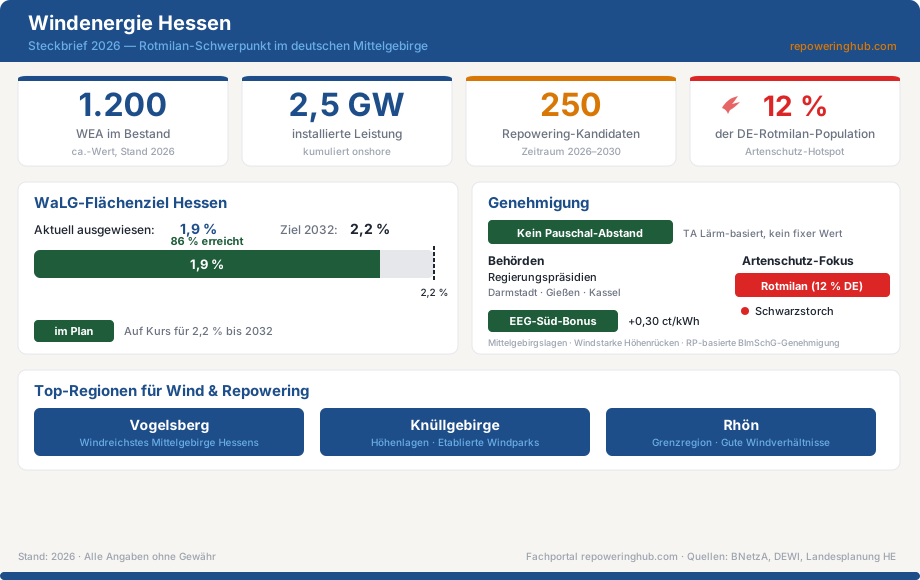
Wind energy in Hesse – market data, red kite focus and permitting framework
Repowering in Hesse with a red kite situation?
We connect you with specialised avifauna firms and planning offices experienced in Hesse. Early nest clarification protects you from procedural failure.
Send an enquiry