AI Yield Optimization for Wind Turbines
The yield increases of +12–17 % cited in the literature come from wind-tunnel experiments and simulations under ideal conditions (aligned turbine rows, stably stratified atmosphere, close spacing). They do not describe the annual AEP gain of a real-world wind park. The actual annual additional yield at park level is significantly lower (typically the low single-digit percentage range). As of 2026, a widely published, independently verified field-study value for the annual AEP gain is not yet available.
Introduction: AI in wind energy – potential and limits
Artificial intelligence promises to operate wind parks more efficiently. The core idea: instead of controlling each turbine in isolation for maximum individual yield, an AI system optimizes the overall yield at park level. That sounds like a paradigm shift – yet a considerable gap separates a research result from a bankable annual yield.
Wake losses can cost up to 30 % of the theoretical energy harvest in closely spaced parks (source: turbit.com). AI wake steering attempts to recover part of these losses. How much of that actually reaches the annual AEP depends on numerous factors: park geometry, wind-direction distribution, atmospheric stability and turbine type.
Wake steering explained
Wake steering means deliberately turning upstream turbines slightly out of the wind (yaw misalignment). This deflects the wake away from downstream turbines. The downstream turbines receive less disturbed wind and can harvest more energy – even though the upstream turbine itself loses a little yield.
Classic analytical wake models (Jensen, Bastankhah-Porté-Agel) simplify the flow heavily. Newer approaches use large-eddy simulations (LES) and CFD calculations that are searched by AI algorithms (reinforcement learning, Bayesian optimization) to find better yaw configurations than analytical models alone can deliver (source: arXiv 2407.20832).
Research findings at a glance
The following table summarizes key study results. The decisive columns: “Condition” and “Classification”.
| Study / source | Method | Gain | Condition | Classification |
|---|---|---|---|---|
| ScienceDirect (2024) | Upstream yaw (wind tunnel) | +12 % | Single turbine/row, controlled conditions | Best case – not transferable to park level |
| ScienceDirect (2024) | Cooperative yaw control | +17.5 % | 5 aligned turbines, specific spacing configuration | Absolute value – achieved only under narrowly defined parameters |
| arXiv (2024) | Operational wake steering (LES/RL) | up to +13 % | Certain wind directions/speeds, not year-round | Possible situationally, not a permanent state |
| Annual AEP (whole park): no widely published, independently verified value available (as of 2026). | ||||
Classification: what reaches the annual AEP?
The figures cited above describe snapshots under optimal conditions. In real operation, these conditions occur only during a fraction of the annual hours:
- Wake steering works primarily for wind directions that run exactly along the turbine rows.
- At high wind speeds (rated-power range) there are barely any wake losses – and therefore barely any optimization potential.
- In an unstable atmosphere (convective mixing) wakes dissipate more quickly.
- Yaw misalignment increases mechanical loads – turbine manufacturers therefore often limit the permissible angle.
Consequence: by current assessment, the annual net additional yield at park level lies in the low single-digit percentage range. Whether 1 %, 3 % or 5 % – that depends heavily on the specific park. We deliberately refrain from a single “AI delivers X % more” claim, because a robust, independently verified field study for this is still pending as of 2026.
AI layout optimization in new planning
Besides operational optimization of existing parks, developers use AI algorithms for the layout planning of new wind parks. Iterative algorithms optimize turbine sites under constraints such as minimum distances, terrain, prevailing wind direction and noise restrictions (source: turbit.com). This is a different use case than wake steering in the existing fleet.
Predictive maintenance: securing availability
A second AI application field is predictive maintenance. SCADA data (temperature, vibration, power) is monitored for anomalies by ML models to detect impending failures early. This does not reduce wake losses but increases technical availability – a different lever on annual yield.
Outlook and open questions
- Field data is missing: for a robust annual AEP statement, the industry needs multi-year, independently audited operating data from real parks with and without wake steering.
- Manufacturer approval: not all turbine manufacturers permit yaw-offset strategies, since increased loads can affect service life.
- Bankability: financing partners have so far rarely accepted AI additional yields as a P50 premium in yield assessments.
- Regulation: there is as yet no established certification guideline for AI-supported yaw strategies (comparable to FGW TR6 for yield assessments).
Frequently asked questions
How much extra yield does AI wake steering really deliver?
Laboratory studies show up to +12–17 % under ideal conditions (aligned turbine rows, steady wind). The actual annual AEP gain of a real-world park is significantly lower, typically in the low single-digit percentage range. As of 2026, a robust field-study value has not yet been widely published.
What is wake steering?
Wake steering means deliberately turning upstream turbines slightly out of the wind (yaw misalignment) in order to deflect their wake away from downstream turbines. The downstream turbines thereby receive less disturbed wind and can harvest more energy.
Does AI replace a classic yield assessment under FGW TR6?
No. AI-supported optimization is an operational tool applied to existing wind-park layouts. The bankable yield assessment under FGW TR6 (German technical guideline for energy yield) remains mandatory for financing and permitting.
What data does an AI system need for yield optimization?
Typically: high-resolution SCADA data (power, wind speed, wind direction, yaw angle per turbine), meteorological met-mast or LiDAR data, a terrain model, and turbine layout with power curves.
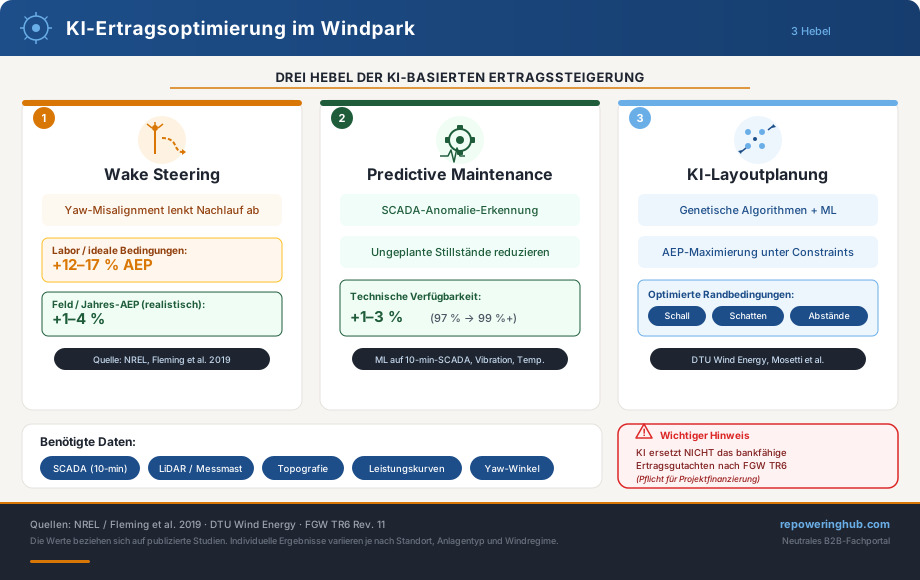
AI yield optimization – wake steering, predictive maintenance and layout planning
Want to evaluate AI yield optimization for your wind park?
We connect you with specialized service providers for wake analysis, operational optimization and predictive maintenance.
Request a consultation