Wind Farm Layout Optimization
What is layout optimization?
Wind farm layout optimization refers to the systematic determination of the optimal turbine positions within a wind farm area. The goal is the maximization of annual energy production (AEP) while simultaneously minimizing wake losses and complying with all permitting requirements (noise, shadow flicker, distances). Unlike manual placement, which is guided by property boundaries and rules of thumb, layout optimization uses algorithmic methods – genetic algorithms, gradient methods or particle swarms – to identify the highest-yield configuration out of thousands of possible ones.
In practice, layout optimization is today regarded as an integral part of wind farm project development. According to a study by the National Renewable Energy Laboratory (NREL), systematic optimization can increase the AEP by 2–8 % compared with a naive initial layout – for large projects with 50+ turbines even beyond that (NREL, Wind Plant Optimization, 2023).
Wake effects as the central problem
The physical basis of layout optimization is wake effects (downstream flows). Every wind turbine extracts kinetic energy from the incoming air and creates, behind the rotor, a zone of reduced wind speed and increased turbulence. Downstream turbines in this wake zone produce less electricity and experience higher structural loads.
Key factors influencing wake intensity:
- Spacing in the main wind direction – rule of thumb: at least 5–7 rotor diameters (D) between turbines. Below 5D the losses rise disproportionately (DTU Wind Energy, 2024).
- Lateral offset – as little as 3D of lateral spacing relative to the main wind direction considerably reduces wake influence.
- Turbulence intensity – higher ambient turbulence (e.g. at forest sites) accelerates wake recovery but increases mechanical loads.
- Wind direction distribution – sites with one dominant wind direction call for an elongated park arrangement perpendicular to it.
With an unfavourable arrangement, wake losses can account for up to 30 % of the gross yield (turbit.com, 2024). Conversely, this is where the greatest optimization potential lies.
Software tools for layout optimization
Several established tools are available for layout optimization, differing in methodology and field of application:
| Software | Developer | Strengths |
|---|---|---|
| WindPRO | EMD International | Integrated optimization module (OPTIMIZE), multi-constraint (AEP + noise + shadow), industry standard in Europe (EMD, 2024) |
| WAsP | DTU Wind Energy | Linearized flow model, worldwide standard for yield calculation, basis of many expert reports (DTU, 2024) |
| OpenWind | UL Solutions | Monte-Carlo-based optimization, cable routing and access planning integrated |
| FLORIS / FLOw | NREL (Open Source) | Python-based, wake-steering optimization, research-oriented, yaw optimization (NREL FLORIS, GitHub) |
| Windographer | UL Solutions | Wind data analysis and preparation, pre-processing for yield and layout studies |
In practice a combination is often used: Windographer for data preparation, WAsP or WindPRO for the yield calculation and a dedicated optimization module (e.g. WindPRO OPTIMIZE or FLORIS) for the iterative position improvement.
Optimization goals and side conditions
Layout optimization is not a pure AEP-maximum problem. In practice, several target variables must be considered simultaneously:
- AEP maximization – primary goal. Increasing net energy production after deducting all losses.
- Noise compliance – meeting the immission reference values under TA Lärm (technical instructions on noise abatement), e.g. 45 dB(A) at night in mixed-use areas. Positions close to settlements may require noise-reduced operating modes that lower the yield.
- Shadow flicker minimization – a maximum of 30 hours per year and 30 minutes per day on shadow-flicker-sensitive uses (BImSchG requirement). The layout directly influences which immission points are affected.
- Cable routing and access – shorter cable routes lower the investment costs. Access roads must be passable for heavy-load transports (tower segments, rotor blades).
- Turbulence limits – the effective turbulence intensity at each turbine must remain below the design value of the IEC class (IEC 61400-1) in order not to shorten the service life.
Modern optimization tools such as WindPRO OPTIMIZE work with multi-constraint algorithms that incorporate all side conditions simultaneously into the objective function (EMD International, 2024).
Layout optimization in repowering
Layout optimization has a particularly strong yield impact in repowering. When old turbines are replaced by new, more powerful ones, the layout changes fundamentally:
- Fewer turbines, larger rotors: modern turbines have rotor diameters of 150–170 m compared with 60–80 m for legacy turbines. The hub height rises from 65–85 m to 120–170 m. As a result, wake geometries and turbulence patterns change completely.
- New positions become possible: since 3–5 new turbines typically replace 10–15 old ones, the positions have to be recalculated from scratch. The old foundation positions are optimal for the new turbines in only the rarest cases.
- Operational data as an advantage: unlike greenfield projects, repowering benefits from 15–20 years of operational data. These allow a more accurate wind field calibration and reduce the uncertainty margins in the yield assessment (BWE, Repowering Guide, 2024).
The German Wind Energy Association (BWE) emphasizes that repowering projects, through an optimized new arrangement, frequently achieve a yield increase of two- to threefold compared with the existing turbines – whereby the pure layout share of this increase, alongside the better turbine technology, typically accounts for 5–10 % (BWE, 2024).
Sequence of a layout optimization
- Data basis: wind measurement data (LiDAR or met mast), terrain model, roughness classification, exclusion areas (nature conservation, settlement distances, infrastructure).
- Wind field modelling: creation of a site-specific wind resource model (WAsP, CFD).
- Initial layout: manual or rule-based first placement taking the exclusion areas into account.
- Algorithmic optimization: iterative shifting of the turbine positions via genetic algorithms or gradient methods while respecting all constraints.
- Result validation: checking the optimized layout against wake models (e.g. N.O. Jensen, Fuga, Bastankhah-Porté-Agel), noise and shadow flicker simulation.
- Documentation: incorporation into the yield assessment per FGW TR6, stating the P50/P75/P90 values for the optimized layout.
Frequently asked questions (FAQ)
How much additional yield does layout optimization deliver?
Studies by the NREL show that systematic layout optimization can increase the AEP by 2–8 % compared with a naive initial layout. For large wind farms with many turbines the effect tends to be stronger, because the wake interactions between the turbines become more complex and offer more optimization potential (NREL, Wind Plant Optimization, 2023).
Which software is used for layout optimization?
The industry standard is WindPRO (EMD International) with an integrated optimization module. Alongside it, WAsP (DTU), OpenWind (UL Solutions), Windographer (UL) and the open-source framework FLORIS (NREL) are used. The choice depends on terrain complexity, park size and the requirements placed on the optimization methodology.
Is layout optimization especially important in repowering?
Yes. In repowering, fewer but larger turbines with a greater rotor diameter are typically erected. The positions have to be recalculated entirely. Because the wake zones of larger rotors are longer and wider, optimization has a particularly strong yield impact. In addition, operational data from the legacy turbines is available, enabling higher model accuracy.
Does layout optimization also account for noise and shadow flicker?
Modern optimization tools work with multi-constraint algorithms that, alongside AEP maximization, also respect noise immission limits (TA Lärm), shadow flicker limits (max. 30 h/a or 30 min/d) and minimum distances to settlements as side conditions. The layout is only rated optimal once all constraints are met simultaneously.
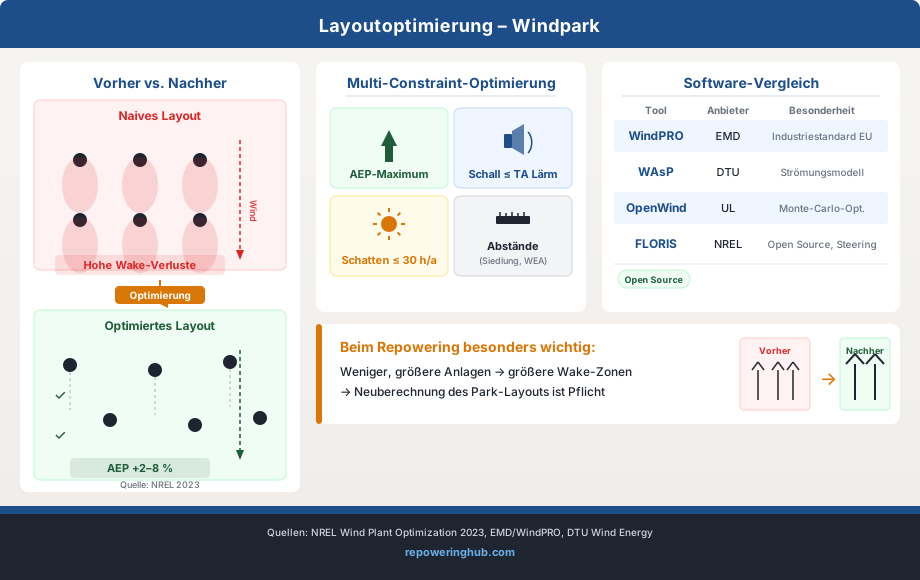
Layout optimization – before/after, constraints and software tools
Layout optimization for your wind farm project?
Are you planning a new wind farm or a repowering project and want to maximize yield through optimized turbine positions? We connect you with specialized planning offices experienced in wake modelling and multi-constraint optimization.
Submit a non-binding enquiry