Wind Yield Assessment to FGW TR6
What is a yield assessment?
A yield assessment forecasts the Annual Energy Production (AEP) of a wind turbine or wind farm over an operating life of typically 20–25 years. It is the central document of project financing: banks, investors and insurers base their decisions on the yield expectations and uncertainties quantified within it.
In Germany, Technical Guideline 6 (TR6) of the Fördergesellschaft Windenergie e. V. (FGW, Wind Energy Promotion Society) has established itself as the binding methodological standard. TR6 defines minimum requirements for wind measurement, modelling, uncertainty analysis and report format. As a rule, credit institutions accept only TR6-compliant assessments as a basis for financing (DNV, 2024).
Requirements of FGW TR6
TR6 structures the assessment into mandatory work steps:
- Site-specific wind measurement – At least 12 months, following the MEASNET procedure and IEC 61400-12 (TÜV Nord, 2024).
- Long-term correction – Comparison of the measurement campaign with supra-regional reference datasets (reanalysis, long-term measurement stations) over ≥ 10 years.
- Flow modelling – Transfer of the corrected wind field to each planned hub position.
- Power curve & losses – Manufacturer-guaranteed power curve, deductions for availability, ice accretion, sound reduction, grid outages.
- Uncertainty analysis – Quantification of all individual uncertainties and consolidation into P-values (P50, P75, P90).
- Report format – Traceable documentation of all input data, methods and results.
Wind measurement: LiDAR vs. met mast
Wind measurement is the foundation of every yield assessment. Two procedures are established:
- Met mast (anemometry) – The classic benchmark: cup anemometers at hub height. Advantage: high measurement accuracy. Disadvantage: cost factor and permitting requirement at large hub heights (> 100 m).
- Ground-based LiDAR – Remote sensing via laser pulse. Flexible to deploy, measures profiles up to > 200 m in height. Recognised in TR6 as an equivalent measurement procedure, provided it is MEASNET-validated (TÜV Nord, 2024).
The measurement campaign must cover at least one full calendar year in order to capture seasonal fluctuations. IEA recommendations and MEASNET protocols ensure data quality and instrument calibration.
Flow modelling: WAsP and CFD
The transfer of the measured wind field to the specific turbine positions is carried out using flow models:
- WAsP (Wind Atlas Analysis and Application Program) – Linearised model, the most widely used worldwide. Suitable for flat to moderately complex terrain (meteoserv, 2024).
- 3D CFD models (e. g. Meteodyn, WindSim, Ventos) – Numerical flow simulation. Required for highly structured terrain (low mountain ranges, forest sites), as it captures non-linear effects (separation, recirculation).
In practice a hybrid approach is often chosen: WAsP for the base modelling, supplemented by a CFD validation run at key positions.
Uncertainties and P-values
A yield assessment without uncertainty quantification is not bankable. FGW TR6 requires the results to be stated as exceedance probabilities:
| P-value | Meaning | Typical purpose |
|---|---|---|
| P50 | Median – value is reached or exceeded in 50 % of years | Expected value, equity return calculation |
| P75 | Value is reached or exceeded in 75 % of years | Mezzanine financing, conservative scenario |
| P90 | Value is reached or exceeded in 90 % of years | Senior debt (bank financing), DSCR calculation |
The difference between P50 and P90 reflects the total uncertainty budget. Typical sources: wind measurement (3–5 %), long-term correction (2–4 %), flow model (2–6 %), power curve (1–3 %), availability, grid connection (DNV, 2024).
Array efficiency and wake losses
Within the wind farm, upstream turbines shade those downstream (wake effect). Wake losses depend on:
- Spacing between the turbines (in rotor diameters)
- Prevailing wind direction relative to the farm geometry
- Turbulence intensity of the site
With an unfavourable layout, wake losses can amount to up to 30 % of the gross yield (turbit.com, 2024). An array efficiency below 80 % is regarded as very low and points to a suboptimal layout (wind-lexikon.de). In the yield assessment, wake losses are calculated using validated models (e. g. N.O. Jensen, Fuga, Eddy-Viscosity) and stated as a percentage deduction on the gross yield.
Who is permitted to prepare a yield assessment?
Bankable assessments require the independence of the assessor from the project developer. In practice, only assessments from recognised firms, often accredited to ISO 17025, are accepted. The established providers include:
- DNV
- TÜV Nord / TÜV Süd
- Deutsche WindGuard
- UL Solutions (formerly AWS Truepower)
- Ramboll
The FGW itself does not accredit assessors, but defines the methodological standard. Credit institutions maintain their own lists of approved assessors.
Frequently asked questions (FAQ)
What does an FGW TR6 yield assessment cost?
Costs vary depending on project scope and measurement campaign. A desk study (based on existing reanalysis data) starts at approx. 10,000 EUR. A complete assessment with a dedicated 12-month LiDAR campaign typically lies between 50,000 and 120,000 EUR (TÜV Nord).
What is the difference between P50 and P90?
P50 denotes the yield value that is exceeded in 50 % of all years (expected value). P90 is the more conservative value reached or exceeded in 90 % of all years. Banks use P90 (or P75) as the basis for debt financing, since it limits the default risk.
How long does it take to prepare a yield assessment?
The measurement campaign alone takes at least 12 months. Including planning, instrument installation, long-term correction and report preparation, the total duration is typically 18–24 months. For repowering projects the duration can be shortened if operating data from the existing turbine is available.
Does a yield assessment also apply to repowering?
Yes. For repowering, the assessment is adapted to the new turbine types and the changed layout. Advantage: operating data from the existing turbines can be drawn on as additional validation of the wind conditions, which can reduce the uncertainty margins.
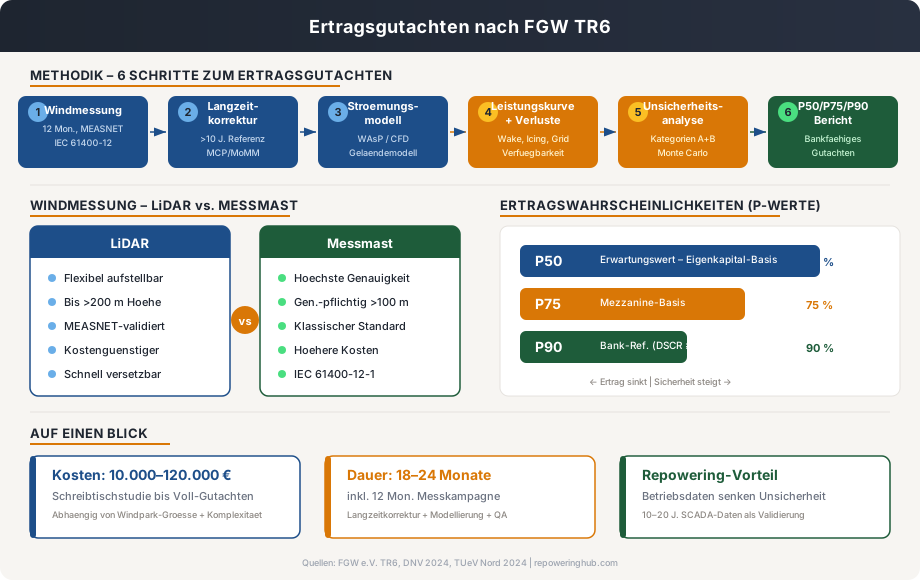
Yield assessment FGW TR6 — process, measurement procedures and P-values
Looking for a bankable yield assessment?
Do you need an FGW TR6-compliant yield assessment for your project financing? We connect you with independent, accredited assessor firms with many years of experience in onshore wind.
Make a no-obligation enquiry