Wake Losses in Wind Farms
What are wake losses?
Every wind turbine (WEA, Windenergieanlage) extracts kinetic energy from the flow and creates a wake plume (Nachlauffahne) behind the rotor with reduced wind speed and increased turbulence. Downstream turbines in the same wind farm therefore operate in a degraded wind field: they produce less electricity and are simultaneously exposed to higher mechanical loads.
The sum of these effects across all turbines in a farm gives the wake losses – the difference between the theoretical gross yield (each turbine in free flow) and the actual net farm yield. In the yield assessment to FGW TR6, wake losses are reported as a percentage deduction from the gross yield.
Physics of the wake
Behind the rotor, a region forms with three characteristic properties:
- Wind-speed deficit: Directly behind the rotor plane the wind speed drops by 40–60 % relative to the free flow. The deficit decreases downstream through turbulent mixing with the surrounding flow (Bastankhah & Porté-Agel, 2014).
- Turbulence intensity: The shear layers at the edge of the wake plume generate additional turbulence (so-called wake turbulence). This results from the superposition of ambient turbulence with wake-induced turbulence – quantified using the Frandsen model (Frandsen, DTU Risoe, 2007).
- Recovery length: The distance until the flow nearly returns to free-field levels is typically 10–20 rotor diameters (D). In large offshore wind farms with low ambient turbulence, recovery can take even longer (NREL, 2022).
Typical magnitude
Wake losses depend strongly on farm size, layout and site conditions:
- Onshore wind farms (5–30 turbines): typically 5–15 % of gross farm yield. With well-optimised layouts and sufficient spacing, losses are at the lower end (Barthelmie & Jensen, Wind Energy Science, 2022).
- Large offshore wind farms (50–200+ turbines): wake losses of 20–30 % are documented. Measurements at the Horns Rev offshore farm (80 Vestas V80) showed power losses of the last row of over 40 % for wind directions along the row axis (Barthelmie et al., DTU, 2009).
- Farm efficiency: As a metric, farm efficiency expresses the ratio of net to gross yield. Values below 80 % indicate a suboptimal layout.
Overview of wake models
To calculate wake losses in the yield assessment, several categories of model have become established:
Analytical models
- Jensen/PARK model (N.O. Jensen, DTU Risoe, 1983): The simplest and most widely used model. It assumes a linear expansion of the wake plume (top-hat profile). The standard model in WAsP and WindPRO. Fast, but conservative – it tends to overestimate wake losses (Jensen, DTU Risoe-M-2411, 1983).
- Bastankhah & Porté-Agel (2014): Assumes a Gaussian velocity profile in the wake (instead of top-hat). Physically more realistic and today implemented in many modern tools (FLORIS/NREL) (Bastankhah & Porté-Agel, 2014).
- Frandsen model: Focuses on wake-induced turbulence. Prescribed in IEC 61400-1 (Ed. 4) as the reference model for determining the effective turbulence intensity within the wind farm (Frandsen, 2007).
Dynamic models
- Dynamic Wake Meandering (DWM): Captures the natural meandering (lateral swaying) of the wake plume due to atmospheric turbulence. Delivers statistically more realistic results than static models, especially at large spacings. More computationally intensive, hence used primarily in research and for detailed site assessments (NREL, 2022).
CFD-based models
Large-eddy simulations (LES) represent the wake physics with the highest accuracy, but are not yet standard for commercial yield assessments due to the computational effort. They serve primarily for model validation and research.
Drivers of wake losses
Turbine spacing (in rotor diameters)
The most important parameter. The greater the spacing between the turbines, the more the wake plume can recover. The following table shows typical wake losses of a single downstream turbine as a function of spacing:
| Spacing (in D) | Wake loss (single turbine) | Typical application |
|---|---|---|
| 4D | 20–35 % | Tight offshore layout (minimum spacing) |
| 6D | 10–18 % | Standard onshore, medium-density farms |
| 8D | 5–10 % | Optimised onshore layout |
| 10D | 3–6 % | Single turbines / large spacings |
Source: Compilation based on Barthelmie et al. (DTU, 2009) and NREL (2022). Values apply to the main wind direction; with lateral offset the losses fall considerably.
Wind rose and farm geometry
In Germany, west to south-west winds prevail. A wind farm whose rows stand perpendicular to the main wind direction has significantly lower wake losses than a farm with rows aligned with the wind direction. The wind rose determines how often individual turbines stand in the wake of others.
Turbulence intensity
Higher ambient turbulence (e.g. at forest sites or in coastal lowlands) leads to faster mixing and therefore a shorter recovery length. Paradoxically, turbulent sites often have lower wake losses – but higher structural loads.
Farm size
In large farms, the wake effects accumulate across several rows (deep-array effect). The rear rows operate in a wind field that has already been weakened by several upstream turbines. Offshore farms with 100+ turbines are particularly affected (Barthelmie et al., DTU, 2009).
Strategies for mitigating wake losses
- Layout optimisation: Wake models can be used as early as the planning phase to iteratively optimise turbine positions. Modern tools (e.g. FLORIS/NREL) allow automated layout optimisation taking into account the site-specific wind rose.
- Wake steering (yaw misalignment): The nacelle of the upstream turbine is deliberately turned a few degrees out of the wind to deflect the wake plume laterally. Field trials at several wind farms showed yield gains of 1–4 % at farm level (Fleming et al., NREL, 2019).
- Curtailment / derating: Targeted power reduction of upstream turbines to leave more wind for downstream turbines. Worthwhile when total farm production increases as a result.
- Larger spacings: The simplest, but most land-intensive measure. In practice limited by available area, plot structure and permitting conditions.
- Heterogeneous rotor diameters: Using differently sized turbines at various positions within the farm can reduce wake interactions – an approach increasingly being trialled in repowering.
Wake losses in the yield assessment
In the bankable yield assessment to FGW TR6, wake losses are a separate item in the loss balance. The assessor typically calculates them with the Jensen/PARK model (industry standard) or a Gaussian-based approach. The uncertainty of the wake model feeds into the overall uncertainty and thus influences the spread between the P50 and P90 value.
For an initial estimate of the yield gain from more modern, larger turbines in repowering, use our repowering yield calculator.
Frequently asked questions (FAQ)
How large are typical wake losses in a wind farm?
Onshore, losses are around 5–15 % of gross farm yield. At large offshore wind farms, values of 20–30 % have been measured. The specific value depends strongly on layout, wind rose and turbine spacing (Barthelmie & Jensen, Wind Energy Science, 2022).
What is the difference between the Jensen model and DWM?
The Jensen model is a simple analytical model with linear wake expansion – fast to compute, but tends to be conservative. The Dynamic Wake Meandering (DWM) model captures the natural lateral swaying of the wake plume and delivers more realistic yield estimates, but is more computationally intensive (NREL, 2022).
Can wake losses be reduced through wake steering?
Yes. In wake steering, the nacelle of the upstream turbine is deliberately turned out of the wind (yaw misalignment) to deflect the wake plume past downstream turbines. Field trials show yield gains of 1–4 % at farm level (Fleming et al., NREL, 2019).
How does turbine spacing affect wake losses?
Spacing is the most important driver. At 4 rotor diameters (4D), the losses of the downstream turbine are typically 20–35 %. At 8D they drop to 5–10 %. As a planning rule, a minimum spacing of 5D in the main wind direction and 3D crosswind applies.
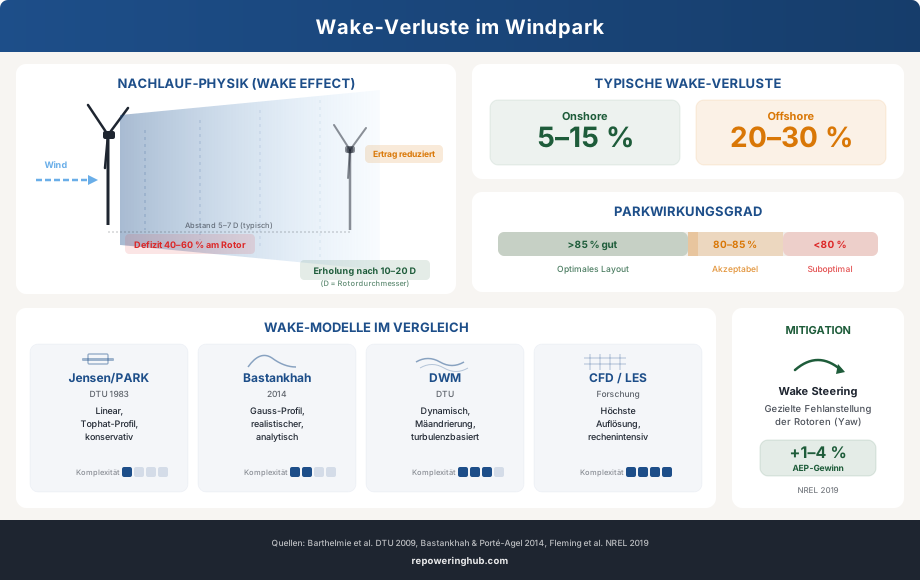
Wake losses in the wind farm – physics, models and mitigation strategies
Looking for a yield assessment with wake analysis?
Are you planning a wind farm or a repowering project and need a sound wake-loss calculation as part of a bankable yield assessment? We connect you with independent, accredited assessor firms.
Send a non-binding enquiry