Ice Risk Analysis for Wind Turbines
The ice risk analysis quantitatively assesses the risk posed by falling or thrown ice from wind turbine rotor blades. It is a central component of the BImSchG permit procedure and determines whether minimum setback distances are met or technical protective measures are required. In Germany it is governed by the Guideline for Wind Turbines of the Deutsches Institut für Bautechnik (DIBt, 2012) and the respective wind energy decrees of the federal states.
What Is an Ice Risk Analysis?
At temperatures around freezing point combined with high humidity, ice forms on the rotor blades — so-called ice accretion. If the rotor continues to turn, ice fragments can be thrown off (ice throw). When the rotor is at standstill, ice falls directly downward (ice fall). The ice risk analysis calculates:
- Icing frequency at the site (meteorological evaluation, typically 5–30 days/year in German upland areas; source: DWD climate data)
- Ice throw range using the ballistic model by Seifert et al. (2003): dependent on rotor diameter, rotational speed and blade height
- Ice fall zone at standstill: directly below the rotor, radius approximately equal to the blade length
- Impact probability on persons/infrastructure (individual risk, threshold typically 10−6/year per international risk acceptance criteria)
- Protective measures assessment: effectiveness of ice detection, automatic shutdown, barriers
Physical Fundamentals: Throw and Fall Distances
The key parameter is the maximum throw distance. Using the model by Seifert, Westerhellweg & Kröning (DEWI Magazine No. 23, 2003), ice fragments are modelled as ballistic projectiles. The throw distance depends on:
- Blade tip speed (typically 60–90 m/s for modern turbines)
- Ice mass and aerodynamic drag coefficient (cw value)
- Release height (hub height + blade position)
As a rule of thumb, the safety setback specified in the DIBt guideline applies: d = 1.5 × (D + H), where D is the rotor diameter and H is the hub height (DIBt Guideline for Wind Turbines, Section 9.4, 2012). For a modern 6 MW turbine with a 160 m rotor diameter and 120 m hub height this yields: 1.5 × (160 + 120) = 420 m.
For ice fall (rotor at standstill or idling), ice drops approximately vertically. The fall zone corresponds roughly to the rotor radius plus a wind drift allowance — typically 50–100 m around the tower base (Seifert et al., 2003).
Standards and Guidelines
| Regulation | Relevance |
|---|---|
| DIBt Guideline for Wind Turbines (2012) | Central German guideline; defines 1.5×(D+H) setback and requirements for ice detection |
| IEC 61400-1 (Ed. 4, 2019) | International standard for wind turbine design; climate classes including icing (Cold Climate) |
| Wind Energy Decree NRW (2018) | State-specific specification: ice throw report mandatory when the 1.5×(D+H) setback to traffic routes is not met |
| Wind Energy Decree Schleswig-Holstein (2021) | Ice detection and shutdown as permit condition when public paths lie within the throw zone |
| BayWEE Bavaria (2016) | 10H setback rule implicitly covers ice throw; ice detection required |
| GL Guideline for the Certification of Wind Turbines (2010) | International certification guideline with Cold Climate annex |
Minimum Setbacks by Federal State (Guidelines)
The following table shows typical requirements from the wind energy decrees and planning guidance of the federal states. The values are guidelines — a specific ice risk analysis may yield different setback distances.
| Federal State | Minimum setback to traffic routes/infrastructure | Source |
|---|---|---|
| North Rhine-Westphalia | 1.5 × (D+H) or ice detection + shutdown | WE Decree NRW 2018, No. 8.2.8 |
| Schleswig-Holstein | 1.5 × (D+H); reduction possible with ice detection | WE Planning Principles SH 2021 |
| Lower Saxony | 1.5 × (D+H) to roads; alternatively ice detection | WE Decree Nds. 2021, No. 4.7 |
| Brandenburg | 1.5 × (D+H); case-by-case review with technical ice detection | WE Decree BB 2023 |
| Bavaria | 10H setback rule (typically covers ice throw); ice detection mandatory | BayWEE 2016, No. 8.6 |
| Thuringia | 1.5 × (D+H) as rule of thumb; report required when paths lie within range | LEP Thuringia 2025 |
Protective Measures
Where the 1.5×(D+H) setback to traffic routes or buildings cannot be maintained, technical and organisational measures are required:
- Ice detection systems: Sensors on the rotor blades (e.g. Labkotec LID-3300, Wölfel IDD.Blade) or performance-based detection via SCADA data identify ice accretion within minutes (DIBt guideline, Section 9.4)
- Automatic shutdown: Upon detected ice accretion the turbine shuts down automatically and only resumes operation after confirmed de-icing — a mandatory permit condition in all current wind energy decrees
- Rotor blade heating systems: Active de-icing (e.g. Enercon systems, Vestas Anti-Icing) shortens downtime and reduces yield losses from icing by up to 2–5% (VGB PowerTech, Technical Report 463, 2020)
- Warning signs and barriers: Mandatory at all access points within the throw zone (BWE Ice Throw Guidance, 2019); typically warning signs with pictogram and distance information
- Path closure / diversion: For hiking or cycling paths within the throw zone, a temporary closure during icing weather conditions can be ordered
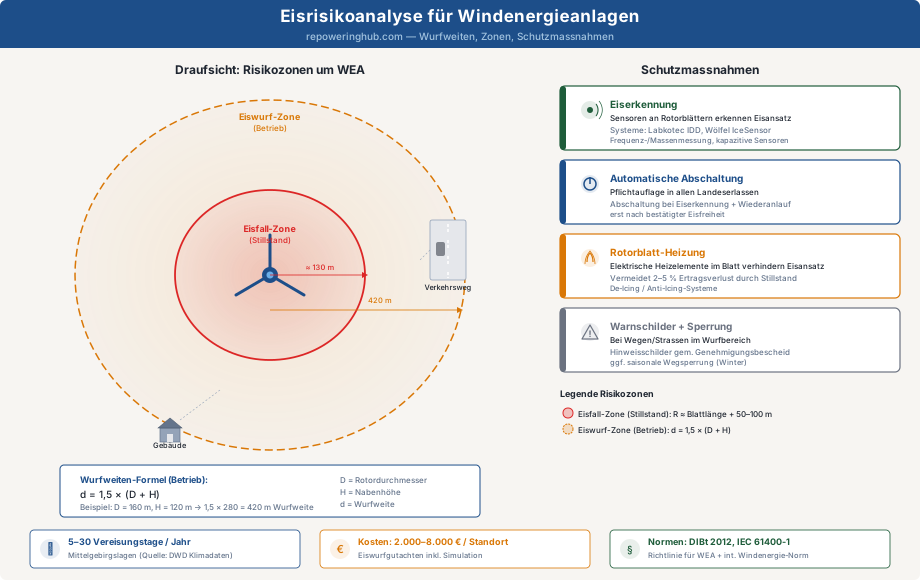
Ice risk analysis — throw distances, protection zones and protective measures
How Much Does an Ice Risk Analysis Cost?
Guideline: EUR 2,000–8,000 per site, depending on:
- Number of turbines (single turbine vs. wind farm with 5+ units)
- Topographic complexity (flat terrain vs. upland areas with cold air drainage)
- Scope of protective measures assessment (simple setback check vs. detailed risk calculation with Monte Carlo simulation)
- Supplementary measurements (on-site ice load measurement, icing climatology)
For repowering projects the effort often lies at the lower end of the range, as site climate data and operational experience from the old turbines are available. The costs represent a fraction of the total report costs for a BImSchG procedure (typically EUR 50,000–150,000 total costs per BWE cost estimate 2022).
Who Prepares the Ice Risk Analysis?
The analysis is typically prepared by specialised engineering firms with experience in wind turbine site assessments. Relevant qualifications: meteorologists, civil engineers or mechanical engineers specialising in wind energy. Established providers: Energiewerkstatt, Deutsche WindGuard, DEWI (UL Solutions), Wölfel Wind Systems, TÜV Süd/Nord.
Ice Risk Analysis for Your Site
We forward your enquiry to an experienced engineering firm for ice risk assessment — matched to turbine type, site and permit stage.
Request a QuoteFrequently Asked Questions
What is the difference between an ice risk analysis and an ice throw report?
The ice risk analysis is the quantitative risk assessment that calculates the probability and severity of ice fall and ice throw. The ice throw report is the formal document containing this analysis, submitted to the permitting authority. In practice, both terms are often used interchangeably.
Is an ice risk analysis mandatory for every wind turbine?
In regions with icing risk — i.e. large parts of Germany, particularly upland areas, northern German coastal regions and higher inland locations — it is regularly required by the permitting authorities. The DIBt guideline for wind turbines (2012) and the federal state wind energy decrees define when ice throw/ice fall evidence must be provided — typically when traffic routes or buildings lie within 1.5×(D+H).
How is the throw distance calculated?
The throw distance is calculated using the ballistic model by Seifert, Westerhellweg & Kröning (DEWI Magazine No. 23, 2003). As a conservative rule of thumb, the DIBt safety setback of 1.5 × (rotor diameter + hub height) applies. Detailed Monte Carlo simulations additionally account for ice fragment size, wind profile and rotor position.
How much does an ice risk analysis cost?
Guideline: EUR 2,000–8,000 per site. For simple flat-terrain sites with few turbines the cost tends towards the lower end; for complex upland sites with many receptor points towards the upper end.