Site Suitability Assessment per DIBt Guideline and IEC 61400-1
The site suitability assessment (German: Standorteignungsprüfung, also known as site assessment) demonstrates that the site-specific wind conditions and environmental parameters fall within the design limits of the selected turbine type class. Without this verification, no permitting authority will issue a BImSchG permit for wind turbines — neither for new construction nor for repowering (DIBt Guideline “Wind Turbines; Actions and Structural Stability Verification for Tower and Foundation”, Edition 2012, Section 7; updated edition 2024).
What Is a Site Suitability Assessment?
The site suitability assessment compares the actual wind conditions at the planned location with the design parameters of the turbine. The central question is: Can the turbine withstand the loads that occur at this specific site? The assessment is based on the international standard IEC 61400-1 Ed.4 (2019), respectively the German adoption DIN EN 61400-1, and is further specified by the DIBt Guideline for the German permitting context.
The assessment ensures that the type class of the turbine (e.g. IEC IIIA) covers the actual site conditions. If this is not the case, either a stronger type class must be selected or an extended structural stability verification (Class S per IEC 61400-1, Section 6.3) must be provided.
Assessment Parameters in Detail
The site suitability assessment covers the following parameters, each checked against the type class limits (IEC 61400-1, Table 1; DIBt Guideline, Section 7.3):
- Reference wind speed Vref — the 50-year extreme wind speed at hub height (10-minute mean). Determined from long-term correlation (Measure-Correlate-Predict) or extreme value statistics.
- Turbulence intensity Iref — ratio of standard deviation to mean wind speed at 15 m/s at hub height. High turbulence means higher fatigue loads (IEC 61400-1 Ed.4, Section 6.3).
- Wind shear (wind profile exponent) — describes the increase in wind speed with height. Strong shear creates uneven loads across the rotor area.
- Extreme wind speeds — 50-year and 1-year gusts (Ve50, Ve1) per IEC 61400-1, Section 6.3.2.
- Earthquakes — site acceleration per DIN EN 1998-1 (Eurocode 8) and DIBt Guideline, Section 7.4. Relevant in seismic zones 1–3 in Germany (Upper Rhine Graben, Lower Rhine, Swabian Alb).
- Temperature range — the turbine must be designed for the extreme temperatures occurring at the site (e.g. cold-climate variant for < −20 °C). IEC 61400-1, Section 6.4.
IEC Wind Classes Overview
IEC 61400-1 defines four wind classes. Vref is the reference wind speed (50-year extreme value, 10-min mean at hub height). Turbulence classes A, B, and C specify the reference turbulence intensity Iref (IEC 61400-1 Ed.4, Table 1):
| Wind class | Vref (m/s) | Iref Class A | Iref Class B | Iref Class C |
|---|---|---|---|---|
| IEC I (high wind) | 50 | 0.16 | 0.14 | 0.12 |
| IEC II (medium) | 42.5 | 0.16 | 0.14 | 0.12 |
| IEC III (low wind) | 37.5 | 0.16 | 0.14 | 0.12 |
| IEC S (special class) | Defined project-specifically by the manufacturer | |||
In Germany, inland sites of classes IEC II and III dominate. Coastal and elevated locations may require IEC I. Class S is used when standard classes do not cover the site conditions — for instance with extreme turbulence from forest edges or complex terrain (IEC 61400-1, Section 6.3).
When Is the Assessment Required?
- BImSchG permit application — mandatory component of the application documents for every wind turbine (DIBt Guideline 2012, Section 7.1).
- Repowering — when replacing with a different turbine type or changing hub height / rotor diameter, a new site suitability assessment is required.
- Site conditions outside the type class — when wind measurement data show that individual parameters exceed the type class limits.
- Type testing / certification — the site suitability assessment supplements the manufacturer’s type certificate with the site-specific verification.
Procedure of the Site Suitability Assessment
- Wind measurement or remote sensing: At least 12 months of measurement data at hub height (mast anemometry or LiDAR). The DIBt Guideline requires a long-term correlation with reference data (≥ 10 years).
- Statistical analysis: Extreme value analysis (Gumbel/Weibull) for Ve50, turbulence evaluation per IEC 61400-1 Annex B, wind profile determination.
- Comparison with type class: Each site parameter is compared against the limits of the turbine type class.
- Expert evaluation: If individual parameters are exceeded: extended structural stability verification (Class S) or recommendation of a stronger type class.
- Report: The expert report documents all input data, methods, results, and the suitability assessment.
What Does a Site Suitability Assessment Cost?
Guideline: EUR 5,000–20,000 per site/report. The range depends on complexity: simple flat-terrain sites with available wind data are at the lower end; complex terrain with special load cases (earthquakes, extreme turbulence) and required Class S evaluation at the upper end. For repowering projects with an existing measurement data history, costs are often lower. Not included are the costs for a potential wind measurement campaign (additional EUR 30,000–80,000 for 12 months of mast measurement; source: BWE Market Overview Wind Measurement, 2023).
Who Is Authorised to Carry Out the Assessment?
The site suitability assessment must be prepared by an expert recognised under the DIBt Guideline. In practice, these are accredited engineering firms and testing organisations with experience in wind site evaluation — such as Deutsche WindGuard, TÜV Süd/Nord, DNV, Windtest Grevenbroich, UL Solutions, or specialised regional firms.
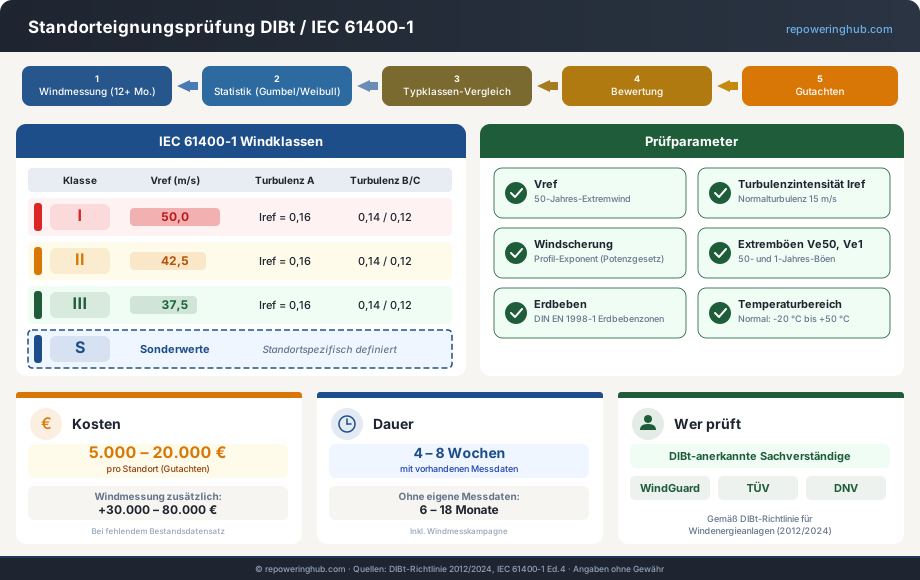
Site suitability assessment — IEC wind classes, assessment parameters, and procedure
Site Suitability Assessment for Your Project
We connect your enquiry with a recognised expert firm — matched to your site, turbine type, and permitting stage. Non-binding and free of charge.
Request a quoteFrequently Asked Questions
When is a site suitability assessment mandatory?
It is mandatory for every BImSchG application for new wind turbines, for repowering with changed hub height or rotor diameter, and when site conditions exceed the parameters of the turbine type class (DIBt Guideline 2012, Section 7).
What happens if site conditions exceed the type class?
The manufacturer must provide an extended structural stability verification (site assessment) demonstrating that the turbine is designed for the site-specific loads (IEC 61400-1 Ed.4, Section 11). Alternatively, a Class S turbine is engineered.
How long does a site suitability assessment take?
With available wind measurement data (at least 12 months), typically 4–8 weeks. Without own measurement data, the timeframe extends by the measurement campaign (6–18 months).
Who is authorised to carry out the assessment?
Experts recognised under the DIBt Guideline, typically accredited engineering firms or testing organisations such as TÜV, Deutsche WindGuard, or DNV.