Ground-Mounted Solar Market 2026 — Additions, EEG Volume, Trends
In short: Germany's PV market was at a high level in 2025 with +16.2 GW of additions (source: Fraunhofer ISE). Roughly half of the EEG (Renewable Energy Sources Act) target path (215 GW PV by 2030) is attributable to ground-mounted installations. For 2026 a target path of 22 GW PV additions per year is foreseen (source: PV Tech).
Key figures 2025
| Metric | Value | Source |
|---|---|---|
| Installed PV capacity end of 2025 | 116.8 GW DC | Fraunhofer ISE |
| Net additions 2025 | 16.2 GW DC (≈ 14.3 GW AC) | Fraunhofer ISE |
| Auction volume ground-mounted solar | 9,900 MW (across 3 rounds) | BNetzA |
| Awarded bids, 01.07.2025 round | 258 bids / 2,271 MW | BNetzA |
| Bid prices, 01.07.2025 round | 4.00–6.26 ct/kWh | BNetzA |
| December 2025 round | heavily oversubscribed | Solarserver |
| Target additions from 2026 | 22 GW PV/year | PV Tech |
| EEG target 2030 (total PV) | 215 GW, 50 % each rooftop/ground-mounted | solarbranche.de |
Auction trend: volume and clearing prices
The EEG auction for ground-mounted solar is the central pulse of this market segment. Across the three 2025 rounds, a combined 9,900 MW went to tender (source: BNetzA). In the 01.07.2025 round, 258 bids totalling 2,271 MW were awarded, at bid prices between 4.00 and 6.26 ct/kWh. According to Solarserver, the December 2025 round was "heavily oversubscribed" — when submitted bid volume exceeds the tendered amount, clearing prices tend to fall, because developers undercut each other on the cent-per-kWh figure to win a slot. For market-watching in 2026, the key question is whether this oversubscription trend continues: if it does, clearing prices keep falling, squeezing the calculation margin for developers carrying high grid-connection or land-lease costs. BNetzA publishes the exact clearing prices per round in its auction results, and an ongoing assessment is also available under Auctions.
Regulation 2024–2026: Solarpaket I and the EEG amendment
Solarpaket I (Solar Package I, in force since 16.05.2024) shifted the legal framework for ground-mounted solar on several fronts. Central to this is the extension of privileged status under § 35(1) no. 8 of the German Building Code (BauGB) to a 200-metre corridor along motorways and railways — details under Permitting. This rule has structurally changed how many developers search for sites: land within the corridor doesn't need the municipality's standard development-plan process, which shortens planning timelines. For the EEG amendment from 2026 onward, it's worth watching how auction volumes and ceiling prices evolve — the binding figures are set by the Federal Network Agency (BNetzA) in its annual auction calendars. Anyone who needs planning certainty for a specific project should check the currently valid version of the EEG and the BNetzA announcements rather than relying on press assessments — this applies especially to the thresholds for mandatory tendering and to ceiling prices.
Agri-PV as a growth driver
Part of the expected growth in additions is attributable to Agri-PV — the dual use of land for farming and power generation. Agri-PV installations receive separate remuneration under the EEG (a distinct installation category with its own ceiling price in the auction) and are politically intended as a way to ease the land-use conflict between agriculture and energy production. Assessment: as classic ground-mounted sites become scarcer and more expensive (see below), Agri-PV's share of total additions is likely to rise structurally in the coming years — but robust share figures for 2026 will only be available once BNetzA publishes its market master data for the current year. Anyone planning this installation type should clarify the separate technical requirements (minimum light transmission, ground clearance depending on the Agri-PV category) with the farming operation and the grid operator early on.
Price pressure on modules and bifacial technology
Module prices are a major cost driver in the calculation of ground-mounted projects. Bifacial modules — which also capture light on their rear side — have become the standard for ground-mounted installations in recent years, because the additional yield over monofacial modules generally more than offsets the small extra cost. Assessment: if price pressure from Asian module production persists, bifacial technology is likely to keep establishing itself as the default design, while the pure module price loses weight as a cost factor relative to grid connection, land lease and permitting costs. For reliable, current module prices, market reports from BSW-Solar or trade media such as pv magazine are the appropriate source — blanket ct/Wp figures go stale within a few months and should be checked against current data in every calculation.
Grid connection as the limiting factor
Grid connection has become the practical bottleneck for new ground-mounted projects in many regions. Distribution grid operators in densely developed areas report capacity constraints that delay or raise the cost of connection commitments (transformer station, cable route, possibly grid reinforcement). For developers this means: the availability of an economically viable grid connection point is now often the limiting factor in project selection — no longer just land availability or permitting feasibility. Requesting a grid connection from the responsible distribution grid operator early, in parallel with securing the site, is now standard practice to reduce the risk of a project failing for lack of grid capacity.
Institutional investors and the PPA market
Alongside the classic EEG auction, the PPA market (Power Purchase Agreement, see PPA) is gaining importance, particularly for large parks above 50 MWp. Institutional investors — infrastructure funds, insurers, pension funds — are looking for long-term, predictable cash flows from operating assets, and are increasingly active in financing new PPA-based projects too, because these aren't subject to the volume cap of the EEG auction. Assessment: as auction oversubscription rises and EEG clearing prices fall accordingly, the PPA route tends to become more attractive for large, creditworthy developers, because it scales independently of BNetzA's auction volume. For smaller projects below the mandatory-tender threshold, the fixed EEG remuneration remains the standard route.
Land scarcity and competition for sites
As the volume of additions grows, competition for suitable land is intensifying in many regions — between ground-mounted solar, wind energy, farming and nature conservation. Municipalities with limited land reserves are increasingly selective about which use they permit through local development planning. This land scarcity is a major reason why the 200-metre privileged corridor along motorways/railways and Agri-PV concepts, both mentioned above, are gaining importance: both open up additional land categories without competing directly for plain arable land. Developers relying on classic ground-mounted sites without privileged status need correspondingly more lead time for municipal development planning and should coordinate the permitting process with the host municipality early on.
Regional focus areas
The distribution of ground-mounted solar additions across German states primarily follows land availability and regional grid-expansion capacity. States with large amounts of farmland and comparatively low lease costs have traditionally been over-represented in ground-mounted solar. Precise, current state-level shares of ground-mounted additions can only be reliably obtained from BNetzA's market master data register, which continuously reports installed capacity by state — blanket rankings without this source should be treated with caution, because the focus of new additions can shift from year to year due to grid bottlenecks and land availability.
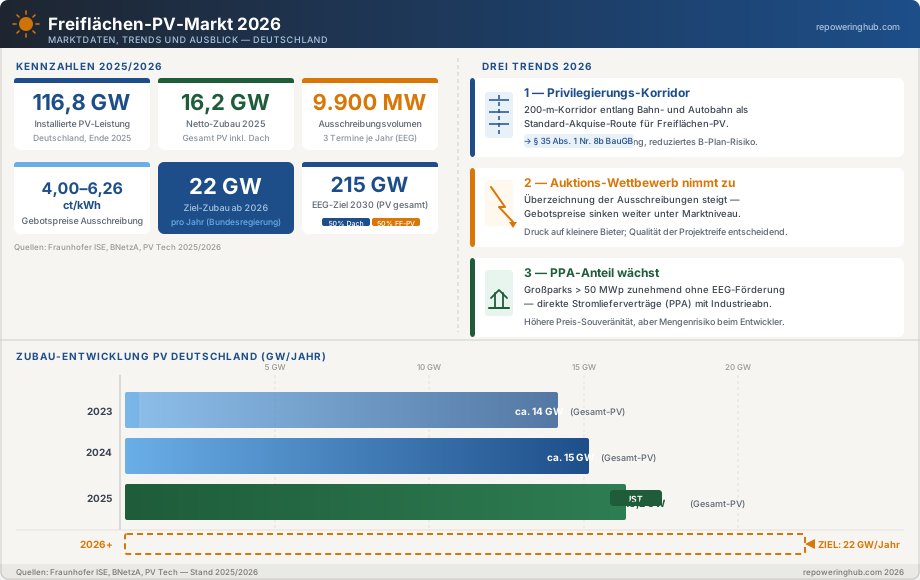
Ground-mounted solar market 2026 — key figures, trends and the trajectory of additions
Frequently asked questions
How large is the ground-mounted share of total PV additions?
Policy targets a 50/50 split between rooftop and ground-mounted in the EEG goal. In practice the ground-mounted share varies from year to year — the exact quota is transparent via the German Federal Network Agency (BNetzA) market master data.
Is it still worth entering the market?
For developers with a site pipeline and experience: yes. For newcomers without a pipeline the barrier in 2026 is considerably higher than just a few years ago — the margin in the auction has narrowed.
Where can official statistics be found?
German Federal Network Agency (BNetzA) (market master data register, auction results), Fraunhofer ISE (annual reports "Recent Facts about Photovoltaics in Germany"), BSW-Solar (industry statistics).