How is a wind farm financed?
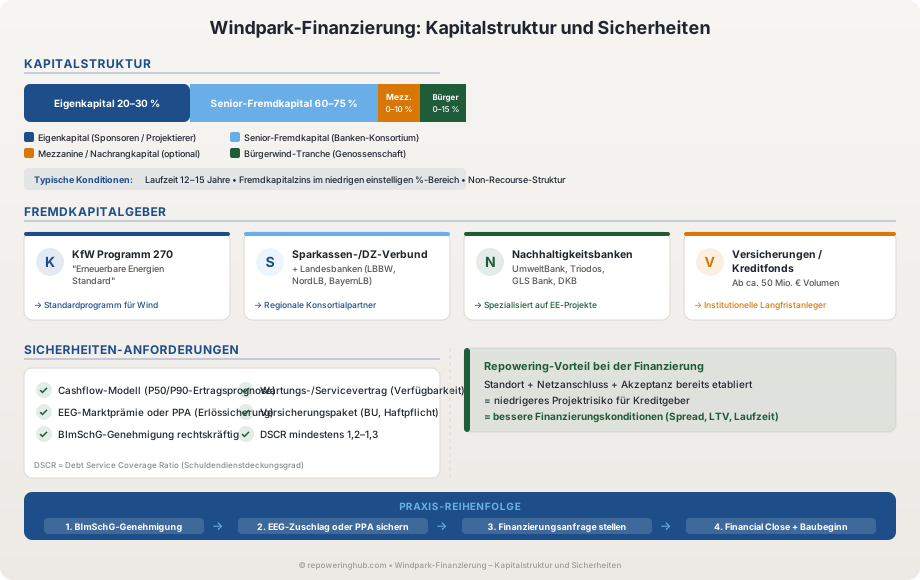
In short: Conventionally through project finance — roughly 20–30% equity, 70–80% debt from the banking market, terms usually 12–15 years, repayment from electricity revenues. The plant itself (not the developer) bears most of the liability — which is why the financing stands or falls with a robust cash-flow model.
The typical capital structure
| Block | Share |
|---|---|
| Equity (project company / sponsors) | 20–30% |
| Senior debt (bank syndicate) | 60–75% |
| Mezzanine / subordinated (optional) | 0–10% |
| Community-wind (Bürgerwind) tranche (cooperative / savings bond) | 0–15% |
Equity comes from the developer, from municipal utilities/energy suppliers or infrastructure funds. A community-wind (Bürgerwind) tranche strengthens local acceptance (see community participation) and can replace equity or debt.
Who provides financing in Germany
- KfW — programme 270 "Erneuerbare Energien Standard" (Renewable Energies Standard) as refinancing for house banks, attractive interest rates.
- Sparkassen and DZ network and Landesbanken (regional state banks) — the largest volumes overall.
- Sustainability-focused banks — UmweltBank, Triodos, GLS, EthikBank, DKB.
- Insurers / credit funds — on larger tickets as direct investors or via Schuldscheine (promissory note loans).
For larger volumes (from ~EUR 50 million) several banks form a syndicate, with one acting as lead arranger and representing the group.
Securities — what the bank requires
- Cash-flow model with conservative wind/electricity-price assumptions (P50/P90 scenarios).
- EEG market premium or PPA as revenue protection — see market premium and PPA.
- BImSchG permit (Federal Immission Control Act permit) legally final.
- Maintenance/service contract with the manufacturer or an ISP (independent service provider).
- Insurance package (machinery breakdown, business interruption).
- DSCR (debt service coverage ratio) at least ~1.2–1.3 across all years.
Repowering has a financing advantage
With repowering, the site, grid connection and local acceptance are already established — this significantly lowers the project risk compared with a greenfield. Banks often reward this with better conditions. The expected additional yield can be roughly estimated with the repowering IRR calculator.
Why project finance works differently from a classic corporate loan
With classic corporate financing, the entire assets of the borrower are liable for repayment. With the non-recourse project finance customary for wind farms, liability is instead limited to the project company itself — usually a purpose-built GmbH & Co. KG holding exactly one turbine or one wind farm. The bank largely waives recourse to the parent company's or sponsors' other assets and instead relies on the plant's own future income as security. That is why banks place so much weight on a robust, conservatively calculated cash-flow model during credit review: it is effectively the only source of repayment.
How the interest-rate environment affects wind farm projects
Because debt makes up 60 to 75 percent of the capital structure and is serviced over 12 to 15 years, the general interest-rate level affects a project's economics disproportionately — more than for many other investments with shorter capital lock-in. A higher interest-rate level increases the annual debt service and thereby narrows the financial headroom the plant must generate to cover operating costs, reserves and equity returns. Developers respond to this, among other things, with longer rate fixings, interest-rate hedges (swaps), or an adjusted capital structure with a higher equity share when debt is currently expensive.
What role the EEG remuneration model plays for financeability
The market premium secured under EEG 2024 provides a plannable minimum revenue floor over the support period, which banks reward in their risk assessment — plannable income lowers default risk and typically improves financing conditions compared with a pure merchant model without any revenue protection. If a long-term power purchase agreement (PPA) with an industrial offtaker is signed instead or in addition, banks assess its creditworthiness and contract term as a separate risk factor — a PPA with a creditworthy, long-term-committed offtaker can have a similarly stabilising effect as EEG support.
Frequently asked questions
How long does project finance run?
Typically 12–15 years, often with a cash sweep after the EEG remuneration expires. The plant's technical service life significantly exceeds this term.
What does the debt cost?
Variable — market rate + risk premium (margin), with project finance usually in the low single-digit percentage range plus arrangement fees. Exact conditions depend on the market environment and creditworthiness.
Can I use community wind and a bank at the same time?
Yes, that is in fact common. The community-wind (Bürgerwind) tranche enters as subordinated equity — the bank accepts it as "quasi-equity", which improves the leverage effect.
What happens on refinancing after the EEG support period ends?
Once the 20-year EEG support period expires, the project must earn most of its revenue on the open electricity market going forward, for example via a PPA or direct sale. Because the original loan is generally largely repaid by that point, ongoing debt service drops significantly, which often continues to support the economics despite the loss of support. Some operators also use this point to decide anew between repowering or continued operation and take out a new, usually much smaller financing package for it.
What role does the creditworthiness of the project company itself play?
In non-recourse project finance, the individual project company's own creditworthiness takes a back seat, because it is usually newly formed and has no credit history of its own. What matters instead is the creditworthiness and experience of the developer or sponsor as the contracting party for construction, operation and maintenance, plus the quality of the underlying contracts — banks mainly assess the reputation and capability of the parties involved here.
Wind farm financing – capital structure, lenders and security requirements