Do Wind Turbines Lower Property Value?
In short: The honest answer is "it depends". In the immediate vicinity (up to ~1 km) of newly built installations, studies find a measurable but moderate price decline — a widely cited RWI study (Leibniz Institute for Economic Research) puts it at around −7 % on average for single-family homes. With distance the effect disappears, and it is frequently temporary. Blanket "my house is worthless" claims are not supported by the data.
What the body of research says
| Finding | Magnitude |
|---|---|
| Single-family home, ~1 km, new installation (RWI) | on average approx. −7 % |
| Distance > 1–1.5 km | statistically mostly no effect |
| Multi-family buildings / apartments | little to no measurable effect |
| After the construction phase / over time | effect partly weakens |
Important: these are statistical averages across many sales. In the individual case, the price depends on location, fittings, market phase and the visibility of the installation — not on the wind turbine alone.
Why the effect is often smaller than feared
- Expectation vs. reality: Concern about noise/shadow is often greater before construction than the actual impairment afterwards. Noise and shadow flicker are capped by law.
- Distance works: Minimum-distance rules (10H in Bavaria, 1,000 m in many states) mean most residential buildings lie outside the sensitive near zone — see distance to residential buildings.
- Habituation: After a few years, perception normalises, which shows up in the price data.
What is methodologically behind the RWI finding
The often-cited figure of roughly minus 7 % is based on a hedonic price regression: the sale prices of single-family homes are related to characteristics such as location, year built, living area, and, precisely, distance to the nearest wind turbine. The effect is a statistical average across a very large number of transactions — it says nothing about whether a specific house actually loses that amount. In individual cases the effect can be larger, smaller, or not present at all, depending on how visible, how loud and how accepted the installation is locally.
Important for context: such studies usually compare sales before and after a new installation is built in a region previously unaffected. Sites where wind turbines have already stood for decades barely appear in such before-and-after comparisons — there, the market has long since adjusted to the situation, and a separate "wind turbine discount" can practically no longer be isolated in prices.
What else influences the effect
| Factor | Effect on the price impact |
|---|---|
| Direct sightline from the property | amplifies the effect |
| Concealed location (forest, hill, buildings in between) | significantly weakens the effect |
| Wind farm already existing in the region | smaller or barely measurable additional effect on repowering |
| Tight regional housing market | effect takes a back seat to general demand |
The other side: financial participation
For landowners within the site area, a wind farm can even raise the value — via lease income. And municipalities benefit through the § 6 EEG levy (EEG 2024 municipal participation payment) and trade tax (see community participation). Anyone affected should check whether a participation or lease model is an option for their own land.
Frequently asked questions
Can I claim compensation?
There is no general legal entitlement to compensation for loss of value in Germany. However, voluntary balancing and participation models offered by the operator are possible. For specific legal questions, advice from a lawyer is required — we do not provide legal advice.
Does visibility play a role?
Yes. Studies suggest that the direct visibility of the installation from the property amplifies the effect, while concealed locations are barely affected.
Do prices recover?
Partly, yes. Several studies find that the initial effect fades after the construction phase and with increasing habituation — but a full recovery is not guaranteed.
Why do study results sometimes differ substantially?
Because the studies use different regions, time periods, building types and statistical methods. A study looking only at rural single-family-home areas in states with strong wind power arrives at different figures than one that includes urban fringe areas. Anyone quoting individual percentage figures from the press without knowing the underlying methodology and sample often transfers a value that is not actually representative of their own specific situation.
Does the effect differ for repowering compared with a first-time build?
Yes, significantly. With repowering, a new turbine replaces an existing one at a site that residents and the local property market have long since perceived as a "wind power site". The surprise and habituation effect typical of a first build largely does not apply, because the fundamental decision — turbines stand here — was already made years earlier and priced into the market. This fundamentally distinguishes repowering sites from the situation most value-loss studies examine.
What can owners actively do if a wind farm is planned?
It helps to start with a factual assessment: how far away is the planned site actually, is the installation visible from your own property, and does your land fall within a zone for which the literature even documents an effect. In parallel, it is worth checking whether your own land shares — for example under access roads, cable routes or setback areas — qualify for a share of lease income. For specific legal or financial questions, this guide does not replace individual advice from a lawyer, tax advisor or expert.
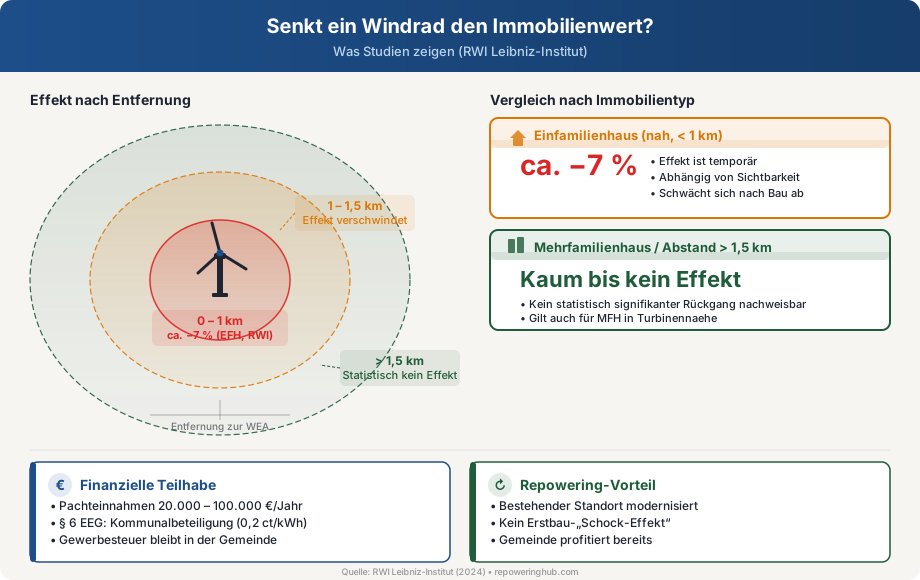
Property value and wind turbines – distance effect per RWI, building types and financial participation