Economics of a Repowering Project
When does repowering make economic sense? Here is a concrete DCF calculation for a typical Northern Germany site, plus sensitivity analysis and stress tests for the critical parameters.
Example Project
| Parameter | Old configuration | New configuration |
|---|---|---|
| Number of turbines | 8 × 1.5 MW | 3 × 6.0 MW |
| Total capacity | 12.0 MW | 18.0 MW |
| Full-load hours | 1,900 h/a | 3,000 h/a |
| Annual yield | 22.8 GWh/a | 54.0 GWh/a |
| Specific investment | — | 1,350 EUR/kW |
| Total investment | — | 24.3M EUR |
| Revenue model | PPA / spot | EEG 7.2 ct/kWh |
| Annual revenue | 1.3M EUR | 3.9M EUR |
| OPEX | 0.9M EUR/a | 1.1M EUR/a |
| Cash flow (pre-tax) | 0.4M EUR/a | 2.8M EUR/a |
What the Investment Consists Of (CAPEX)
The specific investment of around 1,350 EUR/kW in the example is an industry benchmark; real-world onshore repowering usually falls in the 1,000–1,500 EUR/kW range. A rough breakdown of total cost:
| Cost block | Share (benchmark) |
|---|---|
| Wind turbine (tower, nacelle, rotor) | approx. 65–75% |
| Foundation + erection | approx. 8–12% |
| Grid connection + cabling | approx. 6–10% |
| Site development (roads, crane pads) | approx. 3–6% |
| Planning, expert reports, permitting | approx. 3–6% |
| Decommissioning of the old turbine (net) | approx. 2–5% |
The advantage of repowering: site access and the grid connection point often already exist in some form, which lowers ancillary costs compared with a greenfield project. Offsetting that, the old turbine's decommissioning cost is added into the budget — details on Decommissioning.
Ongoing Costs (OPEX)
Annual operating costs for modern turbines typically run in the order of 1.5–3 ct/kWh. The main line items:
- Maintenance and service: a full-service contract with the manufacturer, usually including an availability guarantee — the single largest item.
- Land lease: paid to the landowner, often revenue-linked.
- Technical and commercial operations management: monitoring, billing, communication with authorities.
- Insurance, direct marketing, reserves: machinery-breakdown and liability insurance, marketing fees, and the provision set aside for eventual decommissioning.
DCF Calculation (Simplified)
| Year | Cash flow | Discounted (WACC 5%) |
|---|---|---|
| 0 (investment) | −24.3M EUR | −24.3M EUR |
| 1–20 (cash flow) | +2.8M EUR/a | Σ 34.9M EUR |
| 20 (residual value + decommissioning bond) | +0.3M EUR | +0.1M EUR |
| Net Present Value (NPV) | — | +10.7M EUR |
| Internal Rate of Return (IRR) | — | 9.1% |
| LCOE | — | 65 EUR/MWh |
| Payback period | — | 10–11 years |
Sensitivity Analysis
How does the NPV react to changes in key parameters (±10%)?
| Parameter | −10% | Base | +10% |
|---|---|---|---|
| Full-load hours | +4.2M EUR NPV | +10.7M EUR | +17.2M EUR |
| Electricity price / EEG value | +5.3M EUR | +10.7M EUR | +16.1M EUR |
| Investment costs | +13.1M EUR | +10.7M EUR | +8.3M EUR |
| OPEX | +11.9M EUR | +10.7M EUR | +9.5M EUR |
| WACC (3% / 5% / 7%) | +18.4M EUR | +10.7M EUR | +4.8M EUR |
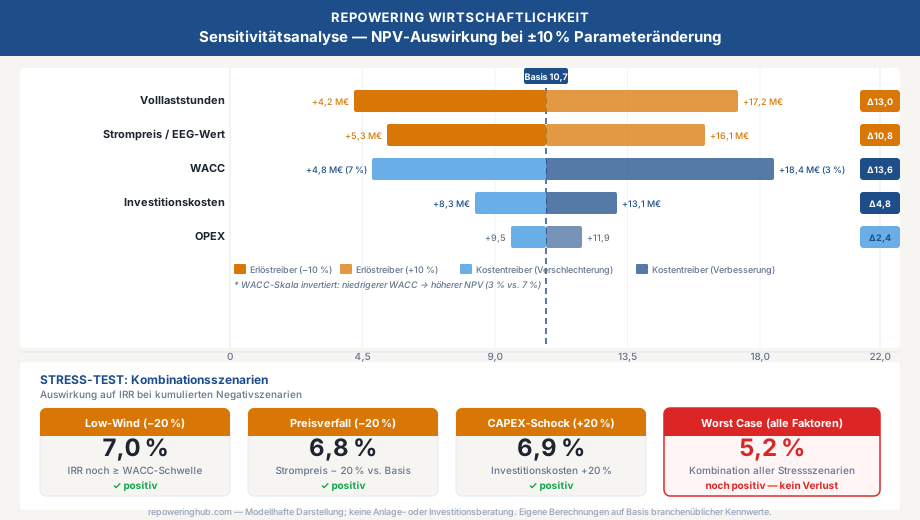
Sensitivity and stress test analysis — full-load hours and electricity price dominate returns
Stress Tests
How does the project react to extreme scenarios?
- Low-wind scenario (FLH −20%): NPV +5.0M EUR, IRR 7.0% — still profitable
- Market price drop (electricity price −20% after EEG expiry): NPV +4.8M EUR, IRR 6.8% — marginal
- CAPEX shock (+20%): NPV +5.1M EUR, IRR 6.9%
- Worst case (all three combined): NPV +1.3M EUR, IRR 5.2% — barely positive
Financing Structure
Typical repowering financing in 2026:
- Equity 20–30%: 5–7M EUR, return expectation 8–12%
- Debt 70–80%: 17–19M EUR bank loan, interest 4–5%, maturity 15 years
- Repayment structure: often interest-only in the first 5 years with bullet payment, then annuity
- Collateral: turbine security assignment + cash flow assignment
Why These Particular Site Figures Decide the Outcome
The four variables in the sensitivity table do not weigh equally on returns. Full-load hours and the electricity price (or applicable EEG value) together drive the revenue side, and both respond to factors an operator can barely influence — wind-year variability, market price development. Investment cost and OPEX, by contrast, are largely negotiable and therefore controllable during the procurement phase. For site selection this implies a clear priority: a robust, multi-year wind measurement campaign reduces yield risk more than any amount of negotiating on turbine price — a point that gets underestimated in early project phases precisely because CAPEX numbers feel more tangible than a probability distribution over future wind years.
When Repowering Clearly Pays Off — and When It Doesn't
The example calculation supports a rough rule of thumb, useful for a first read on a site but no substitute for a full analysis. Economics come out clearly positive when several factors line up at once: above-average wind resource, an existing turbine fleet with materially lower rated capacity than what is available today (a large repowering multiplier), grid connection capacity that already exists and can be expanded, and a site without a foreseeable height restriction. It gets marginal when these factors are missing — a small repowering multiplier (modern old turbines already at high rated capacity), tight grid capacity that would require an expensive upgrade, or an uncertain permitting outlook due to proximity to a protected area. In these borderline cases, the specific Bundesnetzagentur auction round often ends up deciding actual profitability.
Community Wind Participation — Effect on IRR
Where community wind participation is mandatory (MV, BB, NRW): typically 20% equity share to residents/municipality at preferential terms. Effect:
- Equity return slightly reduced (community equity is serviced at a fixed return)
- IRR decreases by approx. 0.5–1 percentage point
- Acceptance improves measurably (lower litigation risk)
- Bank financing often facilitated
Detailed economic analysis for your project?
We connect you with an energy auditor specializing in wind — full DCF model with sensitivity analysis, stress tests, and bankability assessment.
Request consultationFrequently Asked Questions
What IRR is attractive for institutional investors?
Currently in 2026: 7–10% after tax. Below 7% is increasingly difficult to finance, above 10% at premium sites or with higher risk tolerance. Pension funds target 6–8%, private equity 10–15%.
How do delivery time risks affect returns?
Delayed commissioning costs electricity revenue plus a penalty of 10 EUR/kW for exceeding the EEG deadline. A 6-month delay can reduce the IRR by 0.5–1.5 percentage points.
What happens after 20 years?
EEG funding ends, electricity is marketed at spot price or via new PPA. The base case includes 8–10 years of post-EEG operation at approx. 50 EUR/MWh. Optimistic long-term due to rising electricity prices — pessimistic due to renewable oversupply.
Can I get an indication using the repowering yield calculator?
Yes — the Repowering Yield Calculator provides the annual yield difference and additional revenue. For the full DCF calculation, you also need the LCOE Calculator and a sensitivity table like the one above.