Repowering vs. Continued Operation
After 20 years, EEG funding ends. The question: continue operating (often technically possible for another 5–8 years), or repower (new turbines, new 20-year funding period)? The decision depends on a few clear criteria.
The Decision Matrix
| Criterion | Continued operation attractive | Repowering attractive |
|---|---|---|
| Turbine condition | Good, low wear | Worn, frequent downtimes |
| Site quality | Acceptable for existing turbines | Significantly better for modern turbines |
| Remaining lease term | Expires with turbine | Extendable with landowners |
| Setback distances for new turbines | — | Achievable with larger turbine |
| Local acceptance | Conflict level | Better acceptance with fewer, modern turbines |
| Electricity marketing post-EEG | PPA possible | EEG market premium for 20 years |
| Investment readiness | Low — maintenance only | Full new investment affordable |
Option A — Continued Operation
After EEG expiry, the turbine continues running technically. Marketing options:
- Direct marketing: on the spot market at the respective hourly price
- PPA: direct contract with an industrial customer, typically 5–7 year term
- Self-supply: electricity delivery to on-site consumers (industry, commercial)
2026 reality: Electricity market prices fluctuate significantly, averaging 40–80 EUR/MWh. Onshore wind turbines reach their profitability threshold at approximately 30–45 EUR/MWh with current OPEX levels — meaning continued operation remains profitable.
Continued Operation Risks
- Rising maintenance costs: after 20+ years, more frequent wear-part replacements, higher component failure rates, more difficult spare-part sourcing (especially control electronics)
- Longer downtimes: manufacturer support typically ends after 20 years, repairs must often be organized independently
- Insurance: machinery breakdown insurance becomes more expensive after 20 years, with higher deductibles
- Permit conditions: BImSchG (Federal Immission Control Act) conditions such as BNK (aircraft warning light) retrofit apply to existing turbines as well
- Site commitment: ongoing lease must be extended, often with higher demands from landowners
Option B — Repowering
- Full new investment: typically 1,000–1,500 EUR/kW
- Complete new BImSchG procedure with all expert reports
- EEG auction: 20-year market premium at the awarded price
- Significantly higher yield: typically 2–3× annual output
- Procedural simplifications: WaLG (Onshore Wind Act, 2022) simplified 1:1 repowering
Economic Comparison
Wind farm with 8 × 1.5 MW (in operation since 2002, EEG expired 2022):
| Continued operation (5 yr) | Repowering 3 × 6 MW | |
|---|---|---|
| Investment | 0.5M EUR (major overhaul, BNK) | 25M EUR |
| Annual yield | 22 GWh/a | 54 GWh/a |
| Electricity price | 50 EUR/MWh (PPA) | 72 EUR/MWh (EEG) |
| Annual revenue | 1.1M EUR | 3.9M EUR |
| OPEX | 0.8M EUR/a | 0.9M EUR/a |
| Cash flow (pre-tax) | 0.3M EUR/a × 5 yr | 3.0M EUR/a × 20 yr |
| Total return | 1.5M EUR | 60M EUR (pre-discount) |
Simplified calculation without discounting or taxes. The exact economic analysis uses a DCF model — see Economics.
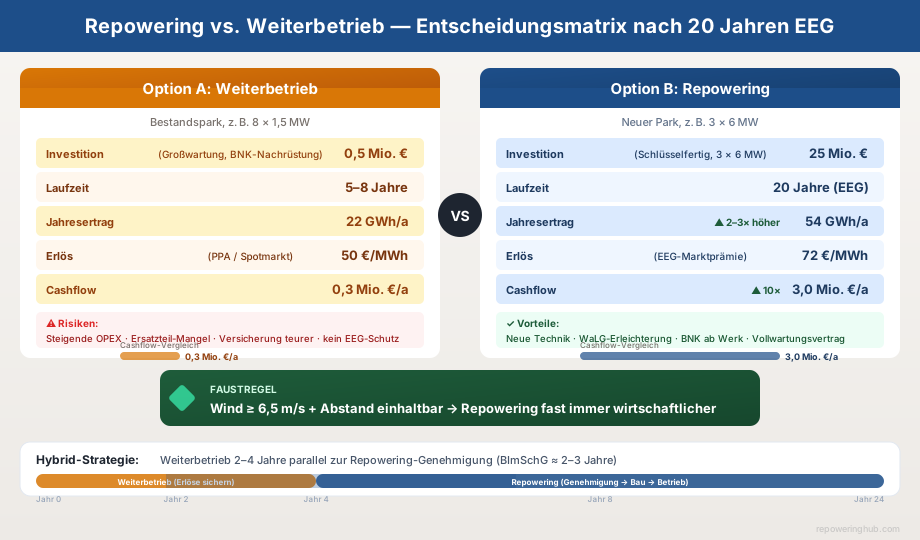
Decision matrix repowering vs. continued operation — cash flow comparison and hybrid strategy
Continued-Operation Assessment — the Technical Prerequisite
Running a turbine beyond its originally certified design life (usually 20 years) is not automatically permitted. It requires a continued-operation assessment that demonstrates structural safety for the extended period. The basis is the BWE guideline on continued operation, supplemented by DIBt (German Institute for Building Technology) requirements. Two components are involved:
- Analytical part: recalculation of the remaining service life based on the actually measured site wind conditions and real operating loads — often more favorable than originally assumed, because the site turned out weaker than the design wind class.
- Practical part: on-site inspection of tower, foundation, rotor blades, drivetrain, and electrical components by a certified expert.
The assessment sets an approved continued-operation period, typically in steps of a few years with renewed inspection required afterward. If the assessment comes back negative or expensive refurbishment becomes necessary, the balance clearly shifts toward repowering.
Legal Framework After EEG Expiry
When the 20-year remuneration period ends, the statutory payment claim expires — the operating permit does not. The BImSchG permit remains valid. For marketing, the turbine falls under direct marketing: electricity is sold on the market through a service provider, without the market premium. Conditions from the original permit — such as a required upgrade to demand-controlled aircraft warning lighting (BNK) — continue to apply regardless of funding status, and burden older turbines with fixed costs spread over only a few remaining operating years.
Anyone who repowers instead goes through a complete new BImSchG procedure and enters the EEG auction — with another 20 years of market premium at the awarded price.
Hybrid Strategy
In many projects the best approach: continue operating for 2–4 years, while pursuing the repowering permit in parallel. Once the BImSchG permit is secured and the auction award obtained: decommission the old turbines, build new ones. This avoids any gap without electricity revenue.
Decision analysis for your wind farm?
We connect you with an energy auditor specializing in wind — full analysis of repowering vs. continued operation, including sensitivity analysis and stress tests.
Request analysisFrequently Asked Questions
How long can a turbine operate beyond EEG funding technically?
Manufacturer warranty covers 20 years; technically realistic is 25–30 years with good maintenance. For older turbines from the 1990s, 25 years is standard, after which maintenance costs rise progressively.
Can we simply keep the repowering site?
Yes, provided you own the land or the lease is extendable. With multiple landowners, negotiations are often necessary because modern turbines require larger foundations and crane pad areas.
What happens to the turbine residual value during repowering?
Recycling revenue minus demolition costs is usually marginal — typically 0–50,000 EUR net per turbine. For rotor blades and generators, additional payments may even be required.
Can we do repowering without EEG funding?
Yes — via PPA with an industrial off-taker or self-supply. Economically viable currently only at premium sites and with long-term PPAs (10+ years).
How often must the continued-operation assessment be repeated?
The assessment itself defines the period for which structural safety is confirmed — typically in steps of a few years with renewed inspection, rather than a one-time approval through to actual end of life. Every extension therefore requires a fresh assessment, and its cost must be factored into the continued-operation economics. For a turbine with only a few economically viable years left, this can tip the balance toward an earlier repowering decision rather than paying for new assessments year after year for an ever-shorter remaining operating period — a calculation that shifts increasingly in favor of repowering as the turbine ages. In practice, it is therefore worth reassessing regularly rather than making a one-time decision shortly after EEG expiry: site quality, turbine condition, and the current state of the Federal Network Agency's auction rounds can change noticeably within just a few years.