Repowering Funding Under the EEG 2024
Under the EEG 2024 (Erneuerbare-Energien-Gesetz, Renewable Energy Sources Act), repowering turbines are treated identically to new-build turbines — they must successfully participate in a Bundesnetzagentur (BNetzA) auction to receive the 20-year market premium. A previously discussed repowering bonus no longer exists (abolished in 2017).
How Does the Funding Work?
- BImSchG permit (Federal Immission Control Act) required for the new turbines
- Participation in a BNetzA auction (4 dates per year)
- Successful bid below the ceiling price (2026: 7.35 ct/kWh)
- Award = "anzulegender Wert" (reference value) guaranteed for 20 years from commissioning
- Commissioning within 30 months of the award (penalty for delay)
- Marketing via direct marketer + market premium from the transmission system operator (TSO)
The "Anzulegender Wert" (Reference Value)
The "anzulegender Wert" is the bidder-specific remuneration rate guaranteed for the next 20 years. Current awards in 2026 frequently settle near the ceiling price of 7.35 ct/kWh (indicating high competition).
The market premium equals the difference to the monthly market value:
Market premium = reference value − monthly market value for wind
Bonus System
| Bonus | Value | When applicable |
|---|---|---|
| South bonus (Sudbonus) | +0.30 ct/kWh | Turbines in BW, BY, HE, RP, SL |
| Low-wind correction | variable | Site quality factor < 70% of reference site |
| Community wind participation | not in EEG | State laws in MV, BB, NRW (from 2025) |
| Repowering bonus | no longer exists | Abolished in 2017 |
Low-Wind Correction
Turbines at low-wind sites receive a correction factor that increases the remuneration compared to the northern German standard. This makes southern sites with lower wind resources economically viable:
| Site quality factor | Correction factor |
|---|---|
| ≥ 100% (reference site) | 1.00 (standard) |
| 90% | 1.11 |
| 80% | 1.29 |
| 70% | 1.49 |
| 60% | 1.77 |
| 50% | 2.07 (floor) |
The site quality factor is reassessed after 5, 10, and 15 years — the actual yield achieved is compared with the reference site, and the remuneration rate is adjusted retrospectively.
The 30-Month Deadline After Award
- Maximum 30 months from award to commissioning
- Delay penalty: 10 EUR/kW
- Non-commissioning: forfeiture of the award + additional penalty
- 6-month extension possible for documented supply chain delays (frequent in 2024–2026 due to manufacturer bottlenecks)
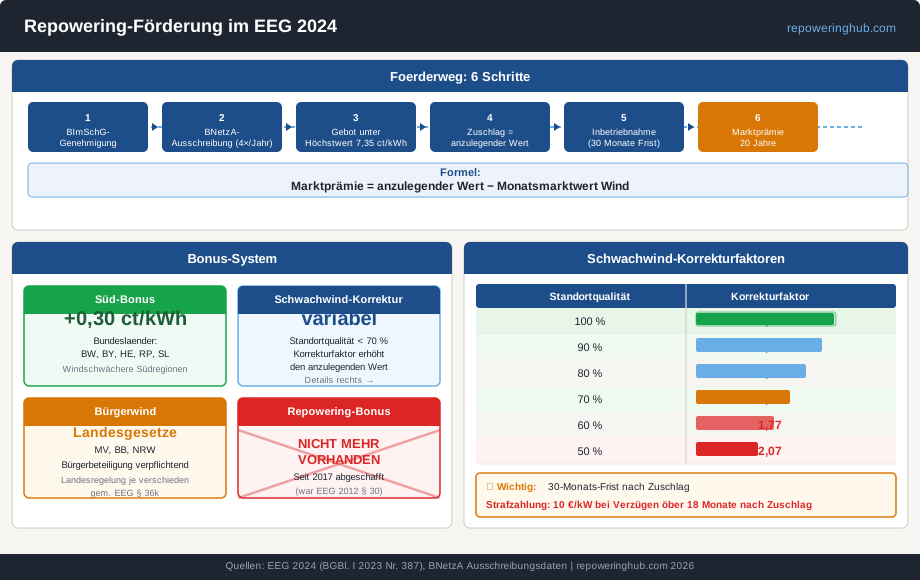
EEG funding for repowering — funding pathway, bonus system, and low-wind correction factors
Repowering Without EEG (PPA / Self-Supply)
Alternatives to EEG funding:
- PPA with industrial off-taker: 10–15 year fixed price, typically 50–65 EUR/MWh — viable at prime wind sites
- Self-supply: direct power supply contract with nearby industrial consumer
- Spot market direct marketing: variable, current average 40–80 EUR/MWh — higher risk
Advantage: no auction bureaucracy, free commissioning timeline, longer contract periods possible. Disadvantage: no fixed-price security, harder to obtain bank financing.
Ceiling Price, Degression, and Auction Volume
The ceiling price caps how high a bid may go. For onshore wind, Section 36b EEG sets a statutory starting value; the Bundesnetzagentur can raise it by formal determination, which has happened repeatedly in recent rounds so that auctions do not fall short of subscription given rising turbine prices. The annual auction volume follows the expansion path anchored in the EEG 2023/2024, targeting 115 GW of onshore capacity by 2030. For bidders this produces a simple logic: as long as rounds are undersubscribed, almost every formally valid bid receives an award near the ceiling price; once rounds become oversubscribed, the bid price itself decides the outcome. The underlying funding mechanics are also covered on the EEG 2024 page.
The Reference Yield Model — Why Southern Sites Stay Competitive
The single-stage reference yield model (Annex 3 to the EEG) ensures that lower-wind sites are not shut out of bidding against the coast. A site's quality factor is calculated as the ratio of actual yield to reference yield; the correction factors (table above) then adjust the award value to match site quality. On top of that, the south bonus of 0.30 ct/kWh lifts turbines in Baden-Württemberg, Bavaria, Hesse, Rhineland-Palatinate, and Saarland. For southern repowering projects this means a site that looks weaker on paper can still reach viable remuneration after correction — provided the turbine model is designed for low-wind conditions. Yield and full-load hours can be estimated in advance with the repowering yield calculator and the LCOE calculator.
Bankability: Why Many Projects Still Go Through the Auction
A PPA can generate higher revenue than the reference value, but the 20-year market premium provides a statutorily guaranteed floor for cash flow. That predictability is exactly what lowers financing costs: banks assess project risk as lower, accept higher debt ratios, and allow longer repayment periods. Pure PPA projects are bankable too, but usually require a creditworthy off-taker on a long-term contract. In practice, many projects combine both — the EEG market premium as a safety net, PPA or spot marketing as upside. The timeline from permit to bid to construction is set out on the Process page.
Bid strategy + EEG advisory?
We connect you with specialised energy-law firms and energy auditors for bid strategy and power marketing advisory.
Get in touchFrequently Asked Questions
What happens if the bid exceeds the ceiling price?
The bid is invalid — excluded from that auction round. Participation in the next round is possible. Since 2023, award values have been very close to the ceiling, indicating high competitive intensity.
Can we submit multiple bids per turbine?
Yes — each turbine site can be bid separately. For wind farm configurations, the entire project is usually submitted as one bid, though sometimes bids are staggered per individual turbine.
When does the 20-year funding period begin?
At commissioning (first power feed-in). For repowering projects, this is typically 2–3 years after the BImSchG application.
What happens after 20 years?
EEG funding ends — electricity is then marketed at spot market prices or via a new PPA. For a turbine repowered today, this means around 2046 — market conditions at that point remain open.
Is the site quality factor recalculated retroactively?
Yes, and this is an often-overlooked point: the actual yield achieved is compared against the reference yield after 5, 10, and 15 years of operation, and the remuneration rate is adjusted accordingly. If a turbine performs better than the reference site, remuneration falls in subsequent years; if it performs worse, remuneration rises. Financing plans should treat this later correction as a range rather than a fixed value for the entire 20-year term.
What happens if the bid exceeds the auction volume for that round?
If a round is oversubscribed, bids are ranked by price and only the lowest bids up to the published volume receive an award; the rest are not funded in that round but may be resubmitted at the next date. In undersubscribed rounds — the more common case through 2026 — essentially every formally valid bid near the ceiling price is awarded, which is why bid strategy has focused more on formal completeness than on aggressive underbidding.