Wind Repowering in Baden-Württemberg
Baden-Württemberg is one of Germany's least windy territorial states and, at the same time, has a large amount of catching up to do on wind expansion. The state's character as a low-wind location and its ecologically sensitive low-mountain uplands shape every repowering and new-build decision more strongly than in the northern coastal states. This overview sorts out the three defining factors: low-wind turbine technology, the conflict between upland wind resource and species protection, and the regional planning that is under pressure from the Wind Energy Areas Act (WaLG).
Why Baden-Württemberg is a low-wind state
Unlike the coast, where high average wind speeds support standard turbines, Baden-Württemberg sits in the inland low-wind band. Economically viable sites are found above all on the ridges — the Black Forest crest, the Swabian Alb and the Hohenlohe region. The standard here is low-wind turbines with a large rotor diameter, low specific power and hub heights of around 175 metres, which reach high full-load hours even in moderate wind. Whether repowering pays off at a specific site therefore depends less on raw wind speed than on the interplay of turbine type, hub height and the subsidy framework. Anyone wanting to quantify this will find a first reference point in our free calculators; on turbine selection, the page on low-wind turbines goes deeper.
Market data at a glance
| Turbine fleet | approx. 800 turbines |
| Installed capacity | 2.0 GW |
| Repowering candidates 2026–2030 | approx. 200 |
| Top regions | Black Forest ridge, Swabian Alb, Hohenlohe |
The comparatively small fleet means that every repowering-capable legacy turbine contributes disproportionately to the state target. Repowering replaces existing, often lower turbines of the 1.5-to-2-MW class with modern low-wind machines — with the same or a lower turbine count, installed capacity rises markedly. The exact fleet per site can be traced via the market master data register (Marktstammdatenregister) of the Federal Network Agency (Bundesnetzagentur).
Black Forest uplands: wind resource meets species protection
The windiest areas lie precisely where species protection is strictest. In the Black Forest uplands the capercaillie is the critical species; the red kite and the wildcat add to this. For projects in these locations an avifaunistic (bird) survey and a sound species-protection assessment are regularly decisive for the procedure — not infrequently, sites fail less because of the wind than because of the habitat conflict. Repowering has a structural advantage here: at already-developed legacy sites the existing ecological impact is documented, which often makes the assessment more predictable than at a greenfield location.
Regional planning and the WaLG land framework
Baden-Württemberg designates wind areas through its regional associations. The Wind Energy Areas Act sets binding area targets: 1.8% of the state's land by 2032. The current designation status of around 0.3% shows a severe delay. The WaLG mechanism is practically relevant because, if the area targets are not met, the exclusionary effect of existing concentration zones lapses — wind energy then becomes privileged in further outer-area locations under § 35 BauGB. For developers this shifts the planning baseline: areas that lie outside the framework today may come into view in the medium term. The legal basis is covered on the page § 35 BauGB.
Economics: low-wind turbines plus the EEG South bonus
BW sites typically reach 5.5–6.5 m/s at 150 m hub height — not economically viable with standard turbines. Low-wind turbines (V162-5.0, E160 EP3) plus the EEG South bonus plus the site-quality correction enable an LCOE of 75–95 €/MWh — viable, but tight. The EEG South bonus of +0.30 ct/kWh is not a marginal factor here but, for many upland projects, the difference between viable and loss-making; the details are governed by the EEG 2024. A repowering intended to improve a thin contribution margin stands or falls with the turbine choice and the real hub height.
Permitting & responsible authorities
- Minimum setback: no flat-rate state rule, based on TA Lärm (Technical Instructions on Noise)
- Authority: Regierungspräsidien (regional administrative authorities — Stuttgart, Karlsruhe, Freiburg, Tübingen)
- WaLG target: 1.8% by 2032; current status: approx. 0.3% — significantly behind schedule
- EEG South bonus: applies — +0.30 ct/kWh
- Species protection: red kite, capercaillie (Black Forest), wildcat
Turbines over 50 m in total height go through a procedure under the BImSchG (German Federal Immission Control Act); the sequence is described on the page BImSchG procedure.
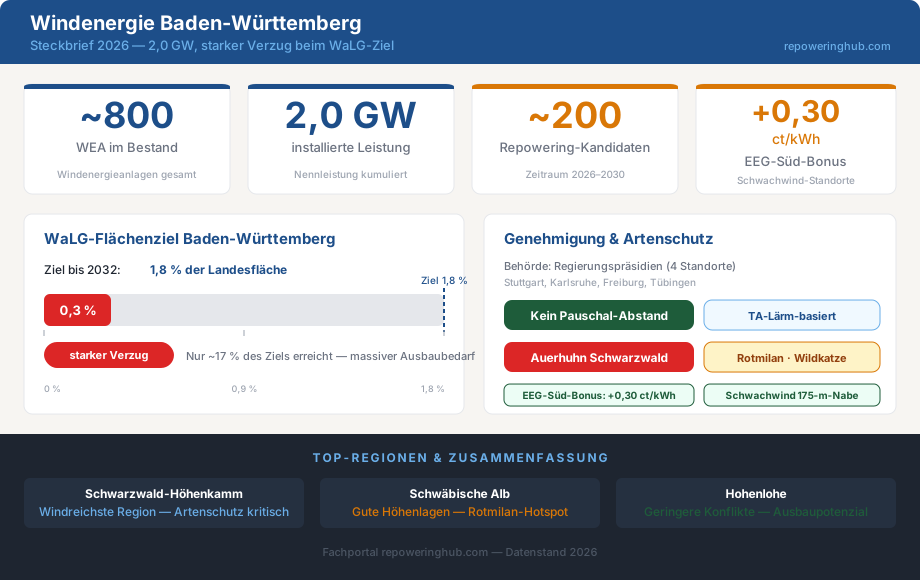
Wind power in Baden-Württemberg – market data, WaLG status and permitting framework
Regionally active players
- EnBW (Karlsruhe) — largest regional utility, own wind projects
- juwi AG (active in BW) — project development
- uhl-windkraft GmbH (Ellwangen) — regional
- LUBW (Karlsruhe) — state environmental authority
Grid connection: the second bottleneck after land availability
Alongside land availability and species protection, grid connection increasingly decides whether a repowering project in Baden-Württemberg can actually be built. Many legacy turbines from the 2000s are connected to grid interconnection points that were designed for considerably lower feed-in capacity. When a 1.5 MW legacy turbine is replaced by a modern low-wind turbine with more than double the rated output, the existing transformer capacity at the site frequently no longer suffices. For developers this means the enquiry to the responsible distribution grid operator belongs at the start of project planning, not at the end. In practice, a late grid-connection check delays repowering projects more often than the actual permitting procedure under the BImSchG. Where reinforcement is needed at the interconnection point, the lead time frequently extends by several months to years, because grid expansion measures themselves require planning and construction time on the operator's side.
Municipal value creation as a location factor
Baden-Württemberg has set its own accent with the mandatory financial participation of host and neighbouring municipalities under § 6 EEG, which goes beyond the nationwide rule. For municipalities in the Black Forest or on the Swabian Alb, whose uplands carry a strong tourism profile, the prospect of ongoing revenue from turbine operation is often the point at which local acceptance first materialises. Repowering projects at established sites benefit here from already-existing participation structures and a population that has known the sight of the turbines for years — an advantage over greenfield sites without a wind history. Anyone planning a repowering project should review existing lease and participation agreements early, since they generally have to be renegotiated when the turbine is replaced. The LCOE calculator additionally helps gauge how higher participation costs affect the levelised cost of electricity at a low-wind site.
Low-wind repowering in the Black Forest or on the Alb?
Whether an upland site pays off despite the capercaillie conflict and a thin low-wind margin is decided by turbine choice, hub height and the species-protection assessment. We connect you with planning offices that have concrete BW experience in exactly these three points.
Make an enquiry