Natura 2000 Screening (FFH Pre-Assessment) for Wind Turbines
The Natura 2000 screening — also called FFH pre-assessment (FFH-Vorprüfung) — answers a single question: Can the planned wind energy project significantly affect a Natura 2000 site? If the answer is "no", the procedure is complete. If it is "yes" or "cannot be ruled out", the more elaborate Appropriate Assessment (full assessment under Section 34(2) BNatSchG) follows. The screening is thus a pre-filter that in the majority of cases avoids a full assessment — provided the site maintains sufficient distance from protected areas and no particularly sensitive species are affected.
When Is a Natura 2000 Screening Required?
The obligation arises from Section 34(1) BNatSchG: projects must be assessed for compatibility with the conservation objectives of a Natura 2000 site before approval, if they are individually or in combination with other plans or projects likely to significantly affect the site. The Natura 2000 network in Germany comprises approximately 4,544 SACs (Special Areas of Conservation) and 742 SPAs (Special Protection Areas) (source: BfN, Natura 2000 site list, as of 2023).
Typical triggers for a screening in wind turbine projects:
- Site located within an SAC or SPA
- Site in the vicinity (typically up to 1,200 m, species-specific up to 6,000 m for collision-prone large birds; cf. Länderarbeitsgemeinschaft der Vogelschutzwarten, Helgoland Paper 2015)
- Possible long-range effects (e.g. barrier effect on bird migration, bat corridors)
- Cumulation: additional wind turbines, overhead lines or infrastructure in the impact zone
Assessment Steps of the Natura 2000 Screening
The screening follows a standardised procedure described in the EU Guidance Methodology (European Commission, "Assessment of Plans and Projects Significantly Affecting Natura 2000 Sites — Methodological Guidance", 2021):
- Site identification: Which Natura 2000 sites lie within the project's zone of influence? Assessment based on Standard Data Forms (SDF) and GIS distance analysis.
- Description of impact factors: Construction-related (land take, soil compaction, noise), installation-related (silhouette effect, avoidance), operation-related (collision, displacement, shadow flicker).
- Significance threshold assessment: Can the identified impact factors significantly impair the conservation objectives of the site (habitat types under Annex I, species under Annex II of the Habitats Directive or Annex I of the Birds Directive)? The benchmark is the favourable conservation status (Art. 6(3) Habitats Directive).
- In-combination assessment: Interaction with other existing or planned projects in the zone of influence — an often underestimated assessment step.
- Result: Either "significant adverse effect ruled out" (→ no further assessment required) or "cannot be ruled out" (→ full Appropriate Assessment required).
Relevant Species and Habitat Types
For wind turbine projects, the following protected assets are regularly the focus of the screening:
| Species group / habitat type | Typical examples | Main impact factor (wind turbines) |
|---|---|---|
| Raptors (Annex I Birds Directive) | Red kite, black kite, white-tailed eagle, lesser spotted eagle | Collision, avoidance |
| Other large birds | Black stork, white stork, eagle owl, crane | Collision, barrier effect |
| Bats (Annex II/IV Habitats Directive) | Greater mouse-eared bat, Barbastelle, Noctule | Collision, barotrauma |
| Habitat types (Annex I Habitats Directive) | Beech forests (9110, 9130), heathlands (4030), grassland (6510) | Land take |
Sources: Annex I/II Habitats Directive 92/43/EEC; Annex I Birds Directive 2009/147/EC; LAG VSW, "Distance Recommendations for Wind Turbines to Important Bird Habitats" (Helgoland Paper), 2015.
Screening vs. Full Appropriate Assessment
| Criterion | Screening (pre-assessment) | Full Assessment (Section 34(2)) |
|---|---|---|
| Objective | Rule out significant adverse effects | Assess adverse effects and, if applicable, examine derogation |
| Legal basis | Section 34(1) BNatSchG | Section 34(2)–(5) BNatSchG |
| Depth | Plausibility check, worst-case approach | Detailed field surveys, quantitative analysis |
| Duration (guideline) | 4–8 weeks | 6–18 months (incl. survey season) |
| Cost (guideline) | EUR 3,000–12,000 | EUR 8,000–40,000 |
| Result | Compatible / cannot be ruled out | Compatible / incompatible with possible derogation |
Cost guidelines based on experience values from BImSchG permit procedures; actual costs depend on the number of sites, species complexity and data availability.
How Much Does a Natura 2000 Screening Cost?
Guideline: EUR 3,000–12,000 per project. At the lower end are sites with only one protected area in the vicinity, existing survey data and a manageable species list. At the upper end are complex cases with multiple Natura 2000 sites, insufficient data and high justification effort for the in-combination assessment.
For comparison: the full Appropriate Assessment costs EUR 8,000–40,000 (source: experience values from BImSchG permit procedures), i.e. a multiple. The screening is therefore worthwhile as a strategic first step — it provides clarity within a few weeks.
Who Prepares the Report?
Expert consultants in nature conservation and landscape planning — typically biologists, ecologists or landscape planners with experience in Natura 2000 procedures and wind turbine permits. There is no formal accreditation requirement as with acoustic experts (Section 29b BImSchG), but the permitting authority reviews the professional qualifications and only accepts reports with a transparent methodology.
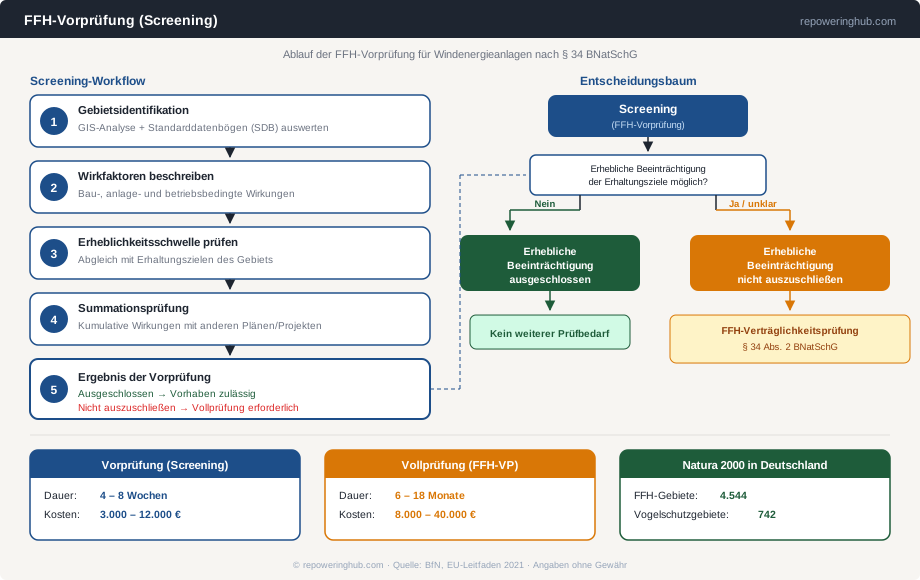
Natura 2000 screening — procedure, decision tree and cost comparison with full assessment
Natura 2000 Screening for Your Wind Energy Project
We forward your enquiry to an experienced expert consultant for Natura 2000 procedures — matched to site, protected area context and permit stage.
Request a QuoteFrequently Asked Questions
When is a Natura 2000 screening mandatory?
Whenever a wind energy project is likely to significantly affect a Natura 2000 site (SAC or SPA). This is regularly the case when the site is located within or near a protected area (Section 34(1) BNatSchG).
What happens if the screening result is negative?
If the screening concludes that significant adverse effects cannot be ruled out, a full Appropriate Assessment must be carried out (Section 34(2) BNatSchG). This extends the procedure by several months and significantly increases report costs.
Who prepares a Natura 2000 screening?
Expert consultants in nature conservation and landscape planning — usually biologists or ecologists with experience in Natura 2000 procedures. Formal accreditation is not required, but the authority reviews the professional qualifications.
Can the Natura 2000 screening run in parallel with the BImSchG application?
Yes. The screening is typically submitted as part of the BImSchG application documents. The competent nature conservation authority is consulted during the procedure and evaluates the screening result.