Wind Energy in Bremen
Bremen is a city-state with around 70 wind turbines, predominantly in port and industrial zones (Bremerhaven, the industrial ports of Bremen). Repowering potential is very limited. For onshore wind investment, the neighbouring districts of Lower Saxony are more relevant.
Market Data
| Installed turbines | approx. 70 units |
| Installed capacity | 0.15 GW |
| WaLG target (Wind Energy Areas Act) | 0.5% by 2032 |
| Focus | Bremerhaven (offshore industry + onshore industrial port) |
Bremen as a Financing and Insurance Location
Besides logistics, Bremen has a long tradition as a Hanseatic trading and insurance centre that also benefits the wind industry. Shipping-adjacent financing houses and regional banks with a maritime focus have expanded their business in recent years to include project financing for offshore and onshore wind farms — an obvious extension, since risk assessment for large projects with long supply chains and weather dependency resembles maritime financing logic. For operators financing a repowering project in the northern German surrounding region, Bremen's banking and insurance landscape can be an additional source of capital alongside the classic development banks.
Offshore Hub Bremerhaven
Bremerhaven is Germany's offshore wind industry hub — manufacturer plants (Senvion historically, Riffgat component production), port logistics for offshore parks in the North Sea. Onshore turbines in Bremen are comparatively small, with a high share of industrial self-consumption, so their output is largely used on site rather than fed into the wider grid.
Recommendation
Onshore wind: sites in neighbouring Lower Saxony offer similar wind conditions with significantly more land availability. Offshore wind industry: Bremerhaven as a logistics location for installation and maintenance.
Repowering Potential
The few existing turbines within the city area are predominantly older industrial sites with units below 2 MW. Repowering there only makes sense if the BImSchG (Federal Immission Control Act) permit is granted for more modern, higher-output units — which, given the proximity to residential and port areas, often fails on the TA Lärm (Technical Instructions on Noise) limits.
Skilled Labour and Training for the Wind Industry
With the Fraunhofer Institute for Wind Energy Systems (IWES) and affiliated test fields, Bremerhaven hosts one of Germany's central research and testing facilities for wind turbine components — from rotor-blade fatigue testing to the certification of gearboxes and converters. This is relevant for the entire northern German wind industry, including repowering projects, because turbine components are tested here before entering series production, and because a pool of skilled engineers and technicians for wind energy technology has formed in the region. Bremerhaven also trains service technicians for onshore and offshore maintenance — a factor that is directly practice-relevant for operators looking for a reliable maintenance partner after repowering.
Permitting & Law
- Authority: Gewerbeaufsichtsamt Bremen (GAA, trade supervisory office) for BImSchG permits
- WaLG target: 0.5% by 2032 (reduced as a city-state)
- Minimum distance: no blanket state-level rule
Local Industrial Demand: PPAs from the Port Area
Industry in Bremen and Bremerhaven — steel, automotive suppliers, port logistics, shipyards — has a high and steady power demand that matches well with the generation profile of nearby wind farms. For operators of Lower Saxony wind farms in the surrounding region, Bremen is therefore an interesting buyer for power purchase agreements: short connection distances via the northern German interconnected grid and an industry sector that increasingly needs green-electricity proof for its own supply chain, for instance under the supply-chain and climate-reporting obligations of large automotive suppliers. This local demand supplements the EEG market premium as a second revenue source and can, specifically for repowering projects with greater turbine output, diversify marketing rather than relying solely on the power exchange.
Why Bremen Matters to the Wind Industry — Just Differently
Bremen is not a location market for new onshore turbines, but an industrial and logistics location for the wind sector. Bremerhaven brings together a heavy-lift terminal, quay edges with sufficient load capacity, and proximity to component manufacturing — infrastructure needed for handling large tower segments and rotor blades. For repowering projects in northern Germany this logistics aspect is of practical relevance: delivery of the considerably larger new turbines is a planning item in its own right, and the later decommissioning of the old turbines runs through the same heavy-lift chains. Anyone who factors in decommissioning costs early avoids nasty surprises: they are part of the permit conditions and are usually secured via a decommissioning bond. Rotor blade recycling too — long an unsolved problem — is a cost factor for which specialised recyclers now exist. For northern German repowering projects, proximity to a capable heavy-lift port is therefore a real, often underestimated location advantage in the cost calculation.
For investors this means: the value creation around Bremen lies in supply and processing, not in operating turbines within the city area. Anyone seeking operator returns will find the land in neighbouring Lower Saxony — a first yield estimate is provided by the repowering economics analysis, and the permitting steps are outlined by the permitting overview.
Related Topics
- Grid connection: Bremerhaven port grid with industrial feed-in capacity
- Financing: BLB Bremen as the regional development bank for energy projects
- Ground-mounted solar: solar parks on converted port and industrial land
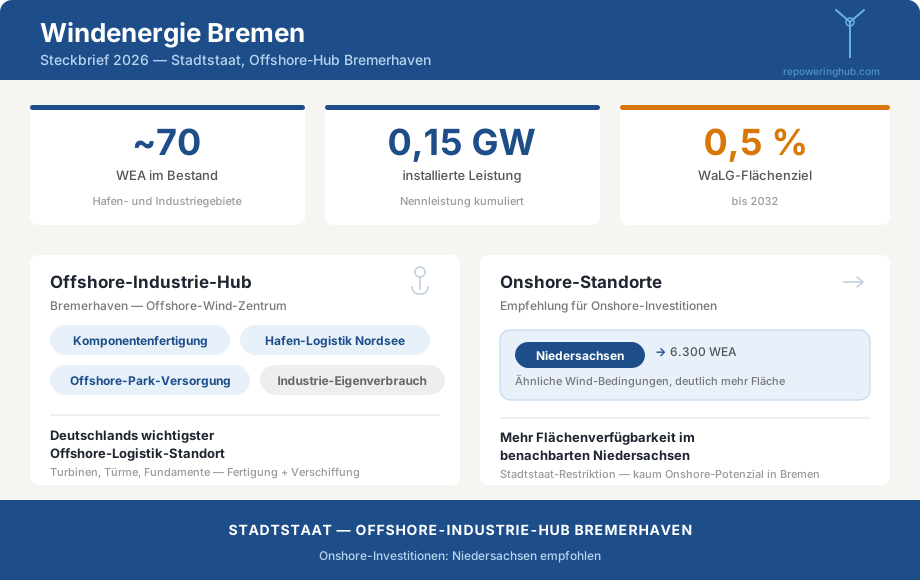
Wind energy in Bremen – city-state and offshore industry hub Bremerhaven
Planning a wind or repowering project in the region?
Get in touch to be connected with specialist engineering firms for expert reports and permitting.
Contact us