What Is Wind Turbine Repowering?
Repowering means replacing old wind turbines with new, more powerful ones at the same or a nearby site. The goal: generate significantly more energy from fewer turbines — often with better public acceptance, because fewer, modern turbines replace many older ones.
The Term and How It Differs from Related Concepts
The term originates in conventional power plant engineering, where “repowering” describes modernizing a power plant unit with more powerful technology. In the wind industry it specifically means turbine replacement: decommissioning the old turbine and erecting a new one at the same or a neighboring site. Three terms are frequently confused:
- Repowering: complete replacement of the turbine with a new, more powerful model. New permit, new subsidy period.
- Retrofit / partial repowering: replacing individual components (gearbox, generator, control system, sometimes rotor blades) on the existing turbine to improve availability or yield — without a full rebuild.
- Continued operation: unchanged operation beyond the certified service life, backed by an expert assessment. Covered in detail under Repowering vs. Continued Operation.
The Typical Repowering Configuration
A classic real-world example from 2026:
| Configuration | Old turbines | New turbines |
|---|---|---|
| Number | 8 × 1.5 MW | 3 × 6.0 MW |
| Hub height | 67 m | 165 m |
| Rotor diameter | 66 m | 162 m |
| Total capacity | 12.0 MW | 18.0 MW |
| Full-load hours | approx. 1,900 h/a | approx. 3,000 h/a |
| Annual yield | approx. 22,800 MWh | approx. 54,000 MWh |
| Yield factor | 1.0× | 2.4× |
With less than half the number of turbines, more than double the electricity is generated.
Why Repowering Now?
Three drivers converge in 2026:
- EEG expiry for pioneer turbines. Turbines that were connected to the grid between 2000 and 2005 reached the end of their 20-year EEG (Renewable Energy Sources Act) remuneration between 2020 and 2025. Continue or repower? is the urgent question for approximately 5,000 existing turbines per year.
- Technical generation leaps. Modern turbines produce roughly 50–60% more energy per installed MW than legacy turbines (higher hub = better wind, larger rotor = more energy capture per wind speed).
- Political tailwind. Section 2 EEG (“overriding public interest”) and the Wind-an-Land-Gesetz (Onshore Wind Act) facilitate permits at existing sites.
Repowering vs. Continued Operation vs. Greenfield
| Option | Effort | Yield | Risk |
|---|---|---|---|
| Continued operation > 20 yr | Maintenance + wear repairs | +0% | Rising downtime, difficult spare parts |
| Repowering 1:1 | Full investment, but existing infrastructure | +200–300% | BImSchG process, acceptance |
| Greenfield new build | Full investment + new infrastructure | Fresh site, often lower quality | + Site risk |
Advantages of Repowering over Greenfield
- Local acceptance: Existing turbines are established; repowering is typically better accepted than new builds on previously undeveloped land
- Existing infrastructure: Access roads, grid connection, and lease agreements can partly be reused
- WaLG simplifications: Preferential treatment in the BImSchG (Federal Immission Control Act) permitting process
- Lower impact balance in the LBP: Less new intervention because existing turbines are decommissioned
- Proven site: Wind resource data from years of operation available
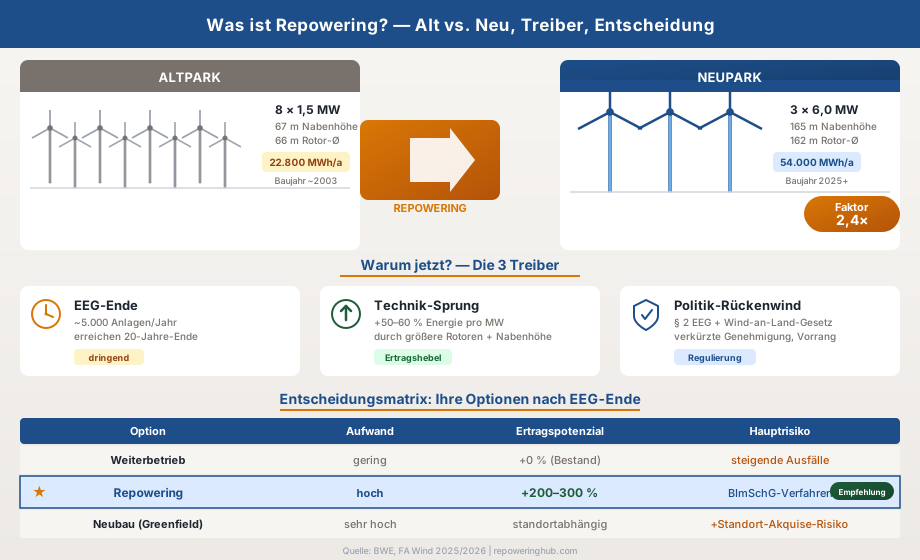
Repowering — old vs. new, drivers, and decision matrix
What Gets Replaced at the Site
Repowering is more than a taller tower. It typically affects:
- The entire turbine: tower, nacelle, rotor — usually with a substantially greater hub height and larger rotor diameter, which raises the yield per installed megawatt.
- The foundation: rebuilt, because modern turbines introduce higher loads; the old foundation is removed (see Decommissioning).
- The grid connection: frequently upgraded, because the higher feed-in capacity requires a stronger connection point.
- The site layout: in a “full repowering,” the arrangement is replanned to optimize spacing and wake effects between turbines.
Because the site is already an established wind location, some infrastructure, measured wind resource data, and lease structures are partly in place — the key difference from a greenfield new build.
Repowering study for your site?
We connect you with an experienced repowering planning firm for an initial economic and permitting pre-assessment.
Request consultationFrequently Asked Questions
Can every old turbine be repowered?
In principle yes, but not every site is worthwhile. Unsuitable cases include: too close to residential areas (minimum setback distance not achievable with a larger turbine), in or adjacent to protected areas (FFH compatibility assessment problematic), in states with blanket restrictions (Bavaria 10H rule), or with poor grid connections.
What does “1:1 repowering” mean?
A single turbine swap — same number of turbines, new turbine type at the same location. The WaLG (Onshore Wind Act, 2022) created procedural simplifications for this. “Full repowering” with layout changes requires a standard BImSchG procedure.
Is repowering economically viable without EEG funding?
At premium sites (coastal, > 3,500 FLH) increasingly yes — electricity can be sold via PPA to industrial customers. At standard sites, the EEG market premium remains necessary. See Economics.
Does the new turbine have to stand in exactly the same spot?
Not necessarily. In a 1:1 repowering, the site is retained in principle, but the layout can shift to optimize setback distances to residential buildings, wake effects, and access infrastructure. Larger turbines often need more spacing between each other, which is why many small existing sites become fewer, more favorably placed ones.
How many old turbines in Germany qualify for repowering?
The turbine fleet from the early-2000s expansion wave is continuously reaching the end of its 20-year EEG remuneration period. For a significant share of these turbines, repowering is the more economically sound alternative to plain continued operation — particularly where the site is suitable for a modern, taller turbine and setback rules can still be met.
Is repowering legally different from an ordinary new build?
Formally no — the new turbine goes through the same BImSchG permitting procedure as a wind farm on a greenfield site, including all mandatory expert reports. The practical difference lies in the site itself: grid connection, access roads, and part of the environmental data already exist and can partly be reused, which often speeds up planning and permitting, even though no separate, legally privileged “repowering status” exists. Details on the procedure are on the Repowering Project Process page. Economically, a repowering project is therefore not a special case but a new-build project with the structural advantage of an already proven, grid-connected site.