When does continued operation make more sense than repowering?
In short: If the turbine is still running cleanly from a technical standpoint, OPEX stays well below the market price and no repowering permitting window is open, continued operation is often the right bridge. But as soon as a repowering project with a clearly higher yield and stable permitting becomes feasible, the answer is usually repowering — the site then delivers a multiple of the output.
The five decision levers
| Lever | argues for continued operation | argues for repowering |
|---|---|---|
| OPEX vs. electricity price | OPEX clearly below electricity price | OPEX approaching the electricity price |
| Technical condition | low wear, manufacturer support available | frequent failures, spare parts scarce |
| Residual structural stability (lifetime extension) | assessment confirms continued operation | assessment reveals risks |
| Permitting window | no repowering possible (setback, protected area) | site is suitable, authority signals go-ahead |
| Lease/acceptance | short-term stable relationships | willingness for higher lease + long-term contracts |
The Repowering IRR calculator provides a quantitative classification — it shows from which electricity price and which turbine class the project tips over.
The math for continued operation (post-EEG)
Without EEG (Erneuerbare-Energien-Gesetz / Renewable Energy Sources Act) remuneration, the turbine carries itself as long as:
(market price − direct-marketing cost) > (OPEX + insurance + bond reserve)
With every annual replacement of the generator or gearbox, OPEX rises. Post-EEG OPEX is typically in the range of 30 to 40 EUR per MWh, with a tendency to increase as the turbine ages. If the market price (e.g. secured via a PPA) lies clearly above that, continued operation makes sense.
The math for repowering
A modern turbine generates, at the same site, typically 2 to 3 times the output of the old turbine. The investment (on the order of 1.0–1.5 million EUR per MW) must, out of the revenues, deliver an adequate return over 20 years — banks usually expect a DSCR ≥ 1.2 and IRR targets in the high single-digit range (see Wind farm financing).
One factor that many first-pass calculations underestimate is the lead time of the repowering procedure itself. Several years often pass between the initial site assessment and the grid connection of the new turbine — permitting under the German Federal Immission Control Act (BImSchG), new bird and bat surveys, new acoustic assessments, and coordination with the grid operator on capacity at the feed-in point all run in parallel during this time. Anyone who fails to plan for this lead time risks a revenue-free gap between decommissioning the old turbine and commissioning the new one — which is exactly what the hybrid approach described below is meant to avoid.
What's often overlooked in practice
Beyond the five main levers, several softer factors play a role in practice that rarely show up in the first economic calculation but can end up tipping the decision. One is land-use efficiency: fewer but larger turbines at the same site often require only a fraction of the previous turbine count, freeing up leased land for other uses and potentially improving acceptance in the host community. Equally relevant is grid connection capacity: an existing grid connection point with sufficient reserve capacity can significantly speed up a repowering project, while a connection that is already at capacity requires additional investment in grid infrastructure that shifts the overall calculation.
Tax and accounting aspects also deserve attention: an already fully depreciated old turbine in continued operation generates a different cash flow on the books than a newly financed turbine with ongoing debt service. For operators who depend on stable, predictable income, debt-free continued operation can look more attractive in the short term, even though the overall return over the project life is higher with repowering. This trade-off between short-term liquidity and long-term yield potential should be part of any sound decision, not just the pure net-present-value calculation.
Why the decision rarely hinges on a single lever
In practice, the choice almost never tips on one isolated criterion. A turbine with low OPEX but no realistic repowering permitting window (for example because a new regional plan excludes the site) stays in continued operation — even if a repowering project would look better on paper. Conversely, a turbine fleet that is still technically running fine can still be repowered if the lease expires and the landowner makes a significantly more modern turbine a condition for renewing the contract. The table above provides the criteria, but the actual order in which they should be checked is: first the permitting window (because it opens or closes feasibility in the first place), then residual structural stability, and only after that the pure return calculation.
What's often underestimated in continued operation
Post-EEG continued operation looks at first glance like the lower-risk option, since it requires no new investment and no new permitting procedure. Two points are regularly assessed too optimistically:
- Marketing risk: without EEG support, the turbine carries the full market-price risk. A PPA can cushion this, but usually ties the operator to a longer contract term with fixed conditions — flexibility drops.
- Spare-parts availability: for turbine types the manufacturer no longer actively supports, repair times lengthen noticeably, and specialty components (gearboxes, older-generation converters) are increasingly sourced on the secondary market — with corresponding uncertainty on lead time and price.
Neither risk can be calculated away, but both belong explicitly in the decision, not just the pure OPEX-versus-market-price formula.
What's often underestimated in repowering
On the other side, the timeline of a repowering project is regularly planned too optimistically. Between the decision to repower and commissioning of the new turbine, several years often pass once the bird and bat survey season, permitting procedure, and construction time are included — see Permitting duration. During this time the site either generates no revenue at all (if the old turbine has already been decommissioned) or keeps running under the hybrid model described above — which in turn requires clean contractual and technical coordination with the grid operator and the landowner.
A pragmatic checklist for the preliminary decision
Before either option is finally locked in, a quick reality check is worthwhile: is a current lifetime-extension assessment available, or would it first need to be commissioned? Is the regional plan for the site repowering-friendly or rather restrictive? What is the lease situation — short-term cancellable or long-term bound? And: how strongly does the site's economics depend on a single support instrument that is expiring? Anyone who has answered these four questions can apply the table above far more reliably, instead of relying solely on the pure cost formula.
Frequently asked questions
How long does the lifetime-extension assessment run?
It extends the type-certificate duration by, as a rule, a further 5 to 10 years, provided the residual structural stability is demonstrated. After that, it can be reassessed.
What happens to the old lease agreement?
With repowering it is usually redrafted or extended — see the guide Lease agreement in repowering.
Can I plan both in parallel?
Yes. As long as the repowering procedure is running, the old turbine can legally keep operating — up until the new turbine is commissioned. A clearly planned transition avoids revenue-free phases.
What role does the EEG 2024 amendment play in the decision?
The current EEG rules, among other things, create incentives for tendering repowering projects and, in certain constellations, ease the permitting process at already-developed sites. This tends to shift the calculation in favor of repowering when a site qualifies for a tender round anyway — but the concrete conditions depend on turbine class, bid deadline and grid connection point and should be checked case by case with the grid operator and a funding check under EEG funding.
What happens if both options are economically close?
In this borderline case, a sensitivity analysis is usually worthwhile: how does the result change if the market price swings by 20%, the old turbine's OPEX rises faster than expected, or the permitting procedure is delayed by two years? Such scenarios often show that continued operation is narrowly ahead in the base case, but quickly falls behind repowering in a conservative scenario with rising maintenance costs. Anyone who wants to secure the site long term should weight this robustness more heavily than the narrow base case.
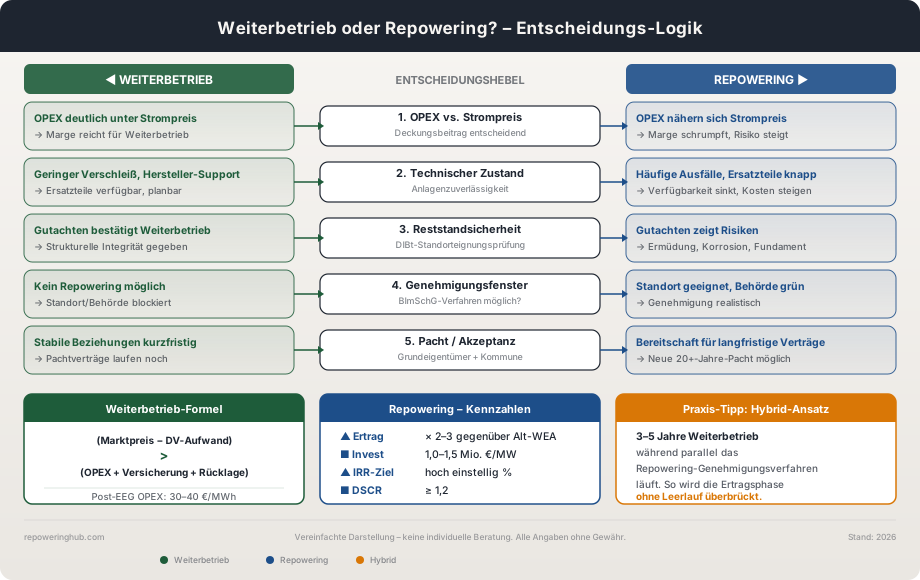
Continued operation or repowering – decision logic with 5 levers, formulas and a hybrid approach
Weighing continued operation against repowering for a specific site? We connect you with the right engineering firms and project developers for an assessment.
Get in touch