How tall is a modern wind turbine — and why so tall?
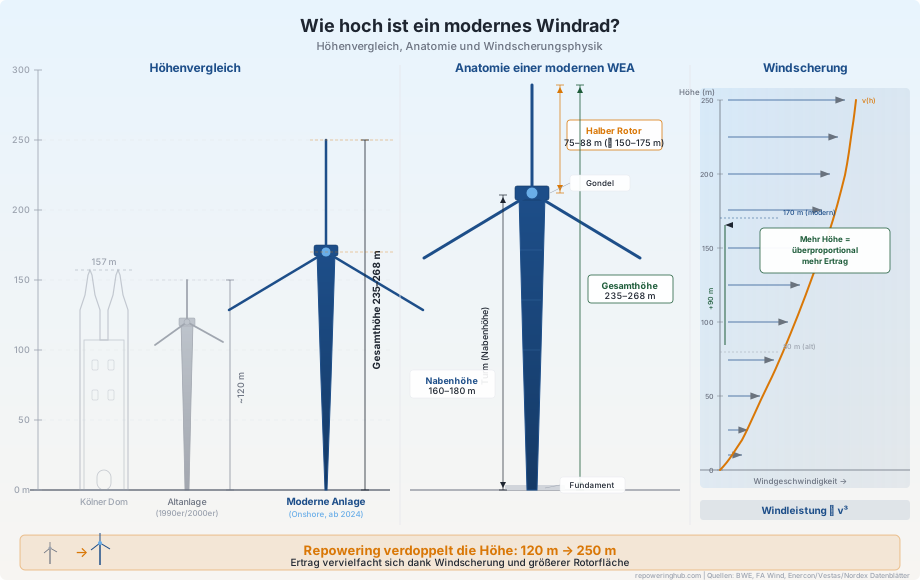
In short: A modern onshore turbine typically reaches a total height of 230 to 280 metres — roughly the height of the Berlin TV Tower at the lower end of the range. The reason is wind shear: every additional metre of height brings significantly more and steadier wind, and therefore economically more viable yield, especially at low-wind sites.
Height in numbers
| Dimension | Range (modern onshore turbines) |
|---|---|
| Hub height | 160–180 m, up to > 200 m at low-wind sites |
| Rotor diameter | 150–175 m |
| Half rotor (above hub) | 75–88 m |
| Total height (hub + half rotor) | 235–268 m, occasionally > 280 m |
| Old turbines (1990s/2000s stock) | Total height often 100–150 m |
Repowering therefore often doubles the height — while output per turbine has risen sharply at the same time (see Electricity yield).
Why so tall? The physics behind it
Right at ground level, vegetation and buildings slow the wind down. At greater heights it blows stronger and more steadily — this effect is called wind shear. Because electricity yield rises with the third power of wind speed, every additional metre of height leverages the yield disproportionately:
- Higher hub height ⇒ more average wind ⇒ disproportionately more yield.
- Larger rotor area ⇒ more wind energy "captured" per turbine.
- Together: significantly higher full-load hours, even at sites where old turbines were barely viable any more.
The full-load-hours estimator provides an assessment of the full-load hours for your site.
Hub Height, Rotor, Total Height — What These Figures Actually Mean
Three measurements are frequently mixed up when talking about wind turbines. Hub height is the distance from the ground to the rotor hub, the point where the three rotor blades meet. Rotor diameter describes the circular area the blades sweep as they turn. Total height results when one blade points straight up: hub height plus half the rotor diameter. For a turbine with a 165 m hub height and a 163 m rotor diameter, total height comes to roughly 246.5 m. Permitting documents and state planning almost always use total height as the reference figure for setback and height rules, not hub height — a point that often causes confusion in public discussions.
Why Turbine Classes Have Different Heights
The IEC turbine classes (I to III) differ by average wind speed and turbulence intensity at the site. Class III turbines are designed for low-wind inland sites: a large rotor, comparatively moderate generator output, and usually the tallest hub heights within their generation. Class I turbines for high-wind coastal sites, by contrast, often get by with somewhat lower hub heights, because sufficient wind is already present at lower altitude there. This explains why a wind farm in Schleswig-Holstein does not necessarily build taller than one in Rhineland-Palatinate — turbine choice follows the site's wind profile, not the other way round.
How Height Affects Transport and Construction
Growing turbine height creates its own logistics and construction challenges. Tower sections with a diameter over 4.5 m can barely be transported on the road as a single round steel tube any more — which is why many manufacturers now use hybrid towers: a lower section made of precast or in-situ concrete, topped by a steel tube tower for the upper segments. This reduces transport width and allows greater hub heights without every haul requiring an elaborate heavy-transport permit with road closures. The construction crane has to keep pace too: hub heights above 160 m require specialised heavy-lift cranes with the corresponding reach, and their availability shapes construction scheduling.
Which legal limits apply
- Air traffic / airport obstacle-clearance zones: near airports, helicopter corridors and radio installations, height limits are common.
- BNK — Bedarfsgerechte Nachtkennzeichnung (demand-responsive night-time marking): obstacle lighting is mandatory from 100 m total height; with BNK it only switches on when an aircraft is detected — see BNK.
- State planning / regional planning: some priority areas impose height limits, often 200 or 250 m total height.
- Visibility: taller turbines are visible from farther away — a topic for the visual impact report.
Frequently asked questions
How tall are turbines at sea (offshore)?
Offshore turbines are even taller today in some cases (rotor > 200 m, total height > 250 m), because neither shadow flicker nor noise for nearby residents is relevant there and significantly larger components can be transported logistically. Onshore is the focus of this portal.
Do taller turbines affect noise and shadow?
Both are assessed site-specifically in the expert report — see the guides How loud is a wind turbine? and Shadow flicker. Taller does not automatically mean louder (noise depends on the turbine type), but shadow flicker reaches farther.
Will wind turbines get even taller?
The trend is clear: each generation gains around 20–40 m of total height. The limiting factors are logistics (bridges/roads), tower structural engineering (hybrid towers of concrete + steel) and legal limits.
Is a taller turbine automatically the more economical choice?
Not as a blanket rule. Beyond a certain hub height, tower and foundation costs rise disproportionately, while the additional yield gain per metre diminishes — wind shear has the strongest effect in the lowest 100 to 150 metres and flattens out above that. Developers therefore calculate site-specifically which hub height delivers the best trade-off between extra cost and extra yield, rather than reflexively choosing the tallest available turbine. The LCOE calculator, which condenses investment cost and yield into a comparable metric, provides an initial orientation.
Why does a 250-metre turbine look different up close than from a distance?
From a distance, the eye mainly perceives the rotor standing out against the sky; without a reference object, the actual height is hard to judge. Up close — right at the base of the turbine — the scale finally becomes tangible: a tower diameter of over 4 metres at the base surprises most visitors with how massive it is. This exact question of perception from different viewpoints is illustrated in the visual impact report using photomontages from defined viewing points, among other things to assess visually overbearing effects on nearby homes.
Height of a modern wind turbine – dimensions, wind shear and the repowering effect