Wind Measurement to MEASNET Standard
What is MEASNET?
The Measurement Network of Wind Energy Institutes (MEASNET) is an international association of wind energy measurement institutes that defines uniform quality standards for wind measurements. Founded in 1997, MEASNET today comprises over 30 institutes worldwide, including Deutsche WindGuard, DTU Wind (Denmark), CENER (Spain) and NREL (USA) (MEASNET, 2024).
MEASNET procedures ensure that wind measurements are reproducible, traceable and verifiable by third parties. For bankable yield assessments to FGW TR6 (German guideline for wind yield reports), a MEASNET-compliant measurement campaign is the minimum requirement for the input data (FGW, TR6 Rev. 11, 2023).
Measurement methods at a glance
Two fundamentally different methods are used in practice:
Met-mast measurement (in-situ anemometry)
A guyed lattice steel mast is erected near the planned turbine (WEA) site. Sensors are mounted at several measurement heights:
- Cup anemometer – Proven sensor for horizontal wind speed. Calibration to IEC 61400-12-1 in a MEASNET-accredited wind tunnel is mandatory (IEC 61400-12-1 Ed. 2, 2022).
- Ultrasonic anemometer – Measures wind speed and direction three-dimensionally, with no moving parts. More susceptible to precipitation and icing.
- Wind vanes – Record wind direction, redundantly at several heights.
- Temperature, humidity and pressure sensors – Required for the air-density correction.
According to MEASNET recommendation, the mast height must be at least 2/3 of the planned hub height. For modern turbines with hub heights of 120–170 m, masts of 80–160 m height are therefore used (MEASNET Evaluation of Site Specific Wind Conditions, V3, 2022).
Remote sensing (LiDAR and SoDAR)
Ground-based remote measurement methods measure the wind profile contactlessly up to great heights:
- LiDAR (Light Detection and Ranging) – Emits laser pulses and evaluates the Doppler shift on aerosol particles. Measures wind profiles up to over 200 m height. Recognised in FGW TR6 as an equivalent method, provided the device is MEASNET-verified (TUV Nord, 2024).
- SoDAR (Sonic Detection and Ranging) – Works acoustically instead of optically. Lower range and higher uncertainty than LiDAR, and therefore less frequently accepted as the sole measurement method in the yield-assessment context.
Comparison: met mast vs. LiDAR
| Criterion | Met mast | LiDAR campaign |
|---|---|---|
| Measurement height | Up to approx. 160 m (mast-limited) | Up to > 200 m (flexible) |
| Accuracy | Reference standard (Class-1 anemometer: ± 1 %) | Comparable after MEASNET verification (± 1–2 %) |
| Permitting | Building permit required (mast > 10 m) | Generally permit-free |
| Mobility | Stationary (fixed location) | Relocatable, multi-point campaigns possible |
| Cost (12 months) | 80,000–200,000 EUR | 40,000–100,000 EUR |
| Terrain suitability | All terrain types | Limitations in very complex terrain |
| Bank acceptance | Unrestricted | Yes, with MEASNET verification |
Sources: cost guideline values per Deutsche WindGuard project practice and TUV Nord; accuracy figures per IEC 61400-12-1 Ed. 2 (2022).
Measurement duration and long-term correction
MEASNET requires a measurement duration of at least 12 months in order to fully capture seasonal variations. However, the measurement campaign alone represents only a limited period. To assess representativeness, a long-term correction is carried out:
- MCP methods (Measure-Correlate-Predict) – The measurement data is correlated with supra-regional long-term reference data (reanalysis datasets such as ERA5, long-term measurement stations) over a period of at least 10 years.
- Common MCP procedures: linear regression, matrix method, variance-ratio method. The choice of method affects the uncertainty by 2–4 percentage points (DNV, 2024).
Calibration
A clean calibration chain is the prerequisite for reliable measurement data:
Sensor calibration
Every anemometer must be calibrated in a MEASNET-accredited wind tunnel before use. The standard IEC 61400-12-1 defines the requirements for calibration procedures, wind-tunnel quality and documentation. LiDAR devices undergo a MEASNET verification campaign against a calibrated reference mast.
Site calibration
If the measurement position does not coincide with the planned turbine position, a site calibration must be carried out. This determines the ratio of wind speeds between the measurement and turbine locations for all wind-direction sectors. This is particularly relevant in complex terrain (forest, slopes) (MEASNET, V3, 2022).
MEASNET quality requirements
The central requirements for a MEASNET-compliant measurement campaign:
- Data coverage rate ≥ 90 % – At least 90 % of all 10-minute intervals must deliver valid measured values.
- Documented sensor calibration – Valid calibration certificates for all sensors used, issued by MEASNET-accredited laboratories.
- Data quality control – Systematic checking for outliers, mast-shadow sectors, icing, sensor failure. Faulty intervals are documented and excluded from the evaluation.
- Mast-shadow correction – For met-mast measurements, wind-direction sectors disturbed by the mast itself (typically ± 30° around the mast) are identified and corrected or excluded during evaluation.
- Traceable documentation – Complete measurement report with sensor specifications, calibration evidence, data-gap log and QC procedure description.
Source: MEASNET Evaluation of Site Specific Wind Conditions, Version 3 (2022).
Cost of a wind measurement campaign
Costs depend heavily on the measurement method, site and campaign duration:
- Met-mast measurement (12 months) – 80,000–200,000 EUR. Largest cost drivers: mast construction and dismantling, building permit, sensors, operation and maintenance, land use.
- LiDAR campaign (12 months) – 40,000–100,000 EUR. No mast construction, lower permitting effort, devices can be rented.
In repowering projects, operating data from the existing turbines can supplement or shorten the measurement campaign, which reduces costs. Guideline values per Deutsche WindGuard project practice and TUV Nord.
Frequently asked questions (FAQ)
How long must a wind measurement to MEASNET standard last?
MEASNET recommends a site-specific measurement campaign of at least 12 months in order to fully capture seasonal variations. A long-term correction against supra-regional reference data (at least 10 years) is then carried out to assess the representativeness of the measurement period (MEASNET, V3, 2022).
Is a LiDAR measurement equivalent to a met-mast measurement?
Yes, provided the LiDAR device holds a valid MEASNET verification and the campaign meets the MEASNET requirements for data coverage and calibration. FGW TR6 and IEC 61400-12-1 Ed. 2 recognise remote sensing as an equivalent measurement method (IEC 61400-12-1, 2022).
What does a wind measurement campaign cost?
A met-mast measurement (incl. mast construction, permitting, sensors and 12-month operation) typically ranges between 80,000 and 200,000 EUR. A ground-based LiDAR campaign is considerably cheaper at 40,000 to 100,000 EUR, as no mast construction is required (guideline values per Deutsche WindGuard / TUV Nord).
What does a data coverage rate of 90 % mean?
MEASNET requires that at least 90 % of all 10-minute intervals in the measurement period deliver valid data. Missing intervals arise from sensor failure, icing or maintenance. If coverage falls below 90 %, the data is considered unrepresentative and can substantially increase the assessment uncertainty (MEASNET, V3, 2022).
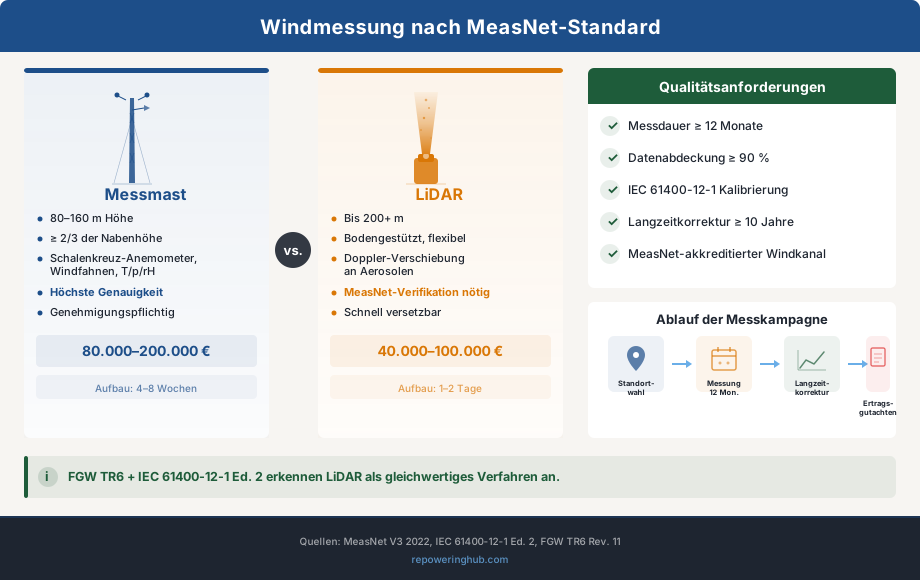
Wind measurement to MEASNET – measurement methods, quality standards and process chain
Looking for professional wind measurement?
Are you planning a MEASNET-compliant measurement campaign for your wind energy project? We connect you with experienced measurement institutes and accredited assessor firms – from campaign planning to the bankable yield assessment.
Submit a no-obligation enquiry