P50 / P75 / P90 – Yield Probabilities Explained
What do P50, P75 and P90 mean?
P values describe exceedance probabilities of the forecast annual energy production (AEP) of a wind turbine or a wind farm. They answer a simple question: With what probability will a given yield value be reached or exceeded in any operating year?
- P50 – In 50 % of all years this yield is reached or exceeded. Statistically, P50 corresponds to the median (and, for a normal distribution, to the expected value). It is the central yield estimate of the assessment.
- P75 – In 75 % of all years this value is reached or exceeded. P75 is more conservative than P50 and is often used for mezzanine financing or internal profitability calculations.
- P90 – In 90 % of all years this yield is reached or exceeded. P90 is the bankable reference value on the basis of which lenders size the debt financing (DNV, 2024).
The logic: the higher the percentage, the greater the certainty that the value will be reached – but the lower the reported yield.
Calculation: From the normal distribution to the P value
The FGW TR6 (Rev. 11, 2022) requires yield results to be presented as a probability distribution. The calculation follows a three-step procedure:
- Determine the P50 yield – From wind measurement, long-term correction, flow modelling and the power curve, the central yield value (expected value, E[AEP]) is determined.
- Quantify the total uncertainty – All individual uncertainties (see below) are expressed as standard deviations and combined via quadratic addition (Root Sum Square, RSS) into a total standard deviation σtotal (FGW TR6, Rev. 11, 2022).
- Derive the P values – Assuming a normal distribution:
P75 = P50 − 0.674 × σtotal
P90 = P50 − 1.282 × σtotal
The factors 0.674 and 1.282 are the z-values of the standard normal distribution for 75 % and 90 % exceedance probability respectively.
Sources of uncertainty in detail
The total uncertainty of a yield assessment is composed of several largely independent components. Typical ranges according to (DNV, 2024) and (TUEV Nord, 2024):
| Source of uncertainty | Typical range (σ) | Influencing factors |
|---|---|---|
| Wind measurement (sensors, setup) | 3–5 % | Device type, calibration, measurement height vs. hub height |
| Long-term correction | 2–4 % | Quality of reference data, correlation length |
| Flow model (WAsP/CFD) | 2–6 % | Terrain complexity, roughness, forest cover |
| Power curve | 1–3 % | Manufacturer data, site turbulence |
| Availability & losses | 1–2 % | Technical availability, grid connection, curtailments |
Worked example: From P50 to P90
The following example shows how the financing metrics P75 and P90 are derived from a P50 yield and the quantified uncertainties.
| Parameter | Value |
|---|---|
| P50 yield (expected value) | 10,000 MWh/a |
| Total uncertainty σtotal | 8 % = 800 MWh/a |
| P75 = 10,000 − 0.674 × 800 | 9,461 MWh/a (−5.4 %) |
| P90 = 10,000 − 1.282 × 800 | 8,974 MWh/a (−10.3 %) |
In this example, the P90 is around 10 % below the P50 – a typical value for well-measured sites. With high terrain complexity or a short measurement campaign, the spread can be 15–20 % (Deutsche WindGuard, 2023).
Bankability: Why P90 is decisive
The project financing of wind farms is based on a non-recourse credit structure. The financing bank shares the yield risk – and protects itself accordingly:
- Debt sizing on a P90 basis – The maximum loan amount is sized so that the debt service can be met even at the conservative P90 yield. The larger the difference P50 − P90, the less debt capital is granted.
- DSCR (Debt Service Coverage Ratio) – Banks typically require a DSCR of ≥ 1.20 on a P90 basis, i.e. the cash flow in the P90 scenario must be at least 20 % above the annual debt service (Deutsche WindGuard, 2023).
- P75 for mezzanine/subordinated capital – Mezzanine providers often use P75 as the basis, as they accept a higher risk profile.
The tighter the uncertainty budget (σ), the closer P50 and P90 move together – and the more debt capital a project can raise. This is why reducing uncertainties (longer measurement campaign, better model, operating-data validation) directly creates value.
P values in repowering
In the repowering of existing wind farms, the operating data of the old turbines can be used as an additional data source. This has two advantages:
- The wind-measurement uncertainty decreases, since real yield data over several years is available (typically: 2–4 percentage points reduction of the total uncertainty).
- The long-term correction becomes more robust when operating data is cross-validated with supra-regional references.
Result: in repowering, P90 is often only 8–12 % below P50 instead of 15–20 % for greenfield projects (TUEV Nord, 2024). This improves financing terms considerably.
Frequently Asked Questions (FAQ)
What is the difference between P50 and P90?
P50 is the median yield: in 50 % of all years this value is reached or exceeded. P90 is the more conservative value that is reached or exceeded in 90 % of all years. The difference reflects the total uncertainty budget of the yield assessment and is typically in the range of 10–20 % (DNV, 2024).
Why do banks require P90 values?
Banks use the P90 yield as the basis for debt sizing. The DSCR (Debt Service Coverage Ratio) is calculated on the basis of the P90 value to ensure that loan repayment is secured even in low-yield years. Typical requirement: DSCR ≥ 1.20 on a P90 basis (Deutsche WindGuard, 2023).
How is the standard deviation in the uncertainty budget determined?
The total uncertainty results from the quadratic addition (Root Sum Square) of the individual uncertainties: wind measurement, long-term correction, flow model, power curve and availability. Each component is quantified separately and documented under FGW TR6 (FGW TR6, Rev. 11, 2022).
Can P values be improved retrospectively?
Yes. Longer measurement campaigns, additional LiDAR devices, operating-data validation or improved flow models can reduce individual uncertainty components. In repowering, existing operating data often lowers the uncertainty by 2–4 percentage points (TUEV Nord, 2024).
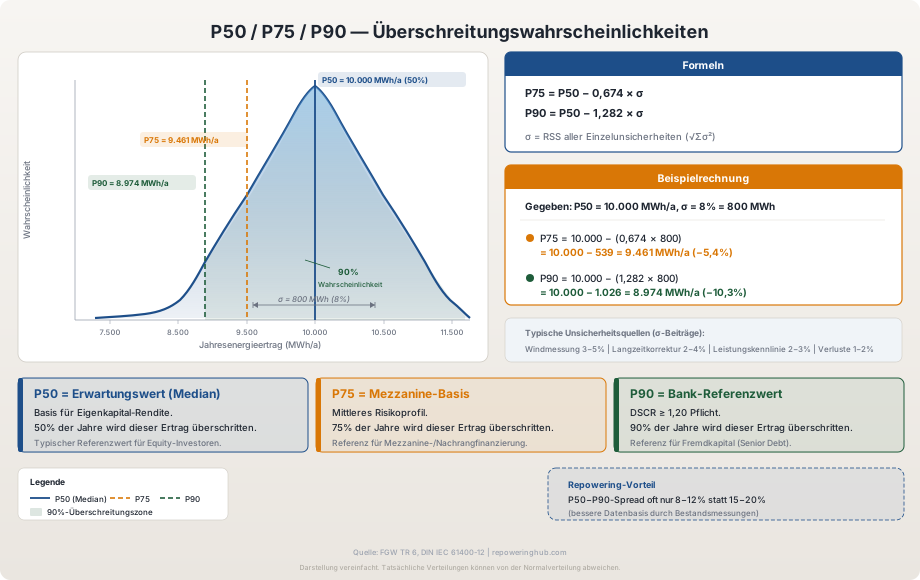
P50 / P75 / P90 — probability distribution, calculation and bankability
A yield assessment with optimal P values?
Want to minimise the uncertainty margins of your wind project and improve your financing terms? We connect you with independent, accredited assessment firms experienced in P50/P90 optimisation.
Make a no-obligation enquiry