Wind Energy in Bavaria
No other federal state has steered wind expansion as strongly through setback law as Bavaria. The 10H rule introduced in 2014 and the nationwide Wind Energy Areas Act (WaLG) have since stood in a legal tension that decides on almost every Bavarian wind project. This overview takes exactly that relationship as its thread: how the 10H rule works, under what conditions the WaLG overrides its exclusionary effect, and what this means for repowering projects.
The 10H rule: origin and legal effect
The 10H rule prescribes a minimum setback of ten times the turbine's total height from residential development — for a 200-metre turbine that means 2,000 metres, and correspondingly more for modern turbines above 240 metres. In legal terms it is a state opt-out clause under § 249 BauGB: Bavaria removes wind turbines below this setback from the outer-area building privilege under § 35 BauGB. The result was a de facto expansion halt — the fleet of around 1,100 turbines barely grew for years. The basic privileging of wind energy in the outer area is explained on the page § 35 BauGB.
Market data and repowering potential
| Turbine stock | approx. 1,100 turbines |
| Installed capacity | 2.5 GW |
| Repowering candidates 2026–2030 | approx. 300 |
| Top regions | Upper Palatinate (Oberpfalz), Middle Franconia (Mittelfranken), Allgäu uplands |
For existing turbines the 10H rule is particularly tricky: anyone replacing a permitted legacy turbine with a taller repowering machine also increases, along with the total height, the setback required under 10H. A site that still supported the legacy turbine can, on paper, fall outside the permissible zone for the larger new turbine. Whether a repowering clears this hurdle depends on the concrete setback to the nearest residential development — and on whether the 10H exclusionary effect still applies at the time of permitting.
WaLG as a lever: when 10H lapses
The Wind Energy Areas Act obliges the states to binding area targets — for Bavaria 1.8% of the state's land by 2032, with an interim target of 1.1% by 2027. The central legal consequence: if a state fails to reach the area targets, the exclusionary effect of state setback rules such as 10H lapses, and wind energy is once again privileged in the outer area under § 35 BauGB. At the current designation status of around 0.7%, missing the interim target is likely. In legal terms this means the 10H rule is no longer a permanently reliable exclusionary basis but is tied to the state's area balance. Developers position themselves accordingly for the possible override — with the risk that the timing and scope of the legal change remain contested in the detail.
Acceptance and political context
The 10H rule was always also an acceptance rule: large setbacks were meant to defuse conflicts with residents. Since the 2022 energy price crisis the mood has shifted — municipal value creation, community-energy models and the prospect of cheap local electricity are changing the discussion in many districts. For developers this is relevant because the permit under the Federal Immission Control Act includes public participation, and the municipal stance noticeably influences how the procedure unfolds. Repowering at established sites often benefits from existing local familiarity with the turbines, which tends to dampen conflicts compared with sites that have no wind history.
Permitting, authorities and species protection
- Minimum setback: 10H rule (10× total height; for a 200 m turbine = 2,000 m)
- Authority: Landratsamt (district administrative office) / kreisfreie Stadt (independent city)
- WaLG target: 1.8% by 2032; current level: approx. 0.7% — behind schedule
- EEG southern bonus (EEG-Süd-Bonus): applies — +0.30 ct/kWh
- Species protection: red kite (Rotmilan) in Franconia, corncrake (Wachtelkönig) in the Alpine foothills
Independently of the 10H question, the actual authorisation runs as an immission-control procedure; the sequence and deadlines are covered on the page BImSchG procedure. The EEG South bonus of +0.30 ct/kWh under the EEG 2024 noticeably improves the economics of the windier-poor southern sites.
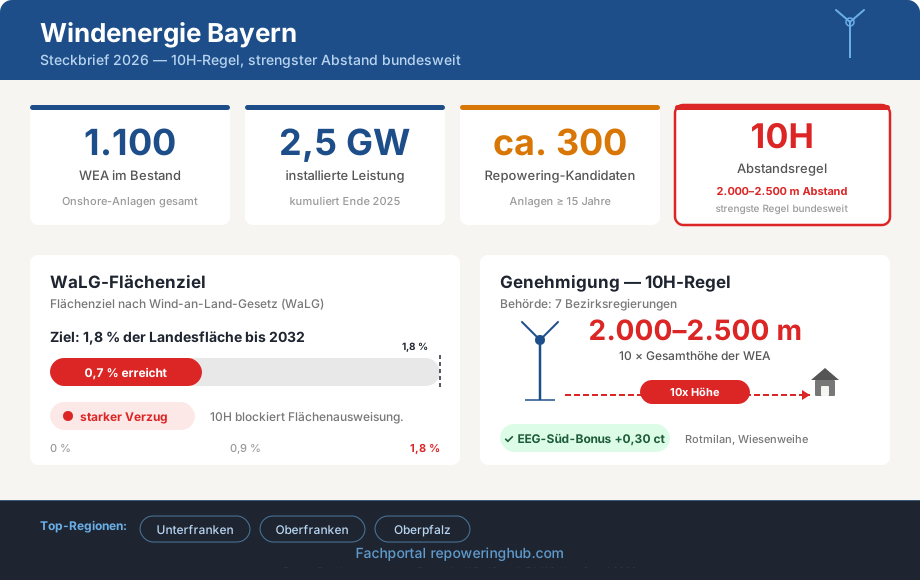
Wind energy in Bavaria – market data, 10H rule, WaLG status and permitting framework
Regionally active players
- BayWa r.e. (Munich) — market leader, wind + solar
- juwi AG (active in Bavaria) — project development
- Stadtwerke München / Stadtwerke Erlangen (municipal utilities) — municipal projects
- LfU Bayern (Bavarian Environment Agency, Augsburg) — nature conservation authority
Grid expansion: Südlink and regional feed-in capacity
Bavaria's role as a net power-importing state also shapes the grid situation for wind projects. The large north-south transmission projects such as Südlink are meant to connect the south to northern German wind power in the medium term — but they do not replace the regional distribution-grid reinforcement that is needed locally for feeding in new and repowered turbines. In the Upper Palatinate and Middle Franconia, the state's more turbine-dense regions, individual grid interconnection points are already reaching capacity limits. For a repowering project that replaces a smaller legacy turbine with a considerably more powerful new one, early coordination with the distribution grid operator is therefore just as decisive as the 10H and WaLG question. Anyone who clarifies both only late risks a site that is permissible under planning law failing at the missing feed-in point.
Permitting duration: why Bavarian procedures take longer
Procedures under the Federal Immission Control Act run in Bavaria through the district administrative offices (Landratsämter) and are therefore more fragmented than in states with a central permitting authority. This does not necessarily mean slower processing, but it leads to noticeable differences between districts — depending on the authority's experience with wind energy applications and on its current workload. For project planning it matters that the 10H check and the species-protection assessment should run in parallel rather than in sequence: anyone who first clarifies the setback question and only then commissions the avifaunistic (bird) survey unnecessarily extends the lead time. The BImSchG cost calculator gives a first orientation on the procedural costs of a Bavarian permit application.
What will decide Bavaria's course in the coming years
Bavaria's wind market hinges on a single switch point: if the state misses its WaLG interim target, the exclusionary effect of the 10H rule lapses automatically — without any further state parliament resolution. For developers this creates an unusual starting position: a site that fails on 10H today can, purely as a matter of law, become permissible again within a few years, without anything changing at the site itself. Anyone who secures land early and prepares the remaining expert reports can use that moment, rather than only starting planning afterwards.
A Bavarian project caught between 10H and WaLG?
Whether your site fails on 10H today and becomes permissible again tomorrow via the WaLG area balance is a legal question with a time axis. We connect you with energy-law firms with 10H/WaLG expertise and planning offices with Bavarian permitting practice — before you invest in project development.
Send an enquiry