Wind Turbine Yield Estimation
What is a yield estimation?
A yield estimation is a rough calculation of the expected annual energy production (AEP) of a wind turbine (WEA, Windenergieanlage) or wind farm. It serves as a preliminary assessment before a formal, bankable yield assessment under FGW TR6 is commissioned.
Unlike the yield assessment, the yield estimation is typically not based on its own site-specific wind measurement campaign, but on already available data sources such as wind atlases, reanalysis data or operational data from existing turbines. The results carry correspondingly higher uncertainties, but in the early project phase they provide a sufficiently robust basis for deciding for or against a more in-depth site investigation.
Distinction: yield estimation vs. yield assessment
Both instruments forecast energy production, but they differ considerably in methodology, effort and reliability:
| Criterion | Yield estimation | Yield assessment (FGW TR6) |
|---|---|---|
| Data basis | Reanalysis data (ERA5, MERRA-2), DWD wind atlas, operational data | Own 12-month measurement campaign (LiDAR/met mast) + long-term correction |
| Modelling | Simplified models or reference yield method | Calibrated flow models (WAsP, CFD) per TR6 requirements |
| Uncertainty | approx. ±10–20 % (guideline) | approx. ±5–10 % with P50/P75/P90 figures (DNV, 2024) |
| Cost | 2,000–8,000 EUR | 50,000–120,000 EUR (TÜV Nord, 2024) |
| Duration | 2–6 weeks | 18–24 months |
| Bankability | No (feasibility/internal) | Yes (debt financing, DSCR calculation) |
The yield estimation is deliberately designed as a faster and more cost-effective alternative. It does not replace the formal assessment but prepares the decision on whether such an assessment is economically worthwhile at all.
Methods of yield estimation
Depending on data availability and project phase, different procedures are used:
Wind index method (BDB index)
The BDB wind index (Betreiber-Datenbasis, operator database) records the yields of more than 1,500 wind turbines in Germany and normalises them to a long-term average (bdb-index.de). Known production data from an existing turbine are combined with the current BDB index value for the region in order to extrapolate to the long-term expected value. This method is particularly suitable for repowering projects, where operational data from the existing turbine are available.
Reference yield model (EEG)
The reference yield model under § 36h EEG 2023 (Erneuerbare-Energien-Gesetz, Renewable Energy Sources Act) defines a reference site (mean wind speed 6.45 m/s at 100 m height, Rayleigh distribution, roughness length 0.1 m). Each WEA type receives a manufacturer-certified reference yield. The actual site yield is expressed as a percentage of the reference yield («site quality»). This method primarily serves EEG remuneration calculation, but it also provides a rough yield indication (EEG 2023, § 36h).
Power curve + mean wind speed
The simplest method combines the manufacturer's power curve (power as a function of wind speed) with an assumed Weibull distribution of the wind speed at the site. Integration over all wind speed classes yields the gross annual production. Deductions for availability, curtailment and grid losses are applied as flat rates (typically 5–15 %). The method is transparent and fast, but heavily dependent on the quality of the input wind speed.
Data sources
The quality of a yield estimation stands or falls with the wind data used. Common sources are:
- DWD wind atlas – The German Weather Service (Deutscher Wetterdienst) publishes wind maps for Germany (mean wind speed at various heights, spatial resolution approx. 200 m).
- ERA5 (ECMWF) – Global reanalysis dataset of the European Centre for Medium-Range Weather Forecasts. Hourly values from 1940, spatial resolution approx. 31 km. International standard for long-term corrections.
- MERRA-2 (NASA) – Comparable reanalysis dataset from NASA, often used as a second independent dataset for cross-validation.
- BDB wind index – Aggregated operational data of German wind turbines (bdb-index.de), suitable for regional long-term corrections.
- Operational data from existing turbines – In repowering: real SCADA production data from the existing turbine provide the most reliable site characterisation.
Typical applications
A yield estimation is used when a robust yield indication is needed without the time and cost of a formal assessment:
- Feasibility studies – Initial assessment of whether a site is fundamentally suitable for wind energy use.
- Site acquisition – Basis for lease negotiations with landowners before project development formally begins.
- Preliminary profitability – Quick check for an internal investment decision (IRR, LCOE estimate) with the repowering yield calculator and LCOE tools.
- Repowering pre-assessment – Comparison of old and new turbine on the basis of existing operational data, in order to estimate the yield-increase potential.
- Auction preparation – Rough yield indication for calculating the bid price before an EEG auction.
Accuracy and limits
The accuracy of a yield estimation is typically ±10–20 % (guideline, depending on methodology and data quality). For comparison: a formal yield assessment under FGW TR6 with its own measurement campaign typically achieves ±5–10 % total uncertainty (DNV, 2024).
The higher uncertainty of the estimation results from:
- Missing site measurement – Reanalysis data have a spatial resolution of 25–30 km and cannot capture local terrain effects (slope acceleration, channelling).
- Simplified loss modelling – Flat-rate deductions instead of site-specific calculation (wake, ice formation, noise reduction).
- No formal uncertainty analysis – P-values (P50/P75/P90) are not reported, or only approximately.
For final investment and financing decisions, a bankable yield assessment under FGW TR6 is therefore always required.
Frequently asked questions (FAQ)
What does a yield estimation cost?
A rough yield estimation based on existing wind data (reanalysis data, DWD wind atlas) typically costs between 2,000 and 8,000 EUR. The price depends on the level of detail and the number of sites examined. A full FGW TR6 assessment, by contrast, runs between 50,000–120,000 EUR (TÜV Nord, 2024).
Is a yield estimation sufficient for bank financing?
No. For project financing, lenders require a bankable yield assessment under FGW TR6 with P50/P90 values and a formal uncertainty analysis. The yield estimation serves exclusively for internal decision-making – feasibility, profitability, site comparison – and is the typical first step before a formal assessment is commissioned (DNV, 2024).
How accurate is a yield estimation?
Typical accuracy is ±10–20 %, depending on data quality and methodology. A formal yield assessment under FGW TR6, by contrast, achieves ±5–10 % through site-specific wind measurement and calibrated modelling. The wider range of the estimation is the price for the considerably lower time and cost.
Which data sources are used?
Common data sources are: the DWD wind atlas, global reanalysis data such as ERA5 (ECMWF) and MERRA-2 (NASA), the BDB wind index for long-term corrections, and operational data from existing turbines. Manufacturers' power curves are used in addition.
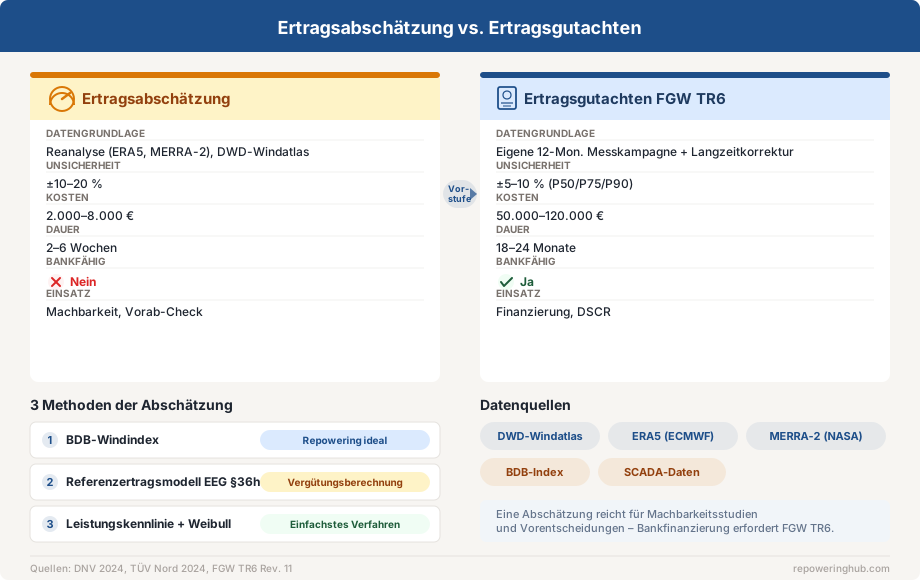
Yield estimation vs. yield assessment – methods, costs and accuracy
A yield estimation for your project?
Are you planning a wind energy or repowering project and need a sound yield estimation as a decision basis? We connect you with experienced expert offices that prepare both rough estimations and bankable FGW TR6 assessments.
Make a non-binding enquiry